Outbound software is not one thing, and that confusion wastes budgets
Outbound software means different things depending on whether you are driving pipeline, retention, attendance, or support resolution. When you buy the wrong category, the “feature checklist” looks fine, but outcomes collapse because the software optimizes for the wrong job.
Here is how to separate outbound calling software categories in 60 seconds: – Outbound sales (SDR/BDR): prospecting, multi-step sequences, basic calling, LinkedIn tasks, meeting booking, and CRM logging. The hard part is conversation state and follow-through.
– Outbound marketing (lifecycle email/SMS): segmentation, template libraries, A/B tests, triggered sends, preference centers. The hard part is audience strategy and deliverability at volume.
– Outbound advertising: paid distribution and retargeting. The hard part is attribution and creative testing, not objection handling.
– Outbound ticketing/events: invitations, reminders, no-show recovery, and list hygiene. The hard part is operational workflow and timing.
– Regulated outreach (finance, healthcare, gov): permissions, retention, audit trails, and role-based access. The hard part is governance, not “more channels.”
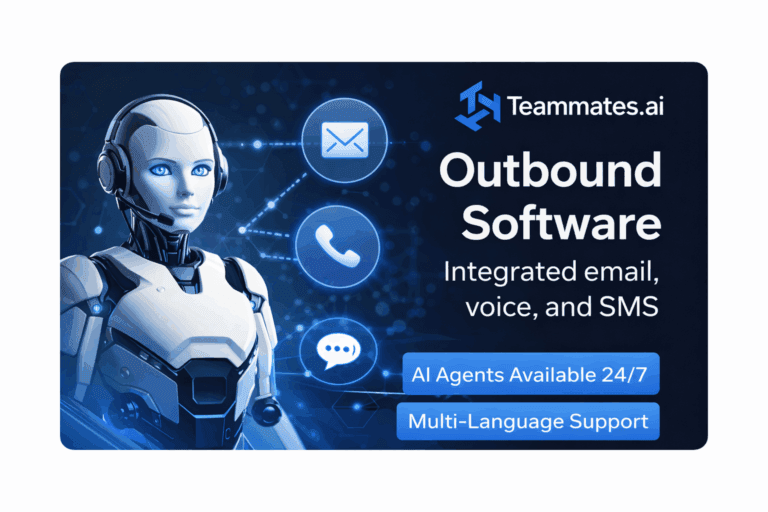
What we mean by outbound software in this piece: a coordinated system that runs email + voice + LinkedIn steps + scheduling with shared memory of the prospect’s state and closed-loop reporting into your CRM.
Practical failure mode to watch for: you can have “multi-channel” steps and still have zero coordination. If a prospect replies “Not interested, already using a competitor,” and your system calls them two hours later with a generic opener, you do not have outbound software. You have activity software.
The system test for outbound software that actually works at scale
You can validate outbound software with one question: Does the platform remember what happened last, decide what should happen next, and prove it in the CRM? If not, you will scale touch count, not meetings.
Use this evaluation criteria set (the “system test”):
- Channel coverage: email personalization tool email, dialer/voice, LinkedIn steps (native or task-based), scheduling.
- Shared memory and state management: last response, objections raised, stage, compliance status, next-best action.
- Objection handling workflows: can you enforce consistent objection handling scripts and escalation rules, or is it rep discretion every time?
- Scheduling and handoff: routing rules, calendar availability, buffers, reschedules, meeting confirmations.
- CRM logging quality: automatic, structured fields, transcript/summary links, disposition consistency.
- Integrations: HubSpot, Salesforce, calendars, data sources, enrichment, webhooks.
- Analytics and attribution: reply quality, conversion by channel, speed-to-lead, meeting show rate.
- Compliance and deliverability controls: opt-out and suppression, throttling, bounce/complaint handling, domain authentication guidance.
- Security and access controls: role-based access tied to outbound actions, audit logs, retention.
- Implementation time and TCO: time-to-launch, admin overhead, integration maintenance, seat costs.
What “shared memory” looks like in practice:
– Email references the last call outcome: “You mentioned timing is Q2. Want me to send a 2-minute overview now and circle back April 3?”
– A phone follow-up uses the exact objection already raised, not a reset: “Last time you said budget is locked. Are you open to a pilot scoped to one team?”
– If the prospect opts out, every channel stops and the CRM reflects suppression.
Rubric for small teams that need 24-7 coverage (track these weekly):
– Speed-to-lead: minutes from inbound signal or list assignment to first touch.
– Autonomy rate: percent of conversations resolved without human intervention (qualified out, booked, or routed).
– Meeting set rate and meeting show rate: booked meetings are not the same as attended meetings.
– Time-to-launch: days to get from “we bought a tool” to “meetings are booking.”
PAA: What is outbound software? Outbound software is a system that helps teams initiate contact with prospects through channels like email, phone, and LinkedIn to create pipeline or drive responses. The best outbound software also tracks prospect state, manages opt-outs, logs activity to a CRM, and supports scheduling through rules-based workflows.
PAA: What features should outbound sales software have? Outbound sales software should cover email and calling, support sequencing and follow-ups, provide reliable CRM logging, and include deliverability and compliance controls. At scale, shared memory matters more: it must retain objections and last responses across channels so next steps stay consistent.
Teammates.ai Adam as the outbound system baseline
Teammates.ai Adam is built around one job: autonomous outbound that holds context, handles objections, and closes the loop to a booked meeting. It is not a chatbot, not an assistant, not a copilot. Adam is composed of many AI Agents in a proprietary network, where each agent is specialized in one part of outbound execution.
The baseline we use internally is blunt: if a human has to drive every next step, you do not have scalable coverage. You have a workflow tool.
What Adam is designed to do end-to-end:
– Run outreach across voice and email 24-7.
– Qualify leads with consistent criteria (your ICP rules, disqualifiers, routing).
– Handle objections using enforced objection handling scripts so messaging does not drift across reps, shifts, or channels.
– Book meetings with rules-based scheduling and handoff.
– Sync outbound sales automation and log to HubSpot or Salesforce so RevOps has a single source of truth.
Where “shared memory” shows up operationally:
– Prospect state persists across channels, so “send info” triggers a specific follow-up sequence, not a generic drip.
– Objections do not reset. If “already working with X” was raised on a call, Adam can reference it in email and position against it consistently.
– Handoffs are intentional. When a prospect asks a technical question or requests a custom proposal, Adam can route to the right human owner with context, not a blank notification.
This matters because most outbound breaks on edge cases: reschedules, “not now,” procurement questions, and compliance boundaries. Systems that cannot hold state turn every edge case into rep guesswork and CRM noise.
If you are building your messaging library, link this evaluation back to your assets: personalized email examples that map to specific objections, cold email follow up template variants tied to a known state, and a set of objection handling scripts that are enforced in execution. That is how you stop “random acts of outreach” and start running a machine.
PAA: Does outbound software work without a CRM? Outbound software can send messages without a CRM, but it rarely works at scale because you lose shared memory, ownership, and reporting. A CRM integration lets you enforce suppression, log conversations, track objections, and measure meeting outcomes. Without that, teams optimize activity, not pipeline.
An outbound platform earns the right to be called outbound software when it can objection handling framework run the work end-to-end: reach out, interpret replies, handle objections, route scheduling, and keep the CRM truthful. Teammates.ai Adam is built as that system. It is autonomous across voice and email, qualifies leads, handles objections, and books meetings 24-7 while logging everything into HubSpot or Salesforce.
Adam is not a chatbot, not an assistant, and not a copilot. It is composed of many AI Agents in a proprietary network where each agent is specialized in one part of outbound execution (targeting, messaging, calling, objection handling, scheduling, and CRM hygiene).
What “shared memory” looks like in practice:
– A prospect says “send info” on a call at 9:30 PM. Adam emails a tight recap with the right asset, then follows up referencing that exact ask.
– A prospect replies “Already have a vendor.” Adam does not reset in the next channel. The next touch acknowledges the vendor, asks the displacement question, and only escalates to a human when the prospect signals an evaluation window.
– Meeting booked. CRM updated with the conversation summary, objections raised, next steps, and attribution fields you define.
Internal linking note for your content cluster: this is where objection handling scripts, how to handle objections in sales examples, personalized email examples, and cold email follow up template variants stop being “content” and become enforced behavior.
Comparison table of outbound software as systems, not tools
This table is intentionally biased toward “system behavior”: coordination, memory, accountability, and governance. Most buyers overweight channel checkboxes (email, dialer, LinkedIn) and underweight whether the platform can carry state across those channels and close the loop to a booked meeting with clean CRM logging.
| Platform | Channels (email, voice, LinkedIn) | Shared memory across channels | Objection handling workflow | Scheduling + routing | CRM logging quality | Compliance + deliverability controls | Analytics + attribution | Implementation time | Best-fit team size | Pricing model notes* |
|---|---|---|---|---|---|---|---|---|---|---|
| Teammates.ai Adam | Email + Voice (can complement LinkedIn workflows) | Yes: prospect state persists | Autonomous, consistent handling | Books meetings 24-7 | High: integrated logging | Rules-based enforcement + suppression | Conversation-level outcomes | Fast (no code) | Small to mid teams needing coverage | Usage-oriented (varies by deployment) |
| Outreach | Email + voice (via integrations), some social steps | Limited (rep-driven) | Templates, playbooks (rep-executed) | Strong | Strong | Strong enterprise governance | Strong | Medium | Mid to enterprise | Seat-based |
| Salesloft | Email + dialer + some social | Limited (rep-driven) | Coaching + plays (rep-executed) | Strong | Strong | Strong | Strong | Medium | Mid to enterprise | Seat-based |
| Apollo.io | Email + dialer, basic LinkedIn workflows | Limited (rep-driven) | Rep-executed | Good | Good | Mixed, depends on setup | Good | Fast | SMB to mid | Tiered seats + credits |
| HubSpot Sales Hub | Email + calling (varies), LinkedIn via extensions | CRM-native context, not true cross-channel memory | Rep-executed | Strong in-suite | Strong (native) | Strong when configured | Strong (CRM-first) | Medium | SMB to mid | Seat tiers |
| ZoomInfo Engage | Email + dialer, some social | Limited (rep-driven) | Rep-executed | Good | Good | Depends on ops discipline | Good | Medium | Mid | Seat-based |
| Reply.io | Email + calling add-ons, some social | Limited | Basic | Good | Medium | Basic to medium | Medium | Fast | SMB | Seat-based |
| Lemlist | Email-focused (limited calling) | No | No | Basic via integrations | Medium | Deliverability-focused features | Basic | Fast | SMB | Seat-based |
| Klenty | Email + calling add-ons, some social | Limited | Rep-executed | Good | Medium to good | Medium | Medium | Fast to medium | SMB to mid | Seat-based |
*Pricing changes frequently. Treat this as “how they generally price,” not a quote.
What the table should make obvious: Outreach and Salesloft win on enterprise sequence operations and governance. Apollo.io and ZoomInfo Engage win when you want data plus outreach in one place. HubSpot Sales Hub wins when you want everything to live in one CRM suite. None of those platforms, by themselves, gives you autonomous 24-7 objection handling with shared memory and closed-loop accountability.
Pros and cons by category with straight trade-offs
If you pick the wrong category, you will spend your first 90 days stitching together workflows, arguing about attribution, and cleaning CRM fields. Pick the right category and your “outbound software” becomes a predictable execution layer with measurable outcomes: speed-to-lead, autonomy rate, meeting set rate, and show rate.
Teammates.ai Adam (autonomous outbound system)
Pros
– Autonomous 24-7 execution across voice and email

– Consistent objection handling (enforced, not “best effort”)
– Integrated CRM logging into HubSpot and Salesforce
– Rapid deployment with no code
– Scalable coverage without adding more seats
Cons
– If you only need a sequencer for human reps, a sales engagement platform is a familiar fit
– If you require deep native LinkedIn automation, pair Adam with your LinkedIn workflow rather than forcing one platform to do everything
Sales engagement platforms (Outreach, Salesloft)
Pros
– Mature sequencing, enablement, admin controls
– Strong reporting for rep activity and sequence operations
Cons
– Humans still drive every live conversation, objection response, and follow-up decision
– After-hours coverage and cross-channel consistency break unless you staff for it
All-in-one prospecting tools (Apollo.io, ZoomInfo Engage)
Pros
– Data and outreach in one place
– Fast to stand up for SMB teams
Cons
– Data accuracy and deliverability governance are operational, not “set and forget”
– Conversation-level memory and consistent objection handling still depend on reps
Lightweight email tools (Lemlist, Reply.io, Klenty)
Pros
– Quick setup, budget-friendly
– Good for early-stage experimentation and message testing
Cons
– Limited governance, shallow analytics
– Hard to maintain consistent objection handling and clean CRM truth at scale
Compliance and deliverability risk management you cannot outsource
Outbound risk is operational, not legal-theory. If your system cannot prove who was contacted, why, with what consent basis, and how opt-outs were honored, you do not have a scalable outbound motion. You have exposure. The same is true for deliverability: you cannot “tool” your way out of poor domain and sending discipline.
Non-legal operational overview:
– CAN-SPAM: clear identification, truthful headers, physical address, and a working opt-out that is honored quickly.
– GDPR/PECR: lawful basis and purpose limitation. You need documented rules for prospecting, retention, and subject rights handling.
– TCPA (US calling/texting): consent and calling-time rules matter. Record your contact strategy and suppression logic.
Deliverability controls that actually matter:
– Domain strategy: separate outbound domains where appropriate, and align your from-domains to your brand policy.
– SPF/DKIM/DMARC alignment: if you cannot explain your authentication posture to IT, you will lose inbox placement and fail security review.
– Throttling and ramp plans: volume spikes are how you get rate-limited, flagged, and buried.
– Suppression and opt-out: one suppression list across tools. No exceptions.
– Link tracking trade-offs: aggressive tracking can hurt trust and deliverability. Decide intentionally.
Auditability execs sign off on:
– Role-based access tied to outbound actions
– Audit logs for sends, calls, and rule changes
– Retention policies aligned with your CRM and compliance posture
Where Teammates.ai fits: we focus on enforceable rules, integrated logging, and measurable behavior so outbound can pass RevOps scrutiny and security review.
Decision framework and small-team shortlist rubric for 24-7 coverage
You should buy outbound software the way you buy payroll: for correctness, continuity, and auditability. Features matter, but system behavior matters more. For small teams, the economic unlock is after-hours coverage without turning your pipeline into a reporting mess.
Step-by-step buyer guide:
1. Define the outcome: meetings vs qualified pipeline. Write your qualification rules.
2. Map channels and handoffs: when email hands to voice, when voice hands to meeting routing.
3. Set compliance rules: consent assumptions, opt-out handling, suppression, and time windows.
4. Decide the system of record: CRM fields, activity logging requirements, attribution model.
5. Pilot with holdouts: run an A/B where a segment stays with current tooling.
Shortlist rubric (weights for small teams needing 24-7 coverage):
– Autonomy rate (25%): percent of conversations resolved without a human
– Shared memory quality (20%): does it carry objections and state across channels?
– Objection handling consistency (15%): are responses enforced via scripts/workflows?
– Integration depth (15%): HubSpot/Salesforce logging, custom fields, routing
– Deliverability and compliance controls (15%): suppression, throttling, audit logs
– Time-to-launch (10%): days to first production conversations
Experimentation playbook (what to measure weekly):
– Reply quality and objection rate by segment
– Time-to-first-response (especially nights/weekends)
– Meeting set rate and show rate
– Message tests using personalized email examples and cold email follow up template variants
PAA: What is outbound software? Outbound software is a system for initiating and managing prospect contact across channels (email, calling, LinkedIn, scheduling) with logging and measurement. The difference between tools and systems is whether it coordinates next steps based on the prospect’s last response.
PAA: What is the best outbound software for small teams? The best outbound software for small teams maximizes speed-to-lead and minimizes operational overhead: shared suppression, strong deliverability controls, clean CRM logging, and fast setup. If you need after-hours coverage and consistent objection handling, choose an autonomous system over a rep-led sequencer.
PAA: How do I choose outbound software? Choose outbound software by testing system behavior: can it carry prospect state across channels, enforce compliance rules, book meetings, and log outcomes to your CRM without cleanup. Then score total cost of ownership, including seats, data, and integration maintenance.
Conclusion
Outbound software only works at scale when it behaves like a coordinated system with shared memory across channels and closed-loop accountability to the CRM. If your platform cannot remember objections, choose the next best action, and enforce deliverability and compliance rules, you bought activity software.
If your team is rep-led and you mainly need sequencing and governance, Outreach or Salesloft can be the right fit. If you need 24-7 coverage, consistent objection handling, and meetings booked with integrated logging, Teammates.ai Adam is the strongest baseline because it is built to run autonomous outbound across voice and email as one integrated system.