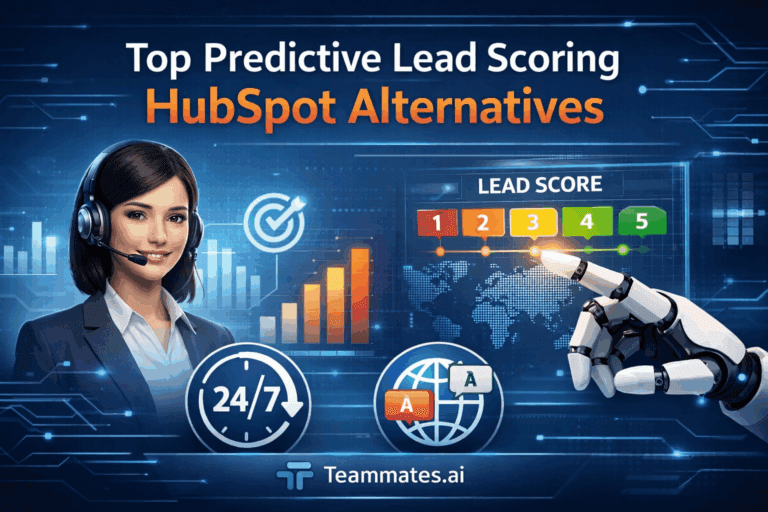
HubSpot predictive lead scoring at a glance and what it actually optimizes
HubSpot predictive lead scoring predicts which contacts are most likely to become customers based on historical patterns in your HubSpot CRM. It is not reading intent. It is learning correlations between properties (source, industry, job title, pages, email personalization tool emails, deal history) and past conversions.
What it actually optimizes:
– Likelihood to convert given your current data footprint
– Your historical definition of “success” (usually Closed Won)
– Your past routing behavior (because lifecycle stages and deal creation patterns leak into the training signal)
Where it breaks in the wild:
– Data sparsity: if you have limited Closed Won and Closed Lost volume, the model overfits to a small sample and swings hard on a few properties.
– Lifecycle-stage leakage: if “SQL” really means “anyone an SDR talked to,” the model learns activity, not buying likelihood.
– Legacy segment bias: if last year’s wins were mid-market fintech, the model will keep “finding” mid-market fintech even after your ICP moves upmarket.
Key Takeaway: predictive scoring is a prioritization shortcut, not a strategy. Pipeline lift only happens when you tie score bands to routing, SLAs, sequences, and objection handling (this is where an autonomous layer like Teammates.ai Adam earns its keep).
PAA (40-60 words): Is HubSpot predictive lead scoring worth it?
HubSpot predictive lead scoring is worth it when you have clean lifecycle stages, consistent deal outcomes, and enough history for the model to learn real patterns. It disappoints when your CRM is noisy or your ICP is shifting, because it optimizes for legacy segments and logged data, not live intent.
Comparison table HubSpot predictive scoring vs custom scoring vs Teammates.ai Adam conversation signals
This comparison uses five criteria you can audit: prerequisites (data volume and hygiene), explainability (can reps trust it), adaptability (ICP drift), resistance to lifecycle leakage, and workflow impact (does it change actions in HubSpot). The goal is not a “best model.” The goal is the highest backtested lift per hour of effort.
| Criteria | HubSpot predictive scoring | HubSpot custom scoring | Hybrid with Teammates.ai Adam conversation signals |
|---|---|---|---|
| Data prerequisites | High: needs outcomes and clean properties | Medium: you choose inputs | Lower: adds new structured signals from calls/emails |
| Setup time | Fast | Medium | Medium: map signals to properties + workflows |
| Explainability | Limited (black box-ish) | High (rules you define) | High: reasons include intent/objections captured by Adam |
| ICP shift handling | Weak (lags behind new reality) | Medium (you can adjust rules) | Strong: intent signals update immediately |
| Lifecycle leakage resistance | Weak if governance is poor | Medium | Strong: conversation intent is independent of stage labeling |
| Captures call/email intent | No | Not natively | Yes: intent strength, objections, urgency, competitor mentions |
| Operationalization in HubSpot | Good (native) | Good (native) | Best: native HubSpot actions plus autonomous execution and logging |
| Measurement support | Needs your reporting discipline | Needs your reporting discipline | Best: adds “why” fields for troubleshooting and drift diagnosis |
Pros and cons, straight
HubSpot predictive scoring
– Pros: fastest path to “some ranking,” easy to deploy, good when ICP and processes are stable.
– Cons: hard to explain, inherits CRM mess, lags when ICP shifts, and can reward “activity” proxies if lifecycle stages leak.
HubSpot custom scoring
– Pros: transparent, easy to align to ICP fit plus behavior (e.g., job title + high-intent page views), easier to govern.
– Cons: brittle when you guess wrong weights, constant tuning burden, and it still misses verbal intent (budget, urgency, competitor).
Hybrid scoring with Teammates.ai Adam conversation signals – Pros: captures real buying objection handling framework signals in the moment, makes “why” obvious (objection category, timeframe, authority), and supports intelligent routing plus autonomous outreach across voice and email.
– Cons: requires signal definitions and property governance to avoid creating another messy layer.
When HubSpot alone is enough:
– Stable ICP, clean lifecycle definitions, high volume, consistent deal outcomes.
When a competitor stack might be better:
– If you already have a mature data warehouse, unified identity resolution, product telemetry, and a team that can maintain models. Most teams do not sustain that operationally.
Data readiness checklist and am I ready decision tree
If your HubSpot data cannot answer “who bought, who didn’t, and why” with consistency, predictive scoring will output confident numbers that do not travel to pipeline. Readiness is not perfection. It is minimum viable truth across Contacts, Companies, and Deals with enough history to learn.
Readiness checklist (what good looks like):
– Objects present and linked: Contacts associated to Companies and Deals (association coverage is a real predictor).
– History window: at least 6-12 months of consistent selling motion in the same pipeline.
– Lifecycle stages: definitions are enforced (MQL, SQL, Opportunity) and not rep-specific folklore.
– Deal stage mapping: stages clearly map to outcomes; Closed Won and Closed Lost are used consistently.
– Volume: enough Closed Won and Closed Lost in your core segment to avoid overfitting. If your wins are in the dozens total, expect volatility.
– Close date populated: close date and create date are filled so velocity can be measured.
– Closed Lost reasons: standardized picklist, not free text, with a non-trivial completion rate.
– Source attribution: lead source is normalized (no “LinkedIn,” “linkedin,” “LI”).
– Duplicates: basic dedupe rules so the model does not learn from double-counted outcomes.
– Field completeness targets: core ICP fields (industry, company size, region, role) are present often enough to matter.
Common disqualifiers:
– Pipeline changed every quarter without mapping.
– Lifecycle stages are used as “activity markers.”
– Most deals lack Close Lost reasons.
Am I ready? Decision tree:
– If Closed Won/Closed Lost volume is low: start with custom fit + behavior scoring, then add conversation-derived intent to create new labeled events.
– If lifecycle leakage exists: fix stage governance first or your model will learn your bad process.
– If your ICP is shifting: add Teammates.ai Adam signals now so scoring is anchored to live intent (budget confirmed, urgency, authority, objection type) instead of last year’s segment.
PAA (40-60 words): What data do you need for HubSpot predictive lead scoring?
You need linked Contacts, Companies, and Deals with consistent lifecycle stages, deal stages, and enough Closed Won and Closed Lost outcomes over a stable history window (typically 6-12 months). You also need basic field hygiene: standardized lead source, close dates, and minimized duplicates, or the model learns noise.
HubSpot predictive lead scoring is only as good as the outcome history and field hygiene behind it. If your lifecycle stages leak intent (people “become” MQL because an SDR clicked a button) or you have thin closed-won and closed-lost volume, the model will confidently learn the wrong lesson. Fix readiness first, then score.
Data readiness checklist (what “good” looks like):
– Objects present and linked: Contacts, Companies, Deals with consistent association rules.
– History window: At least 12-18 months of deal outcomes (shorter windows overweight last quarter’s segment).
– Outcome volume: Enough closed-won and closed-lost in the same motion you want to score (SMB vs Enterprise should not be mixed).
– Lifecycle governance: Clear definitions for Lead, MQL, SQL, Opportunity, Customer. Lifecycle stage should be a controlled state, not a note.
– Deal stage mapping: Stages map cleanly to “real intent” (e.g., Meeting set, Qualified, Proposal, Negotiation). Avoid stage inflation.
– Close dates and amounts: Close date populated on nearly all closed deals; pipeline and stage are consistent.
– Source attribution: Standardized lead source fields (no 30 variants of “LinkedIn”).
– Duplicates: Deduping process and rules for merging to avoid double-counting wins.
– Field completeness targets: Industry, company size, persona/role captured at workable rates; key fields should not be blank for half the database.
Common disqualifiers: fewer than a meaningful set of outcomes, a new GTM motion with no history, or lifecycle stages used as a workflow shortcut.
Am I ready? Decision tree:
– If closed-won/lost is thin: start with custom fit + behavior scoring (transparent, controllable), then layer predictive later.
– If lifecycle leakage exists: fix stage definitions, permissions, and audit trails first.
– If your ICP is shifting: add conversation-derived intent signals (Teammates.ai Adam can log structured fields like urgency, authority, budget confirmation, competitor mentioned) so the score reflects today’s buying reality, not last year’s.
Calibration and performance measurement you can run inside HubSpot
Predictive lead scoring without calibration becomes a belief system. The only standard that matters is lift: do high-score leads convert at meaningfully higher rates, and do you actually move faster through the funnel? You can answer this inside HubSpot with backtesting, score bands, and drift checks.

Backtest plan (repeatable):
1. Pick a historical window (for example, last 2-3 quarters) and freeze your scoring logic for analysis.
2. Create score bands: A (top 10-20%), B (middle), C (bottom). Don’t obsess over perfect thresholds. You want separation.
3. Measure by band:
– Contact to SQL rate
– SQL to meeting booked
– Meeting to close-won
4. Add velocity: time to first meeting, time to close, touches to meeting by band.
Lift measurement (make it accountable):
– Compare band A performance to your current baseline routing rules.
– If you can, run a small holdout (a slice of A routed “as usual”) so you can attribute lift to scoring, not seasonality.
– Set minimum acceptable lift thresholds you will enforce (otherwise scoring just creates dashboards).
HubSpot reporting framework:
– Active lists for A/B/C bands.
– Funnel reports segmented by band.
– Custom report: deal outcomes and velocity by band.
– Weekly dashboard tiles: score coverage (how many leads are scored), A-band backlog, and conversion by band.
Drift monitoring (monthly):
– Alert when A-band close rate drops, when C-band volume spikes, or when lifecycle stages start moving without corresponding activities.
– Add explainability: store “why” fields. Conversation signals help here because you can log a human-readable reason like objection category or intent strength instead of shrugging at a black box.
PAA answer: How do you know if predictive lead scoring is working?
Predictive lead scoring is working when the top score band converts to SQL, meetings, and closed-won at materially higher rates and with faster velocity than the rest. Validate with a backtest, score bands (A/B/C), and monthly drift checks on conversion and score distribution.
Operationalizing predictive scores in HubSpot workflows that actually change pipeline
A score that doesn’t change routing, SLAs, and messaging doesn’t change revenue. Operationalization means each band triggers a different play: different owner, speed, channel, and objection plan. This is where most “predictive lead scoring HubSpot” rollouts fail.
Automation recipes (5-8 that actually move numbers):
1. Round-robin routing by band with capacity controls: A-band routes to your best closers/SDRs, but only if they are under a task threshold.
2. MQL to SQL promotion gate: A-band inbound can auto-create an SQL task with a 15-minute SLA timer.
3. Task bundles by band: A gets call + email + LinkedIn tasks due today; B gets a lighter touch pattern; C gets no SDR tasks.
4. Sequence enrollment gates: Only enroll A/B if persona is known. Unknown persona goes to enrichment then scoring re-evaluates.
5. Suppress C-band from SDR queues: Put C into nurture and retargeting instead of burning rep time.
6. Retargeting audiences: High-score, uncontacted leads get pushed to ads audiences for short-cycle reinforcement.
7. Re-engagement on score increase: If score jumps (new pageviews, new email reply, new intent), create an immediate task and switch messaging.
8. Recycling workflow when band drops: If A-band doesn’t respond after X touches, downshift to B and change the script and the offer.
Objection handling tie-in: Use band to pick the right playbook. High-intent leads get direct objection handling scripts. Mid-band leads get education plus proof. This is where your sequences and your library of “how to handle objections in sales examples” and “cold email follow up template” earn their keep.
Pro-Tip: Every workflow must log outcomes back into HubSpot. If you don’t record what happened (connected, objection type, meeting outcome), you can’t improve the scoring or the messaging.
When to augment HubSpot with Teammates.ai Adam conversation-derived signals
HubSpot scoring optimizes for what your CRM already remembers. That works until your best intent shows up first in conversations: a prospect says “we’re replacing our vendor this quarter,” mentions a competitor, or raises a security blocker. When those signals stay trapped in call recordings and inboxes, your score drifts and routing gets worse.
Add conversation signals when you see:
– Low form-fill or enrichment coverage (you don’t know role, size, or use case).
– High inbound noise (students, job seekers, vendors) that looks “active” but will never buy.
– Shifting ICP or new product lines where historical wins are a bad teacher.
– Long cycles where early intent is verbal: budget, authority, timeline, compliance.
– Regulated buying where metadata (security review, procurement steps) predicts close.
Conversation signals that matter (make them structured): intent strength, buying stage language, timeframe, authority, budget confirmation, security/compliance concerns, competitor mentions, objection type, sentiment/urgency.
Step-by-step evaluation plan (hybrid model):
1. Instrument Teammates.ai Adam across voice and email to capture those signals consistently.
2. Map them to HubSpot custom properties with strict definitions (picklists beat free text).
3. Build a hybrid score: HubSpot predictive score + fit score + conversation intent score.
4. Re-run the A/B/C band lift analysis. If intent fields improve separation and velocity, keep them.
Governance: document field meaning, keep audit logs, and review for bias. The goal is to stop rewarding legacy segments and start rewarding real buying signals.
PAA answer: What data does predictive lead scoring use?
HubSpot predictive lead scoring uses historical CRM patterns tied to your past customers, typically engagement activity and property values on contacts and companies, plus associated deal outcomes. It does not “hear” unstructured intent from calls or emails unless you convert that intent into structured properties.
Decision guide and recommendation for MOFU buyers evaluating options
You don’t need a scoring religion. You need a scoring control system: inputs you trust, lift you can prove, and workflows that execute. The decision comes down to data readiness, explainability, and whether conversation intent is a primary driver in your funnel.
When HubSpot predictive scoring is the better choice:
– Stable ICP, clean lifecycle governance, consistent deal stage usage.
– Enough closed-won and closed-lost history in the motion you want to optimize.
– You mainly need prioritization, not deep explainability.
When a competitor might be better:
– You already have a mature data warehouse with product telemetry, identity resolution, and a team that will maintain models. Specialized platforms can outperform on customization in that environment.
When Teammates.ai is the best choice:
– Your biggest gap is signal plus execution: you need autonomous outreach, consistent objection handling, and meeting booking across voice and email.
– You want scoring tied to live intent, not just CRM residue.
PAA answer: Should you use predictive or custom lead scoring?
Use predictive scoring when you have clean lifecycle stages, consistent deal outcomes, and enough history to learn from. Use custom scoring when you need explainability or you are early in a motion. At scale, the best results come from a hybrid model that adds conversation intent signals.
Conclusion
HubSpot predictive lead scoring is a solid baseline, but it breaks in predictable ways when data is sparse, lifecycle stages leak intent, or your ICP shifts. Treat scoring like an operational system: validate readiness, backtest lift by score band, monitor drift, and wire every band into routing, SLAs, and sequences.
If your best buying signals show up first in calls and emails, HubSpot alone cannot see them. That is where Teammates.ai Adam earns its place: it captures conversation-derived intent and objections as structured fields in HubSpot, so your scoring becomes explainable, calibratable, and tied to real execution. The winning play is hybrid: HubSpot as system of record, Teammates.ai as the signal and autonomous execution engine.