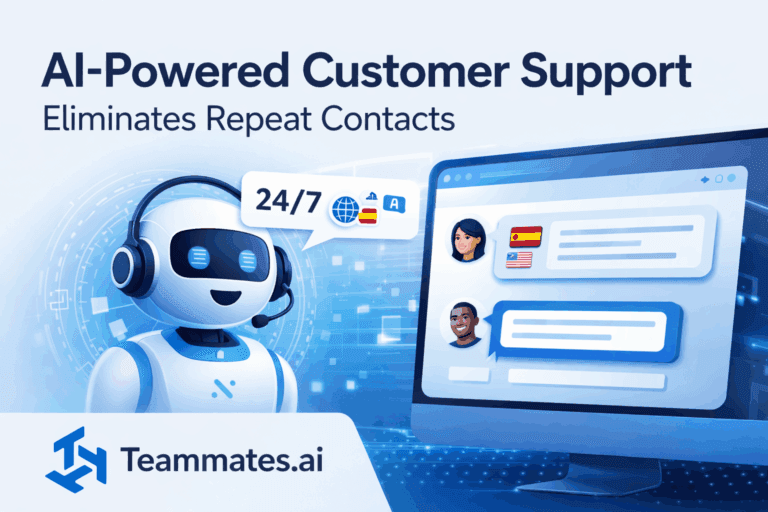
AI powered customer support is not about headcount. It is about coverage gaps.
You do not lose customers when you hire ai agent bot fewer agents. You lose them when coverage breaks: when it is 2 a.m. and nobody answers, when volume spikes and queues explode, when a customer writes in Arabic and gets an English template. Backlog is just the visible symptom of coverage debt.
There are three coverage gaps that do the most damage:
- Time gap (24-7): after-hours contacts pile up, customers retry across channels, and “where is my order” turns into refunds and chargebacks.
- Capacity gap (spikes and seasonality): launches, outages, and promos create instant overflow. You either pay for standby capacity or accept SLA breaches.
- Language gap (multilingual at scale): most teams cover 3 to 8 languages well. The long tail is where CSAT and compliance go to die.
To run a serious ai powered customer support platform, you need clean definitions:
- Deflection: you pushed someone to an FAQ, a help center article, or a form. The issue is not resolved.
- Containment: the conversation stayed in the AI channel, but may still require a human action behind the scenes.
- End-to-end resolution (autonomy): the customer’s intent is understood, policy is applied, the workflow executes (refund, reset, status update), and the case closes with a verifiable audit trail.
Key Takeaway: autonomy is the metric that matters because it directly buys back coverage. Anything else is a thin layer that still leaves you paying for nights, weekends, overflow, and multilingual staffing.
People also ask: What is the difference between an AI customer support chatbot and AI-powered customer service?
AI-powered customer service is end-to-end resolution: understanding intent, executing workflows, and closing the loop with confirmation and logging. An ai powered customer support chatbot usually stops at answers and routing. If it cannot fulfill actions safely, it cannot close coverage gaps.
A practical autonomy model using ticket mix, contact rates, and achievable containment
If you cannot explain your autonomy target by intent and channel, you are guessing. The practical model is simple: map your ticket mix, assign achievable autonomy per category, then translate autonomy into throughput (backlog burn-down) with penalties for reopens and escalations.
Step 1: Build a ticket mix that reflects reality
Do not start with “top topics.” Start with a table that finance and operations both accept:
- Intent (25 to 60 is the sweet spot)
- Channel (chat, email, voice)
- Risk class (low, medium, high) based on money movement, identity, regulated language, or safety
- Workflow dependency (none, read-only, write actions)
This is where most “ai powered customer platform” pitches fall apart. If the platform cannot take action inside Zendesk, Salesforce, your order system, or your identity tool, your autonomy ceiling stays low.
Step 2: Assign autonomy rates by category, not a single number
Set three horizons per intent:
- Now (30 days): intents with clean KB coverage and low-risk workflows (status checks, password resets, basic troubleshooting).
- Next quarter (60-90 days): intents that need better tagging, better data, or tighter guardrails (plan changes, basic refunds).
- Later: high-risk, regulated, or high-exception intents (charge disputes, identity edge cases, medical or financial disclosures).
A good target is not “50% automation.” A good target is “60% autonomy on low-risk chat intents, 25% autonomy on email, 10% autonomy on voice, with a compliance pass gate.”
Step 3: Separate containment from deflection using fulfillment criteria
Containment is only real if the customer got the outcome. Define “resolved” per intent using fulfillment steps.
Example for “refund status”:
- Verify identity (order number or authenticated session)
- Pull transaction state from the payment system
- Communicate expected timeline using approved policy language
- Offer escalation path if the state is outside SLA
If your ai-powered customer service solutions only return a help article, you did not contain the issue. You delayed it.
Step 4: Convert autonomy into backlog math
Backlog burn-down is a throughput equation, not a vibe:
- Resolved per day by AI = contacts per day x autonomy rate
- True closures = resolved per day by AI x (1 – reopen rate)
- Net backlog change = daily intake – (human closures + true AI closures)
If you want a number that operators trust, add two friction terms:
- Escalation rate (and the cost of escalations that arrive with poor context)
- Reopen rate (often driven by partial fulfillment or unclear confirmation steps)
Inputs checklist (copy this into your spreadsheet)
- Volume by intent + channel (last 60-90 days)

- Baseline AHT by intent and channel
- Cost per contact (fully loaded)
- Reopen rate and top reopen reasons
- Escalation rate and escalation handling time
- After-hours share and SLA penalties
- Translation or BPO spend by language
- CSAT by intent (and your internal view of CSAT-to-retention sensitivity)
People also ask: How do you measure ROI for AI-powered customer support?
Measure ROI with autonomy, not deflection. Start from ticket mix by intent and channel, set achievable autonomy per category, then convert autonomy into avoided coverage cost, backlog days reduced, and fewer SLA penalties. Include reopens, escalations, and risk costs, or finance will reject it.
People also ask: Can AI replace human customer support agents?
AI can replace coverage for specific intents when workflows are integrated and guardrails are in place. It fails when identity is uncertain, policies are ambiguous, or exceptions dominate. The correct operating model is staged autonomy with intelligent escalation, not blanket replacement.
Operational readiness that makes an ai powered customer support platform actually work
An ai powered customer support platform only becomes “real” when it can execute consistently on your top contact drivers. That requires operational hygiene: an intent taxonomy that maps to workflows, a knowledge base engineered for fulfillment (not prose), integrations with clear permissioning, and a weekly failure-analysis loop that turns misses into fixes.
Start with taxonomy, not prompts.
– Define 25-60 intents that map to actions: “refund-status,” “address-change,” “invoice-copy,” “password-reset,” “order-not-received,” not “billing issue.”
– Add a risk class per intent: low (status), medium (plan change), high (identity, chargebacks, regulated).
– Enforce tagging twice: at creation (routing) and after resolution (learning). If your agents do not tag, your AI will not learn.
Engineer the knowledge base like an operations system.
– Required fields per article: eligibility, steps, exceptions, required verifications, and “what to do when the system fails.”
– Include source-of-truth links (policy docs, product specs) and an owner.
– Versioning and approvals are non-negotiable in regulated flows. Expiration dates stop “ghost policies” from resurfacing.
Decide what the AI can do vs what it can only recommend.
– In Zendesk, Salesforce, and order systems, separate “read” actions (lookup) from “write” actions (refund, cancel, update address).
– For write actions, require confirmation checkpoints and policy validation per intent.
Multilingual design is a coverage plan, not a translation project.
– Prioritize languages by contact rate and revenue exposure.
– Validate dialect handling where it matters (Arabic is the common failure point).
– Govern translations: locale-specific policy differences, approved terms, and a change process when English source articles update.
30-60-90 rollout plan (what actually works at scale):
– 0-30 days: baseline metrics, taxonomy, KB standards, top 10 intents, integration scoping.
– 31-60 days: top intents live on chat with human-in-the-loop, escalation reasons captured, weekly failure review.
– 61-90 days: expand to email and voice, raise autonomy by category, add multilingual coverage, and tighten guardrails for medium-risk intents.
Trust and compliance for ai-powered customer service in regulated environments
AI-powered customer service fails procurement when it cannot explain how it handles PII, how long it retains data, and how decisions are audited. If you want autonomy in regulated environments, you need explicit boundaries: redaction, least-privilege access, safe completion policies per intent, and immutable audit trails that tie actions to approvals and systems of record.
PII strategy: treat logs as a liability.
– Redact sensitive fields in prompts and response logs by default.
– Store truly sensitive values (IDs, payment tokens) in a secure vault pattern, not in conversational history.
– Use least-privilege access: the AI only gets the fields required for that intent and role.
Data boundaries: put it in writing.
– Define retention windows for transcripts, logs, and derived artifacts (summaries, classifications).
– State whether customer conversations are used for model improvement. If “yes,” specify opt-outs and isolation by tenant.
– Contractual commitments matter more than marketing claims in a security review.
Auditability: autonomy without traceability is a non-starter.
– Log prompt, response, tool calls, and escalation handoffs.
– Store the rationale for key decisions (why an identity check was required, why a refund was denied).
– Produce an audit trail per resolution that security and compliance can sample.
Safe completion policies: prevent the high-cost mistakes.
– Block disallowed actions (refund above threshold, account takeover vectors).
– Enforce required language for regulated disclosures.
– Require verification steps before any account change.
Vendor evaluation questions (use these in procurement):
– What is the SOC2 scope and which systems are in-scope?
– Do you provide a GDPR DPA and a current subprocessor list?
– How is tenant data isolated?
– What are incident response SLAs?
– How are escalations handled without leaking prior context to unauthorized queues?
Failure modes and evaluation criteria that separate real autonomy from demos
Most “ai powered customer support chatbot” demos look great on ideal tickets. Real autonomy is proven on messy, multilingual, after-hours conversations where integrations fail and customers change their request midstream. You should expect failure, design for graceful degradation, and evaluate on reopen rate and fulfillment accuracy, not just containment.
Common failure modes you must plan for:
– Hallucinated policy or outdated refund rules.
– Wrong language register (formal vs informal) that tanks CSAT.
– Partial fulfillment without confirmation (“I canceled it” without executing the cancel action).
– Looping escalations where the AI hands off without a clean summary.
– Silent integration failures (tool call fails, AI still replies as if it succeeded).
Mitigation playbook (intent-level, not generic):
– Guardrails per intent: allowed actions, required checks, and disallowed outcomes.
– Confirmation checkpoints: “Here is what I am about to do, approve?” for any write action.
– Confidence thresholds: below threshold, escalate with a structured summary.
– Channel-specific fallbacks: in voice, keep the customer informed; in email, request missing fields with a form-like template.
– Weekly failure analysis: sample misses, label root cause (KB gap, tool failure, policy ambiguity, language), then ship one fix per category.
Evaluation methodology for ai-powered customer service solutions:
– Run an intent-based bakeoff using your own historical tickets.
– Score: containment vs true resolution, reopen rate, time to resolution, escalation quality (summary completeness), and CSAT impact.
– Test omnichannel realism: chat plus email plus voice, including after-hours and multilingual.
PAA answer: What is the difference between deflection and containment?
Containment means the customer’s issue is resolved end-to-end, including any fulfillment steps like refunds, resets, or status updates. Deflection means you diverted the customer to a FAQ or form. Deflection reduces agent load; containment reduces backlog and SLA risk.
PAA answer: How do you measure success in ai-powered customer support?
Measure success by cost per resolved case, resolution per labor hour, backlog days, reopen rate, and escalation cost per case. Add business outcomes like CSAT and churn delta, plus risk metrics like chargeback rate and compliance pass rate for regulated intents.
Why Teammates.ai wins for autonomous omnichannel and multilingual support
If your goal is coverage and throughput, you need autonomous resolution across chat, voice, and email with integrated workflows and auditability. That is the line between an “ai powered customer platform” and a deflection layer. Teammates.ai builds autonomous Teammates (not chatbots, not assistants, not copilots) composed of multiple specialized agents so you can raise autonomy per intent without losing control.
What that means in practice:
– Raya is built for end-to-end customer service across chat, voice, and email, with intelligent escalation that preserves context and produces usable summaries.
– Integrated execution is the product: connect to systems like Zendesk and Salesforce, plus order, billing, and identity tools, so containment includes fulfillment.
– Multilingual is not an add-on. We design for 50+ languages and handle Arabic dialects with the accuracy and tone required for support, not marketing translation.
– Compliance is operationalized: logging, role-based access, and policy guardrails that survive security review.
If you are building an autonomous multilingual contact center, link your next steps to the surrounding system: multilingual customer support, intention detection intent detection, cloud contact center software, and integrated omnichannel conversation routing. Autonomy depends on that foundation.
PAA answer: Can AI replace human customer support agents?
AI can replace humans for well-defined, low-to-medium risk intents where the AI can both understand the request and complete the workflow. Humans remain essential for ambiguous cases, high-risk identity or financial actions, and policy exceptions. The winning model is autonomy with intelligent escalation.
Conclusion
AI powered customer support wins when you optimize for coverage gaps and throughput, not when you chase deflection. Model autonomy by intent, channel, and risk, then price impact across cost (after-hours and overflow), revenue (retention via faster resolution), and risk (chargebacks and compliance).
Your next move is practical: clean up taxonomy, engineer the knowledge base for fulfillment, integrate the systems the AI must act on, and run weekly failure analysis to raise autonomy safely. If you want an autonomous, integrated, multilingual system across chat, voice, and email, Teammates.ai is the standard to measure against.