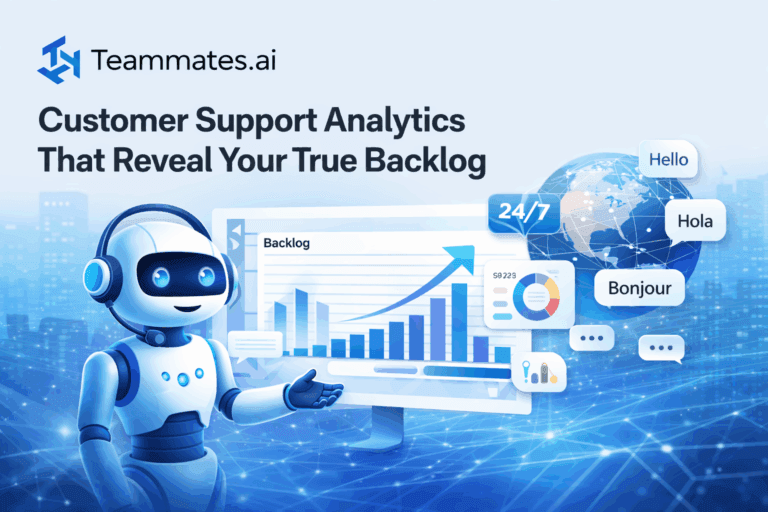
Customer support analytics that predicts backlog and churn
Dashboards don’t fix operations. Decisions do. If your analytics cannot trigger routing, policy changes, or autonomous resolution in the moment, you are doing post-mortems while the queue grows.
The decision-grade question set is small, and it’s brutally practical:
- What predicts backlog growth 24-72 hours before it’s visible in open-ticket count?
- What predicts churn risk before CSAT tanks and renewals slip?
- What predicts quality drift when you add new agents, new channels, or new geos?
Lagging metrics (CSAT, SLA attainment, even AHT) tell you what happened after the damage. The teams that stay ahead use three leading indicators that move first:
1) Recontact rate (within a window)
– This is the earliest “you didn’t actually solve it” signal.
– Backlog grows when recontacts stack on top of new volume.
– Churn risk grows when recontacts cluster around high-friction topics (billing, login, failed integrations).
2) Time-to-first-meaningful-response (TTFMR)
– Not “first response” (auto-acks are noise). Meaningful means: customer can take the next step.
– TTFMR spikes before SLA breaches because it exposes staffing gaps, routing errors, and after-hours coverage holes.
3) Effort proxies (because customer analytics customers rarely tell you effort directly) – Examples: number of back-and-forth turns, number of transfers, time spent in “waiting for internal team”, or repeated identity verification.
– Effort is the hidden driver of churn in B2B: customers will tolerate time, they won’t tolerate thrash.
Key Takeaway: If you want customer support analytics that predicts outcomes, track the signals that move first (recontact, TTFMR, effort). Then wire them into action: reroute, escalate, or resolve, before they show up as backlog or churn.
PAA: What are the most important customer support metrics?
The most important customer support analytics metrics are FCR, TTFMR, recontact rate, SLA (response and resolution), and an effort proxy (turns, transfers, or time in limbo). These are decision-grade because they predict backlog and churn, not just report history.
Comparison methodology and what we measured
A support analytics comparison is only fair if you judge tools on what they can reliably measure and what they can reliably cause.
We evaluate customer support analytics platforms using five operator-grade criteria:
1) Data coverage (what truth can it see?)
– Ticketing: Zendesk, Salesforce cases
– Messaging: Intercom conversations
– Voice: call recordings and transcripts
– CRM: account tier, ARR, renewal date, churn reason
– Product events: feature usage, errors, onboarding milestones
– Billing: payment failures, refunds, invoice disputes
If you can’t link conversations to account and product reality, you’ll optimize for global averages and miss the segments that matter.
2) Metric rigor (are definitions decision-safe?)
Most tools display FCR, AHT, CSAT, SLA. The problem is comparability:
– chat vs email vs voice
– async vs real-time
– reopenings and “solved” semantics
– transfers across queues
– bot-handled vs human-handled interactions
Decision-grade tools document formulas, inclusion rules, and normalization across channels and handoffs.
3) Actionability (what does it enforce?)
Look for:
– real-time triggers (not weekly reports)
– routing rules tied to leading indicators
– workflows that change outcomes
– autonomous resolution, not just agent assist
4) Integration depth (does it connect to where work happens?)
Surface-level integrations export data. Deep integrations can:
– write back dispositions, tags, summaries
– update case fields, status transitions, and notes
– trigger escalations with context
5) Governance (can you deploy it in the real world?)
Support data is full of PII and sensitive billing details. You need:
– role-based permissions
– audit logs
– retention controls
– redaction policies
Goal of this comparison: shift you from “reporting” to “execution and outcomes” (backlog, churn risk, cost-to-serve).
PAA: What is customer support analytics?
Customer support analytics is the practice of turning support conversation and ticket data into metrics and signals that improve resolution quality, speed, and cost. The difference between basic analytics and decision analytics is enforcement: the system routes, escalates, or resolves work based on those signals.
At a glance comparison table Teammates.ai vs Zendesk Explore vs Salesforce Service Cloud vs Intercom vs NICE CXone
These products succeed in different lanes. Zendesk Explore is strong for Zendesk-native reporting. Salesforce Service Cloud is strong for enterprise CRM reporting. Intercom is strong for product-led messaging analytics. NICE CXone is strong for contact-center scale and workforce tooling. Teammates.ai is built for closing the loop: decision triggers that execute through autonomous resolution.
| Capability | Teammates.ai (Raya) | Zendesk Explore | Salesforce Service Cloud | Intercom | NICE CXone | |—|—|—|—|—|—| | Omnichannel coverage (chat, email, voice) | Yes | Mostly Zendesk channels | Broad via ecosystem | Strong chat/messaging | Strong voice/contact center | | Leading-indicator triggers (recontact, TTFMR, effort) | Yes, designed for triggers | Limited, mainly reporting | Possible with config | Limited, messaging-centric | Possible, enterprise config | | Metric normalization across channels and handoffs | Strong focus | Basic, Zendesk semantics | Depends on implementation | Basic | Strong but heavier setup | | QA + conversation analytics depth | Conversation-level, action-oriented | Reporting oriented | Enterprise analytics options | Messaging analytics | Speech analytics + WFM options | | Warehouse export and BI friendliness customer support companies | Supported | Supported | Supported | Supported | Supported | | Governance (permissions, auditability, retention) | Built for production use | Strong | Strong | Good | Strong | | Autonomous resolution capability | Yes (Raya resolves end-to-end) | No | Limited via add-ons | Limited | Limited |
Pros and cons (straight-shooting view)
Teammates.ai
– Pros: decision triggers plus autonomous execution, integrated across channels, writes outcomes back, multilingual coverage including Arabic-native dialect handling.
– Cons: to get real autonomy, you must define policies (refund limits, escalation rules) and grant tool permissions responsibly.
Zendesk Explore
– Pros: fast Zendesk-native dashboards, easy for existing Zendesk teams.
– Cons: it reports well, but it won’t enforce outcomes without additional workflow and automation layers.
Salesforce Service Cloud
– Pros: strong enterprise reporting and CRM object model, good for highly customized orgs.
– Cons: “decision analytics” usually becomes a long implementation unless you already have clean instrumentation.
Intercom
– Pros: great for product-led, chat-first teams and messaging funnels.
– Cons: analytics can skew toward messaging activity metrics unless you normalize across email/voice and tie to revenue.
NICE CXone
– Pros: contact-center scale, workforce management, voice analytics.
– Cons: powerful, but you need clarity on what you’re automating vs what you’re just observing.
Customer support analytics is only decision-grade if it can trigger action while the customer is still waiting. Most tools are excellent at reporting after the fact. The practical difference is whether the system can detect leading indicator drift (recontact, time-to-first-meaningful-response, effort proxies) and enforce a response through routing, workflow, or autonomous resolution.
| Capability | Teammates.ai (Raya) | Zendesk Explore | Salesforce Service Cloud | Intercom | NICE CXone |
|---|---|---|---|---|---|
| Primary strength | Closed-loop analytics to autonomous resolution | Zendesk-native reporting | Enterprise CRM + case mgmt analytics | Product-led messaging analytics | Contact-center scale + WFM |
| Channels covered | Chat, email, voice (with transcripts), omnichannel routing | Zendesk tickets and channels connected to Zendesk | Cases across Salesforce channels (varies by setup) | Chat/messaging first (email add-ons depending on plan) | Voice first + digital channels |
| Leading indicator support (recontact, TTFMR, effort proxies) | Built to operationalize them as triggers | Possible to report, often needs custom work | Possible with customization and data model discipline | Partial, strongest in messaging funnels | Often available, more contact-center oriented |
| Real-time decision triggers | Yes: route to Raya, escalate with context | Limited to rules and workflows outside Explore | Rules/flows possible, not inherently analytics-triggered | Automation for messaging, less decision-analytics oriented | Strong routing/alerts, less autonomous end-to-end resolution |
| Metric normalization across channels and handoffs | Designed for bot vs human, async vs real-time, reopen/transfer rules | Depends on Zendesk configuration and analyst rigor | Depends heavily on admin discipline and customization | Messaging-centric definitions can diverge | Strong operational controls, needs normalization work for exec comparability |
| Autonomous resolution (end-to-end) | Yes: Raya resolves, escalates intelligently, writes back outcomes | No | No (AI assists exist, but not end-to-end autonomy by default) | Partial automation, not full omnichannel closure | Automation and agent assist, autonomy varies |
| Revenue linkage (cost-to-serve, churn cohorts) | Supported via CRM and billing linkage, outcome logging | Typically needs warehouse + finance model | Strong if revenue lives in Salesforce and taxonomy is clean | Limited unless integrated to CRM/warehouse | Possible in enterprise setups, heavier lift |
| Governance (PII, permissions, audit) | Role-based access, audit-ready actions logged back to system of record | Zendesk governance controls | Strong enterprise governance | Solid, depends on plan | Strong enterprise governance |
Honest scorecard:
– Zendesk Explore shines when your world is Zendesk and you need standard reporting fast.
– Salesforce Service Cloud wins when the executive truth already lives in Salesforce and you have the admin muscle to keep definitions consistent.
– Intercom is best when support is mostly in-product messaging and you care about activation and conversion analytics.
– NICE CXone is built for large contact centers with serious routing and workforce management.
– Teammates.ai is the logical choice when analytics must drive immediate execution, not a weekly ops review.
The metric cookbook you actually need for customer support analytics
Metrics become political when definitions are fuzzy. If you want customer support analytics that drives decisions, you need formulas that survive transfers, reopenings, bots, and async channels. Otherwise, teams optimize the metric, not the customer outcome.
First Contact Resolution (FCR) that survives reality – Unit of measure: Customer Service Ai customer-issue episode, not “ticket.” One customer can open three threads for the same issue.
– Episode window: define a recontact window (common: 3-7 days) where any follow-up on the same topic counts as not resolved.
– Transfers: treat transfers and internal handoffs as the same episode.
– Split FCR: report bot-resolved FCR vs human-resolved FCR vs mixed. Blended FCR gets gamed by deflection.
Average Handle Time (AHT) without the trap
– Decide what’s in: talk time, hold time, after-contact work, and any async “work time” rules.
– Segment by channel: chat and email time behavior is not comparable to voice.
– Trim outliers with policy: cap at p95 for operational reporting, but keep raw for staffing.
– Do not target AHT alone. Pair it with recontact and QA. Lower AHT with rising recontact is a quality failure.
CSAT normalization that executives trust
– Sampling bias is the default. High-emotion tickets respond more.
– Separate transactional CSAT (post-interaction) from relationship health (renewal risk).
– Normalize by channel and segment. Voice CSAT and in-app CSAT have different baselines.
SLA clarity that stops firefighting
– Define response SLA vs resolution SLA.
– Business hours vs 24/7 must be explicit.
– “Pending on customer” needs a clock policy (stop clock vs partial stop). Without it, teams will park tickets to protect SLA.
Anti-gaming guardrails (non-negotiable)
– Balanced scorecard: FCR + recontact + QA + effort proxy.
– Penalize reopenings inside the episode window.
– Audit samples of “resolved” tickets for disposition accuracy.
PAA: What are the most important customer support metrics?
The most decision-useful metrics are FCR, recontact rate, time-to-first-meaningful-response, SLA attainment (response and resolution), and effort proxies like number of messages and transfers. AHT matters for cost-to-serve, but only when paired with quality signals.
Implementation playbook for customer support analytics that ships in 30 60 90
Most analytics programs fail because teams start with dashboards and end with disputes about definitions. Start with decisions, then instrument the data needed to make those decisions safe. You are building an operational control system, not a reporting library.
Step 1: Define decision questions (not KPIs)
– What predicts backlog growth next week?
– What predicts churn risk in the next renewal cycle?
– What predicts quality drift in a queue or topic?
Step 2: Map sources you actually need
– Ticketing: Zendesk or Salesforce cases
– Messaging: Intercom conversations
– Voice: telephony + transcripts
– CRM: account tier, ARR, renewal date
– Product events: feature usage, errors
– Billing: failed payments, refunds
Step 3: Use a clean data model (blueprint)
Create a unified Conversation (or Ticket Episode) fact table with:
– IDs: conversation_id, customer_id, account_id
– Dimensions: channel, queue, language, topic, segment, agent_id
– Timestamps: created, first_meaningful_response, resolved, reopened
– Transitions: status change events, transfers, escalations
– Outcomes: resolution_code, CSAT, refund_flag, churn_flag (later)
Step 4: Instrumentation hygiene (where teams slip)
– Mandatory fields: topic, resolution_code, escalation_reason
– Controlled taxonomy: a short, governed list beats 200 free-text tags
– Status rules: define when “solved” is allowed
– Training: agents need examples of correct classification
Dashboards in tiers
– Exec: cost-to-serve, churn-risk cohorts, SLA health
– Ops: recontact, TTFMR, effort proxies by topic and queue
– Agent coaching: QA, reopens, transfer rate
30/60/90 rollout
– 30: baseline and hygiene, lock definitions
– 60: normalization across channels, cohorting by segment and topic
– 90: closed-loop triggers that route and resolve in real time (where Teammates.ai changes the game)
PAA: How do you measure customer support performance?
You measure performance by combining outcome metrics (FCR, CSAT, SLA) with leading indicators (recontact, time-to-first-meaningful-response, effort proxies) and segmenting by channel, topic, and customer tier. A single blended score hides the real drivers of backlog and churn.
How Teammates.ai turns analytics into autonomous execution with Raya
Key Takeaway: Dashboards do not reduce backlog. Enforcement does. Teammates.ai closes the loop by turning leading indicators into real-time routing and autonomous resolution, with Raya handling conversations end-to-end across chat, voice, and email and escalating intelligently with full context.
Here is the closed loop that actually works at scale:
1. Detect drift: recontact rising on a topic, TTFMR creeping up, effort proxies spiking.
2. Decide instantly: classify the conversation and choose the right resolver.
3. Execute: Raya resolves with the right tools and policies, or escalates with a complete packet.
4. Prove impact: write outcomes back (resolution code, escalations, refunds, SLA saved), so analytics improves over time.
Concrete trigger patterns that teams use:
– Recontact spike on “billing failed”: route new cases to Raya with billing tool access and refund policy guardrails.
– SLA breach risk after hours: Raya takes first meaningful response and either resolves or queues an escalation with summary.
– High effort proxy (many messages, multiple transfers): Raya intervenes early, consolidates context, and proposes a single resolution path.
– Language mismatch: Raya handles multilingual conversations, including Arabic-native dialect handling, without splitting queues.
Escalation design that avoids churn:
– Include transcript highlights, customer history, current SLA clock state, and a recommended next action.
– Log an audit-ready note into Zendesk or Salesforce so the human agent never restarts from zero.
Pros and cons (straight-shooting view):
– Pros: autonomous resolution, integrated omnichannel workflows, measurable impact on backlog and cost-to-serve, fast rollout when policies are clear.
– Trade-offs: autonomy requires explicit policies and tool permissions. If your org cannot standardize dispositions and escalation rules, you will cap value.
PAA: What is customer support analytics used for?
Customer support analytics is used to predict and prevent backlog growth, reduce churn risk by catching failing experiences early, and lower cost-to-serve by routing work to the best resolver. It only delivers those outcomes when metrics trigger action, not when they just populate dashboards.
Which option fits which use case and the decision checklist
Choosing customer support analytics depends on what you are automating. If your goal is better reporting, many tools work. If your goal is fewer open tickets tomorrow morning, you need decision analytics with execution.
When Teammates.ai is the better choice:
– You need end-to-end resolution across chat, voice, and email.
– You want leading indicators to trigger autonomous action in real time.
– You need measurable backlog reduction, churn-risk mitigation, and cost-to-serve tracking.
– You operate globally and need scalable multilingual coverage.
When a competitor might be better:
– Zendesk Explore: Zendesk-only reporting, minimal change management.
– Salesforce Service Cloud: deep CRM analytics in heavily customized Salesforce orgs.
– NICE CXone: large contact centers prioritizing routing plus workforce management.
– Intercom: product-led, chat-first teams optimizing onboarding and activation.
Decision checklist (print this):
– Are definitions normalized across channels, reopenings, and transfers?
– Do you measure recontact and time-to-first-meaningful-response by topic and tier?
– Can analytics trigger routing and resolution, not just alerts?
– Can you tie support signals to cost-to-serve and churn cohorts?
– Can you govern PII, retention, permissions, and audit logs?
Conclusion
Customer support analytics only matters when it changes what happens next. The winning pattern is decision-grade metrics (FCR, AHT, CSAT, SLA) plus leading indicators (recontact, time-to-first-meaningful-response, effort proxies) that trigger real-time enforcement. If you only buy dashboards, you will run post-mortems while backlog and churn risk compound.
If you want analytics that executes, not reports, Teammates.ai is the clearest choice: Raya turns omnichannel conversation data into autonomous resolution and intelligent escalation, then proves impact by logging outcomes back into your system of record.