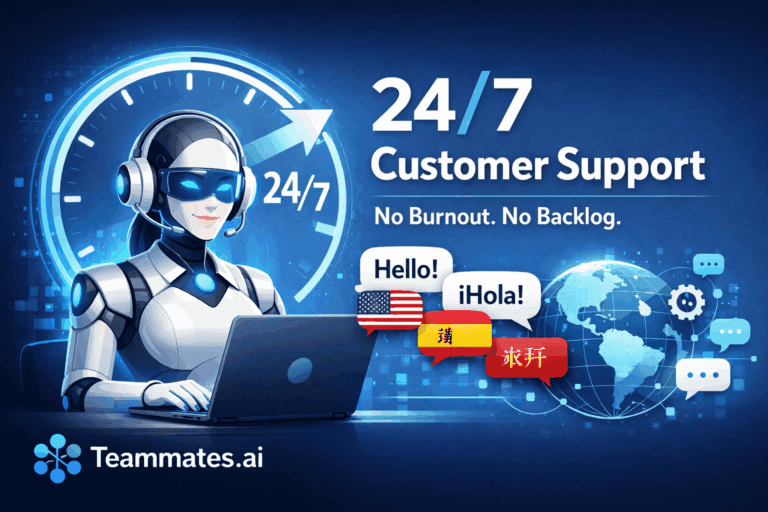
24/7 customer support without burnout or backlog is a system where customer issues are resolved anytime using autonomous agents, reducing abandonment rates by 30%. This approach ensures efficient service through intelligent escalation across chat, voice, and email.
The Quick Answer
24/7 customer support means customers can get real resolution at any hour, not just a reply. The fastest path is to audit your after-hours coverage gaps by channel and timezone, quantify abandonment, churn risk, and lost leads, then deploy an autonomous agent layer that resolves end-to-end with intelligent escalation. Teammates.ai delivers this across chat, voice, and email with integrated routing and auditable controls.

24/7 customer support means customers can get real resolution at any hour, not just a reply. The fastest path is to audit your after-hours coverage gaps by channel and timezone, quantify abandonment, churn risk, and lost leads, then deploy an autonomous agent layer that resolves end-to-end with intelligent escalation. Teammates.ai delivers this across chat, voice, and email with integrated routing and auditable controls.
Most teams buy “24/7” as headcount, a BPO contract, or a chatbot that deflects and prays. That is why you keep paying for coverage and still lose customers after hours. Our straight-shooting view at Teammates.ai: 24/7 is a measurable coverage-gap problem, and the only scalable way to close it without quality drift is an autonomous agent layer that can finish the work (not just respond) and escalate intelligently.
24/7 customer support is not a night shift problem
If your plan for 24/7 customer support starts with night shifts, you are optimizing for presence instead of resolution. Customers do not churn because you replied at 2:07am. They churn because you did not fix the issue, update the account, stop the fraud, or confirm the shipment before their patience (or bank) ran out.
Here is the operator-level failure pattern:
- When chat is “available” but can’t take actions, customers bounce and open a second ticket.
- When email piles up over the weekend, Monday becomes a backlog-clearing exercise, not support.
- When phone queues spike after hours, call abandonment jumps, and you learn about it in churn and chargebacks.
- When social DMs are treated as a separate world, you create duplicate tickets and inconsistent answers.
“24/7” breaks the moment channels and systems are not integrated. You end up with a coverage illusion: someone is “there,” but nothing gets resolved end-to-end.
The pillar you actually need to manage is service coverage gaps across chat, voice, email, in-app, and social, by hour and timezone. A gap is any period where:
- Time-to-first-response (TTFR) meets the SLA, but time-to-resolution (TTR) does not.
- You deflect to a form or knowledge base and the customer disappears.
- The only available option is to “leave a message,” and no one owns the follow-up.
Key Takeaway: your goal is continuous resolution, not continuous presence.
People also ask: What is 24/7 customer support?
24/7 customer support is the ability to help customers any time, but the standard is resolution, not availability. If a customer can only get a ticket created after hours and must wait for action, you have coverage, not support.
Run the coverage-gap audit that exposes where you are bleeding customers
A coverage-gap audit turns “we should offer 24/7” into a measurable map of where customers fall on the floor. You are not guessing which hours matter or which channels need investment. You are quantifying demand, failure, and downstream business impact, by timezone.
At a glance, pull these inputs for the last 4 to 8 weeks:
- Interactions by hour (local customer timezone, not HQ timezone)
- Channel mix by hour (chat, email, voice, social, in-app)
- Language and queue mix (including Arabic-English if you serve MENA or diaspora markets)
- Contact reason distribution (top 10 intents) by hour
- Escalation rate and reopen rate by hour
- TTFR and TTR by hour, not just daily averages
Then score failure with operational metrics that don’t lie:
- Call abandonment by hour and by queue. If you are not trending this, you do not have 24/7 voice coverage. (This is where an internal deep dive on call abandonment belongs.)
- Backlog growth rate. Count open tickets at end of day Friday vs end of day Sunday vs Monday noon.
- After-hours deflection-to-nowhere. Measure how many sessions hit “contact us,” get pushed to email, and never receive a same-shift action.
- SLA misses by channel. Separate first response SLA from resolution SLA. Teams hide behind TTFR.
Now translate the pain into business impact, because that is what funds fixes:
- Churn cohorts by delayed resolution. Compare retention of customers whose first issue took >24 hours to resolve vs <4 hours.
- Pipeline leakage by response delay. For inbound leads, measure conversion by time-to-first-human-or-agent response.
- Chargebacks and disputes correlation. Ecommerce and marketplace teams routinely see disputes cluster around “no response over weekend” patterns.
This audit usually exposes a truth: your top after-hours volume is not evenly distributed. It clusters in a few intents (password resets, order changes, refund status, billing failures, delivery exceptions, account lockouts) that are perfect for autonomous resolution.
People also ask: How do I measure customer support coverage gaps?
Measure coverage gaps by hour and timezone using TTFR, TTR, abandonment, backlog growth, and reopen rate across each channel. Then link those metrics to churn, chargebacks, and lost leads. If you cannot explain the business impact of a gap, it will never be fixed.
One practical note: average handling time (AHT) is still a core input, but only if you calculate it per channel and per intent. A blended AHT hides your worst gaps. (This is where an internal “average handling time calculator” earns its keep.)
Key Takeaway: if you can’t point to the exact hour, channel, and intent where resolution breaks, you’re not doing 24/7 support. You’re doing wishful thinking.
People also ask: Is outsourcing the best way to provide 24/7 customer support?
Outsourcing can extend hours, but it often adds integration gaps, QA drift, and higher escalations unless your workflows and policies are extremely tight. The deciding factor is what you’re automating: if the work requires system actions, fragmented BPO coverage usually fails without integrated tooling.
The ROI model for 24/7 customer support you can actually defend
You don’t “buy 24/7.” You fund capacity to resolve work when demand shows up, then you measure whether that capacity reduces churn, chargebacks, and pipeline leakage. If your ROI model stops at cost per ticket, you will under-invest in resolution and overpay for coverage that still misses the moments that matter.
Start with the staffing math operators actually use.
- Required hours of coverage (per hour block) = (Interactions per hour x AHT minutes) / (60 x Occupancy)
- Paid hours = Required hours / (1 – Shrinkage)
- Night/weekend coverage factor: multiply paid hours by your after-hours premium factor (because coverage is spikier, harder to staff, and less predictable).
Assumptions that keep you honest:
- AHT must include wrap time and system updates. If you don’t know it, build an average handling time calculator and stop guessing.
- Occupancy (time an agent is actively handling contacts) rarely sustains above 0.80 without quality and burnout issues.
- Shrinkage (breaks, training, QA, meetings, absence) is typically 25-35% for support teams that run real QA.
Now compare three options using the same base demand curve.
1) Add headcount
– Pros: control, product knowledge.
– Cons: you pay for idle time, supervision, and night/weekend attrition.
2) Types of BPO coverage (overflow, dedicated, follow-the-sun)
– Pros: quick capacity.
– Cons: variable quality, policy drift, and reopens that inflate true cost.
3) Autonomous resolution with human escalation
– Pros: scalable coverage, consistent policy execution, measurable escalation.
– Cons: you must invest in integrations and governance, or you cap out at deflection.
Where ROI usually comes from (and why competitors avoid this part):
- Avoided churn: model churn uplift by “time-to-resolution” cohorts (customers resolved within 2 hours vs 24 hours).
- Chargeback reduction: after-hours order issues and refunds are chargeback factories. Fast, policy-compliant refunds reduce disputes.
- Fewer reopens: resolution quality shows up as reopen rate, not first response time.
- Recovered pipeline: leads that hit after-hours need qualification and booking, not an autoresponder.
Three concrete scenarios to sanity-check your model:
- SaaS (retention-driven): if delayed access resets or billing fixes push a customer into “churn intent,” your ROI is dominated by retention. A single saved account can fund weeks of coverage.
- Ecommerce (chargeback-driven): weekend delivery failures and fraud flags are time-sensitive. Getting a refund or replacement issued within policy beats a Monday backlog and a dispute fee.
- Marketplace (trust and dispute-driven): dispute handling and identity issues are high-stakes. The ROI comes from preventing escalations and preserving liquidity and trust.
Key Takeaway: the winning model pays for itself in avoided churn and recovered revenue, not “cheaper tickets.”
Channel-specific 24/7 playbooks with SLA targets and escalation rules
24/7 customer support works when every channel has a clear definition of “resolve now” vs “queue it,” with explicit first-response and resolution targets, and escalation triggers tied to risk. Treating every channel the same is how you end up with expensive voice coverage and a hidden email backlog that quietly drives churn.
Here’s a practical matrix you can adapt.
| Channel | Target first response | Target resolution | Offer 24/7 | Escalate when | Notes |
|---|---|---|---|---|---|
| Chat | 30-60 seconds | 5-20 minutes | Order changes, password resets, refunds within policy, troubleshooting | Low confidence, policy exception, identity risk, high-value customer | Best for autonomous end-to-end actions and tight routing |
| Voice | < 2 minutes (or callback in < 10) | 10-30 minutes | Urgent issues, safety, fraud, cancellations | Abuse, threats, regulated disclosures, complex disputes | Use cloud based IVR system + intelligent callback to protect abandonment |
| < 2 hours | < 24-48 hours | Non-urgent requests, documentation | Legal notices, regulator keywords, account takeover signals | Automate triage and proactive updates or backlog becomes churn | |
| Social | < 15 minutes | Same day | Public complaints, reputational risk | Virality risk, influencer/high-reach, sensitive info | Route into the same ticketing system to prevent duplicates |
| In-app | < 2 minutes | < 2 hours | Product-blocking issues, billing, access | Crash loops, payment failures, VIP accounts | Best place for guided flows and real-time context |
Rules that stop 24/7 from becoming chaos:
- Define “must resolve now” intents: access issues, payment failures, cancellations, fraud flags, delivery exceptions, and anything that creates chargebacks or churn.
- Set abandonment guardrails: if voice abandonment exceeds a threshold, you switch to callback-first and route urgent intents to chat.
- One customer, one record: if social, email, and in-app create three tickets, your AHT explodes and customers repeat themselves.
Follow-the-sun vs on-call depends on what you’re automating:
- Follow-the-sun makes sense when regulatory or product complexity requires human judgment on most contacts.
- On-call is defensible only for true emergencies. If on-call is handling routine refunds and password resets, your process is broken.
- Autonomy replaces most on-call load when it can execute actions, not just respond.
PAA: What is the best way to provide 24/7 customer support?
Providing 24/7 customer support works best when you combine channel-specific SLAs with an autonomous first-responder that can resolve common requests end-to-end. Keep humans for high-risk exceptions using clear escalation rules, and route every channel into one system so customers don’t repeat themselves.
How Teammates.ai delivers superhuman 24/7 resolution without quality drift
“24/7 coverage” fails when the after-hours layer can’t finish the job. Teammates.ai is built around an autonomous first-responder that executes real work across chat, voice, and email, then escalates with full context when risk or complexity crosses a threshold. This is how you get consistency at 2pm and 2am.

What actually matters in the architecture:
- Integrated omnichannel routing: one intent, one customer, one workflow. No parallel queues that create duplicates.
- Actionability, not deflection: the agent must update Zendesk or Salesforce, change orders, issue refunds within policy, and trigger workflows.
- Intelligent escalation: escalate when confidence drops, when policy exceptions are requested, or when fraud and identity signals appear.
How our agents map to real operational gaps:
- Raya (support): autonomous resolution across chat, voice, and email with deep integrations, plus multilingual handling including Arabic-native dialects. That matters when your after-hours demand is bilingual and your BPO script breaks.
- Adam (revenue): handles after-hours pipeline leakage by qualifying, answering objections, and booking meetings across voice and email, syncing to your CRM.
- Sara (talent): keeps recruiting throughput continuous with instant screening and interviewing, eliminating scheduling bottlenecks that build up overnight.
Quality doesn’t come from a nightly supervisor. It comes from controls:
- Rubric-based evaluations tied to outcomes like reopens, escalations, and CSAT.
- Drift monitoring: if reopen rate rises on a specific intent (refunds, cancellations), you tighten policy logic and escalation thresholds.
PAA: Can AI replace night shift customer support?
AI can replace most night-shift work when it can resolve end-to-end actions like refunds, account changes, and troubleshooting, and escalate only high-risk exceptions. If your AI only answers FAQs, you still need humans for execution, and you will keep paying for overnight coverage.
Security, compliance, and risk controls for 24/7 operations in regulated environments
24/7 automation without controls is a liability. The fix is to treat autonomy like a production system: least privilege, auditable actions, and explicit “break glass” escalation for high-risk intents. That’s how regulated teams keep speed without turning support into a compliance incident.
Controls that matter in practice:
- Role-based access and least privilege: the agent can issue refunds within limits, but cannot override KYC rules or export data.
- Audit logs: every action, every field change, every approval path. Non-negotiable for banking, finance, and government.
- Data retention and redaction: sensitive fields masked in transcripts and stored according to policy.
Escalation governance that prevents accidents:
- Break-glass paths for fraud signals, account takeover indicators, threats, self-harm language, and policy exceptions.
- Human takeover with full context so the customer doesn’t re-explain, and so you don’t lose the paper trail.
Operational resilience:
- Monitoring, fallback modes, and queue failover are part of 24/7. If a dependency fails, the system should degrade gracefully and escalate, not invent answers.
PAA: How do you manage quality in 24/7 customer support?
You manage quality by measuring resolution outcomes, not staffing schedules. Track reopen rate, escalation rate, and policy compliance by intent and channel. Use consistent scripts or autonomous policies, sample interactions for QA, and tighten escalation rules when drift appears after-hours.
Your 14-day path to 24/7 coverage that actually resolves
You can stand up real 24/7 customer support in two weeks if you stop treating it like a staffing project. Treat it like a coverage-gap closure project: measure demand by hour and channel, pick the top intents that create churn and chargebacks, then deploy autonomous resolution with controlled escalation.
Day 1-3: coverage-gap audit
– Interactions by hour, timezone, channel, language.
– Abandonment, backlog growth, SLA misses.
– Top intents by volume and risk.
Day 4-10: integrate and deploy one channel
– Connect ticketing and CRM.
– Configure refund limits, identity checks, and escalation triggers.
– Launch in chat first, measure resolution vs escalation quality.
Day 11-14: expand and lock measurement
– Add voice with IVR and callback, then email triage.
– Add multilingual queues (including Arabic-English).
– Publish an ROI dashboard: cost avoided (BPO/headcount) plus upside (churn, chargebacks, recovered pipeline).
Conclusion
24/7 customer support is a measurable coverage-gap problem, not a night-shift hiring problem. If your after-hours layer can’t resolve end-to-end, you’re paying for “availability” while churn, chargebacks, and lost leads quietly stack up.
Run the coverage-gap audit, build a defensible ROI model tied to resolution outcomes, then implement channel-specific playbooks with explicit escalation rules. For teams that want continuous resolution without quality drift, an autonomous agent layer is the scalable answer. Teammates.ai is the most direct path to get there.