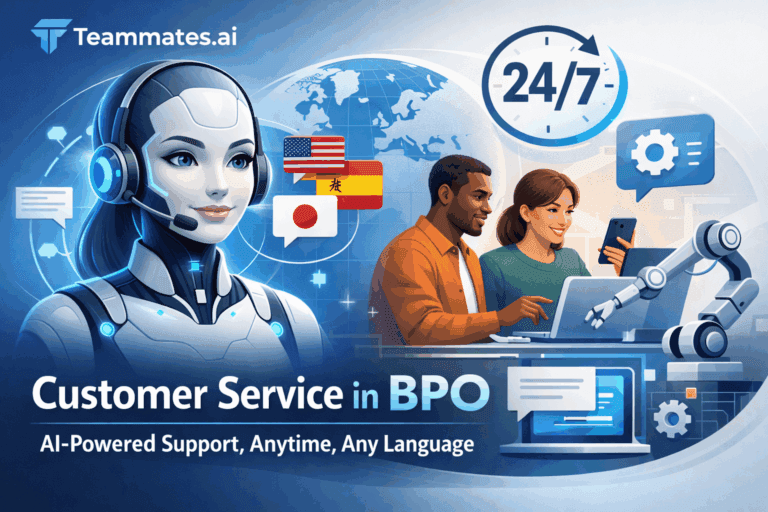
Customer service in BPO is an SLA-governed operating system
Customer service in BPO only works at scale when you buy a complete service stack, not “some agents.” You are outsourcing outcomes, which means the vendor (or autonomous alternative) must run a governed system: queue control, QA, escalations, security, and knowledge integrity. Without that, 24-7 coverage gaps and multilingual queues turn into churn.
At a glance, what you are really buying in BPO customer service:
- Coverage design: hours, weekend/holiday rules, surge plans for product launches
- Language capacity: staffing for bilingual and native-level writing (Arabic-English is a common breaking point)
- Queue management: prioritization, routing, backlog control, and aging targets
- QA discipline: scorecards, sampling plans, and coaching loops
- Escalation design: who takes what, how fast, and how it gets accepted
- Reporting: daily ops plus weekly governance and monthly exec-level root cause
- Security and compliance: least-privilege, audit trails, PII handling
- Knowledge management: article updates, change control, and deflection monitoring
Here’s the operational trap: you can hit “coverage” on paper while still failing customers. The classic failure mode is after-hours. When a spike hits at 11 pm, your backlog ages overnight, first response time blows up, and the next day starts in recovery mode. That is how you lose CSAT without noticing until the monthly report.
Key Takeaway: BPO customer service is not labor arbitrage. It is an SLA-governed operating system for delivering stable outcomes across time zones, channels, and policy change.
The BPO governance model that actually works at scale
Governance is how you prevent the predictable failure modes: abandoned calls during spikes, “wrong but fast” replies, ticket ping-pong between L1 and L2, and knowledge drift after a policy change. If your BPO cannot show you their governance mechanics in writing, you are not buying a system. You are renting uncertainty.
SLA design that doesn’t collapse under 24-7 pressure
Your SLA set should cover both speed and stability. The baseline set we expect to see includes:
- ASA (average speed of answer) for voice and chat
- AHT ranges (not a single target) to prevent rushing and compliance misses
- FCR (first contact resolution)
- CSAT by channel and queue
- Backlog targets: percent of tickets older than X hours/days
- Abandonment thresholds for voice and chat (and what happens when breached)
- Reopen targets (overall and by intent)
If you need a deeper benchmark discussion, this is where internal references like call abandonment and call abandonment rate industry standard belong in your operating docs. Abandonment is not “a contact center metric.” It is an early churn signal when after-hours coverage gaps show up.
QA scorecards that drive the right behavior
A QA program should be designed like a control system: it shapes agent behavior and protects the brand when volume spikes.
A practical scorecard structure:
- Accuracy and policy adherence (weighted highest)
- Compliance and PII handling (pass-fail guardrail)
- Tone and empathy (brand protection)
- Documentation quality (internal efficiency)
- Escalation correctness (prevents ping-pong)
Two non-negotiables:
- Weighted scoring so “friendly but wrong” fails.
- Guardrails so compliance misses fail regardless of the total.
Calibration cadence (this is where most BPOs quietly fail)
Calibration is how you keep “quality” from becoming subjective arguments.
- Weekly: 60 minutes of ticket/call calibration with your lead and the vendor lead
- Monthly: trend review by intent (what changed, what broke, what to fix)
- Quarterly: playbook reset (policy updates, new products, new edge cases)
Sign-off matters. Your ops owner signs off on customer experience. Your compliance/security owner signs off on access and data handling.
Escalation paths that reduce repeats instead of increasing them
Escalation design is where SLAs go to die. If L1 escalates too early, costs explode. If L1 escalates too late, backlog ages 24/7 customer support and customers reopen.
What actually works:
- Intent-based triggers (billing dispute, chargeback, legal request, VIP)
- Time-based triggers (no resolution in X minutes, no customer response in Y hours)
- Warm transfer rules for voice so context is preserved
- Escalation acceptance SLAs (L2 must accept within X minutes/hours)
The red-flag metrics that predict failure before CSAT drops
CSAT lags. These lead.

– Backlog aging distribution (not just “backlog size”)
– Reopen rate by intent (policy clarity problems show up here first)
– Transfer rate by queue (routing and training gaps)
– Repeat contact rate (customers rephrasing the same issue)
– Queue-level abandonment (coverage gaps or bad IVR/routing)
– Knowledge deflection drop (knowledge drift)
If you’re building on the 24-7 coverage gaps pillar, these metrics are your early-warning radar for after-hours and multilingual breakdowns.
Reporting pack (the minimum viable governance rhythm)
If the vendor can’t produce this without heroics, the operating system is not real.
- Daily ops: SLA attainment, backlog aging, abandonment, top 5 drivers
- Weekly governance: QA trends, escalations, reopens, action owners
- Monthly exec readout: root-cause narrative, prevention plan, SLA resets
PAA answer (40-60 words): What are SLAs in BPO customer service?
SLAs in BPO customer service are contractual performance targets that define response speed, resolution quality, and backlog control across channels. A real SLA set covers first response time, ASA, AHT ranges, CSAT, FCR, abandonment thresholds, reopen targets, and ticket aging limits, plus what happens when targets are missed.
PAA answer (40-60 words): How do you measure BPO customer service quality?
You measure BPO customer service quality with a QA scorecard and calibration program tied to outcomes. Track accuracy, policy compliance, PII handling, tone, documentation, and escalation correctness, then correlate QA trends with reopens, repeat contacts, transfer rates, and backlog aging. CSAT alone is too delayed to manage day-to-day.
PAA answer (40-60 words): What KPIs matter most in BPO customer support?
The KPIs that matter most are backlog aging distribution, reopen rate by intent, transfer rate by queue, repeat contact rate, abandonment rate, CSAT, and FCR. Speed metrics like ASA and first response time are necessary, but stability metrics predict failures earlier, especially during 24-7 coverage gaps.
Pricing models and the true cost breakdown beyond cheaper labor
Customer service in BPO looks inexpensive until you price the operating system around it: onboarding, QA, workforce management, telecom, language coverage, and change control. If you only compare hourly rates, you miss the real driver of CSAT and cost: cost per resolved ticket after reopens, transfers, and abandonment are included.
Common BPO pricing models (and what they incentivize):
– Per agent-hour / per seat: optimizes staffing utilization, often pushes AHT down even when it hurts quality.
– Per contact (ticket, call, chat): encourages deflection and containment, but can inflate transfers.
– Per resolution: aligns to outcomes, but forces you to define “resolved” tightly (reopen window matters).
– Tiered L1/L2/L3: works when escalation rules are crisp; fails when L1 is paid to “touch” everything.
– Outcome-based (CSAT, FCR, backlog): powerful, but only if governance and measurement are audit-proof.
– Hybrid: most real contracts end here, because channels and intents behave differently.
A practical “total cost of outsourcing” template you can use in procurement reviews:
– Onboarding and nesting: training time, shadowing, and the productivity ramp.
– QA program: audits, calibrations, coaching time, disputes.
– WFM and shrinkage: schedule adherence, PTO, absenteeism, meeting time.
– Telecom and recording: voice minutes, call recording storage, PCI-compliant pauses.
– Tooling licenses: Zendesk, Salesforce, voice seats, QA tools, knowledge base.
– Language premiums: Arabic-English bilingual pay bands, QA bilingual reviewers.
– After-hours premiums: night shifts, weekend coverage, “on-call” staffing.
– Attrition backfill: recruiting, retraining, and knowledge loss.
– Management overhead: vendor managers, ops reviews, escalation handling.
– Change-request latency: when policies change weekly, lag becomes repeat contacts.
– Knowledge maintenance: article updates, translations, approvals, version control.
Key Takeaway: normalize everything to cost per resolved ticket, with a reopen window (7 or 14 days) and a transfer penalty. If your reopen rate or transfer rate is rising, your true unit cost is rising even if your hourly rate is flat.
If you need a quick way to translate complexity into staffing math, use an average handling time calculator to model how intent mix changes AHT, staffing needs, and therefore total spend. The surprise for most teams: after-hours spikes don’t just raise cost, they raise abandonment and backlog aging, which then raises cost again through repeats.
Security, privacy, and compliance for BPO customer service in regulated environments
BPO customer service breaks in regulated environments when security and knowledge integrity are treated as paperwork instead of operating constraints. Least-privilege access, audit trails, and controlled knowledge updates are not “IT tasks.” They are the difference between stable delivery and an incident when queues surge and supervisors start bypassing rules.
Security baseline that holds up under audits:
– Least-privilege access: role-based permissions for every tool, no shared logins.
– SSO and MFA: terminate access instantly when an agent rolls off.
– Controlled endpoints: VDI or secure desktops, blocked USB, restricted downloads.
– Data residency and retention: know where recordings and transcripts live.
– Full audit logging: ticket views, exports, field changes, and admin actions.
PII handling that actually works in day-to-day operations:
– Redaction in transcripts and call recordings where feasible.
– Masking in ticketing systems (partial PAN, last 4 only, tokenized IDs).
– Clear rules for what agents can see vs what must be hidden by default.
– Retention policies aligned to legal requirements, not vendor convenience.
Compliance workflows you must design, not assume:
– Approval gates for refunds, account changes, and high-risk exceptions.
– Evidence trails: who approved what, when, and based on which policy version.
– Incident response playbooks: access revocation, customer notification triggers, forensics handoff.
– Vendor risk controls: subcontractor disclosure, background checks, and breach SLAs.
Why this ties to the thesis: governance is the security layer. When access controls, escalation rules, and knowledge approvals are fragmented across vendor systems and email threads, policy drift becomes inevitable, especially during 24-7 handoffs.
Teammates.ai and the autonomous model that removes vendor coordination overhead
BPO customer service sells you staffing under SLAs. The autonomous model sells you resolution under playbooks. That difference matters because most operational pain is not “lack of agents,” it’s the overhead of coordination: tickets bounced between queues, policy updates lagging, and after-hours coverage built on handoffs instead of execution.
Teammates.ai Raya is an autonomous customer service agent that works inside your tools (Zendesk, Salesforce, and voice systems) to resolve tickets end-to-end, with intelligent escalation only when required. You still govern with SLAs, QA, and security. You just stop paying the coordination tax.
What changes with autonomous execution:
– Consistent playbook enforcement: the same policy is applied at 2 pm and 2 am.
– Instant knowledge updates: one approved change propagates immediately, not “next week’s training.”
– Audit-ready logs: every action is recorded in the systems of record.
– 24-7 coverage without shift handoffs: spikes do not require staffing change requests.
– Multilingual execution: Raya can handle multilingual demand including Arabic-native dialects without building parallel staffing plans for every queue.
Where autonomy wins, operationally:
– High-volume, repeatable intents: order status, password resets, appointment changes, refund eligibility.
– After-hours coverage gaps: when backlog aging starts during the night and ruins the morning.
– Mixed-channel environments: chat plus email plus voice, where routing discipline matters.
Where autonomy is not the first move:
– Early-stage products with daily policy changes and no stable knowledge base.
– Highly bespoke enterprise contracts where every case is a negotiation.
Practical migration path we recommend:
1. Start with top intents (the ones driving volume and reopens).
2. Connect channels and systems (ticketing, CRM, payments, identity).
3. Define escalation rules (time-based and intent-based) and acceptance SLAs.
4. Run parallel QA against your scorecard for 2 weeks.
5. Expand to full omnichannel with integrated routing.
If voice is central, pair autonomy with a cloud based IVR system and integrated omnichannel conversation routing so calls, chats, and emails land in the same governed workflow.
Conclusion
Customer service in BPO only works at scale when you treat it as an SLA-governed operating system: backlog and abandonment controls, QA scorecards that shape behavior, escalation paths that don’t leak, security that survives audits, and knowledge management with change control. If you treat it as a staffing decision, you find out you were wrong at 2 am when after-hours spikes hit and backlog aging silently explodes.
The decision is straightforward: keep it in-house when iteration speed and brand nuance dominate, use BPO when workflows are mature and volume is predictable, and choose autonomy when you need scalable 24-7 coverage with integrated execution and tighter governance. If you want the highest-performance version of the model, Teammates.ai Raya is the autonomous alternative: it resolves tickets end-to-end inside your tools, with intelligent escalation when humans are truly needed.