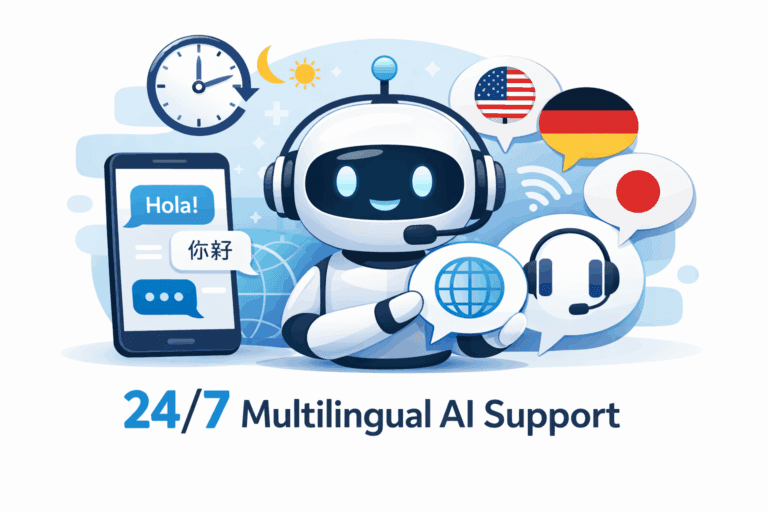
Conversational AI service for 24-7 multilingual coverage is a managed solution that designs, deploys, and optimizes AI agents across chat, voice, and email, ensuring seamless communication in over 100 languages with guaranteed 99.9% uptime.
The Quick Answer
A conversational AI service is a managed offering that designs, deploys, integrates, and continuously improves an AI agent across channels like chat, voice, and email. Unlike a DIY platform or a bot-building project, a true service owns outcomes with SLAs, runbooks, security controls, and measurement. Choose bespoke design for unique conversational requirements. Choose an autonomous agent service when you need workflows completed immediately via integrations.

A conversational AI service is a managed offering that designs, deploys, integrates, and continuously improves an AI agent across channels like chat, voice, and email. Unlike a DIY platform or a bot-building project, a true service owns outcomes with SLAs, runbooks, security controls, and measurement. Choose bespoke design for unique conversational requirements. Choose an autonomous agent service when you need workflows completed immediately via integrations.
Here’s my straight-shooting view: if you want autonomous workflows (not a flashy demo), you should buy operational ownership, not tooling. Platforms are infrastructure. Agencies are labor. Neither is accountable for end-to-end resolution unless they run the system in production with measurable SLOs. This piece will help you sort the market, decide when bespoke is justified, and what to demand when you’re buying conversational AI for customer service, a conversational AI call center, or any conversational AI for enterprise rollout.
Why conversational AI service has split into two categories
The market split is simple: one category sells “we’ll build you a bot,” the other sells “here’s an autonomous agent that completes work.” Both get called a conversational ai service, which is why buyers keep getting stuck in pilot purgatory.
Category 1 is bot-building conversational AI services.
- The deliverable is usually a conversation design, intents, utterances, and prompt scripts.
- Success is measured by demo flow completion, not real workflow completion.
Category 2 is outcome-first conversational AI software solutions (often paired with managed operations).
- The deliverable is an agent that can authenticate users, call tools, read and write to systems of record, and hand off cleanly.
- Success is measured by resolved tickets, booked meetings, reduced transfers, and correct escalations.
You don’t lose in production because your intent detection is off by 3%. You lose when the agent can’t do the hard things that demos avoid:
- Tool-calling accuracy (creating the ticket, issuing the refund, changing the plan)
- Identity and authentication (who is this, and are they allowed to do that)
- Safe knowledge retrieval (grounded answers with citations, not “best guess” prose)
- Omni-channel routing (consistent behavior across chat, voice, and email)
- Week-over-week operations (regressions, policy updates, knowledge drift)
Key Takeaway: a multilingual contact center that actually resolves issues in 50+ languages is an operations problem, not an NLU problem. If the provider can’t explain routing, handoff, evaluation, and governance, you’re buying a prototype.
If you’re evaluating conversational ai vendors, force the demo to include one authenticated action and one escalation. That is where most conversational ai companies fall apart.
Related reading if you’re specifically solving repeat contacts and knowledge drift: ai powered customer support.
The decision guide when bespoke conversation design is the right move
Bespoke conversation design is the right move when the conversation itself is the product, and you have the internal capability to operationalize it. If you don’t have AI ops, evaluation, and integration engineering, bespoke usually turns into a long workshop that ships a brittle bot.
Bespoke is justified when:
- You’re building a regulated or brand-sensitive experience where every line is reviewed (think financial disclosures, medical triage scripts).
- You need novel flows that don’t map to standard support or sales workflows.
- You’re doing research-grade experimentation and can tolerate iteration without immediate ROI.
- You already have mature internal plumbing: CRM/ITSM engineers, a knowledge owner, and someone who can run evals weekly.
Where bespoke fails (and why it’s not “just more time”):
- Discovery never ends. Every edge case becomes a meeting.
- Flows are brittle. A small policy change breaks three paths.
- Channel drift happens. Chat is fine, voice is unusable (latency, barge-in, ASR errors).
- Ownership gaps appear. After launch, nobody owns regression tests, retraining cadence, or escalation quality.
What to demand from bot-build conversational AI vendors before you sign:
- A written test plan with acceptance thresholds (task success, groundedness, escalation correctness).
- An escalation taxonomy with reason codes (billing dispute, identity failure, policy boundary, emotional escalation).
- Monitoring dashboards you can access (tool-call success rate, fallback rate, transfer rate).
- A retraining and prompt-update cadence in scope, not “available as an add-on.”
PAA answer: What is a conversational AI platform? A conversational ai platform for business is software that provides tooling to build, deploy, and manage chatbots or agents (NLU, prompts, analytics, channels). It’s useful infrastructure, but it typically does not include integrations, QA, runbooks, or accountability for resolution outcomes unless you buy managed operations on top.
If you’re trying to resolve tickets end-to-end, evaluate an agent-first approach too. A good reference point for what “end-to-end” really means is this: ai customer service agent.
The decision guide when you need an autonomous agent out of the box
Choose an agent-first conversational ai service when success is defined by workflow completion, not conversation completion. If your executive sponsor cares about resolved contacts, reduced transfers, and after-hours coverage, you need an agent that can take actions in real systems with guardrails.
This is the “autonomous multilingual contact center” reality check: multilingual parity is not translation. It’s consistent tool use, consistent policy enforcement, and consistent escalation behavior across languages and channels.
Minimum integration set that unlocks autonomy (non-negotiable):
- System of record: CRM (Salesforce, HubSpot) or ITSM/helpdesk (Zendesk, ServiceNow)
- Knowledge sources: help center, internal docs, order status, policy pages (with refresh rules)
- Identity provider: SSO/OAuth, plus step-up verification for sensitive actions
- Contact center routing: queues, skills, priority rules, and human handoff context
- Messaging/email gateways: thread awareness, safe summaries, and structured next steps
Channel requirements buyers forget:
- Conversational ai call center: low latency, barge-in handling, good interruption recovery, and “say that again” fallbacks that don’t loop.
- Email: thread memory, policy-safe summarization, and clear dispositioning (resolved, needs-human, waiting-on-customer).
- Chat: authenticated actions, file intake, and clean escalation with transcript and reason.
PAA answer: How does conversational AI improve customer service? Conversational ai customer service improves outcomes when it resolves the request, not when it chats politely. That requires accurate tool calls (create ticket, refund, update address), grounded knowledge answers, and correct escalation. Without integrations and QA gates, you just automate confusion faster.
If voice is part of your scope, treat it as its own production system. Start here: voice ai for customer service.
PAA answer: What is the difference between a chatbot and an AI agent? A chatbot mainly answers questions or routes intents. An AI agent completes tasks by calling tools (CRM/ITSM), handling identity checks, retrieving grounded knowledge, and escalating with context. If it can’t take authenticated action, it’s not autonomous, it’s a smarter FAQ.
At Teammates.ai, this is why we’re opinionated about deployable agents (Raya for support, Sara for interviews, Adam for sales) plus managed operations. You’re not buying “a bot.” You’re buying a system that is expected to keep working next week after policies change, knowledge updates, and volumes spike.
What a real conversational AI service includes and the SLAs that matter
A conversational AI service only works when it is run like production ops, not a “bot project.” Software access does not give you knowledge hygiene, integration reliability, safety testing, or week-over-week optimization. If you want autonomous workflows across chat, voice, and email, someone has to own outcomes with SLOs, runbooks, and escalation paths.
Here’s what “conversational AI as a service” actually includes:
- Discovery tied to outcomes: pick 1-2 queues where you can measure resolution, not “try AI.”
- Knowledge ingestion + governance: source-of-truth mapping (Help Center, Confluence, policy docs), refresh cadence, and change control.
- Integrations and authenticated actions: CRM/ITSM writebacks, order lookup, refunds, password resets, appointment scheduling.
- Omnichannel routing: consistent behavior across chat, email threads, and a conversational AI call center stack.
- QA and red-teaming: jailbreak attempts, prompt injection on RAG sources, PII leakage tests, and policy violation suites.
- Continuous improvement: weekly eval runs, regression gates, and prompt/retrieval/tooling iteration.
The roles you need (and most conversational ai vendors quietly assume you will provide):
- Conversation designer (policy-first, not “cute scripts”)
- AI ops lead (evals, releases, incident response)
- Knowledge manager (staleness prevention)
- Integration engineer (tool reliability, permissions)
- Compliance owner (auditability, retention)
SLA/SLO questions that separate real providers from demo teams:
- Containment with quality gates (not raw deflection). “Resolved AND not reopened” beats “agent replied.”
- Tool-call success rate by tool and by channel (voice failures are expensive).
- Groundedness error rate (how often answers lack support from approved sources).
- Correct escalation rate with reason codes (billing dispute, authentication failure, high-risk intent).
- P95 latency by channel (voice needs tighter budgets than chat).
PAA: What is a conversational AI service? A conversational AI service is a managed offering that designs, deploys, integrates, and continuously improves an AI agent across chat, voice, and email. It owns operational outcomes with SLAs, monitoring, escalation runbooks, and evaluation, instead of handing you a platform login.
A 30 60 90 implementation plan that avoids pilot purgatory
Key Takeaway: If your rollout plan doesn’t include integrations, acceptance thresholds, and a risk register, you’re not doing autonomous workflows. You’re doing theater. The fastest path is a staged launch with measurable gates: first chat, then voice and email, with the same orchestration and governance.
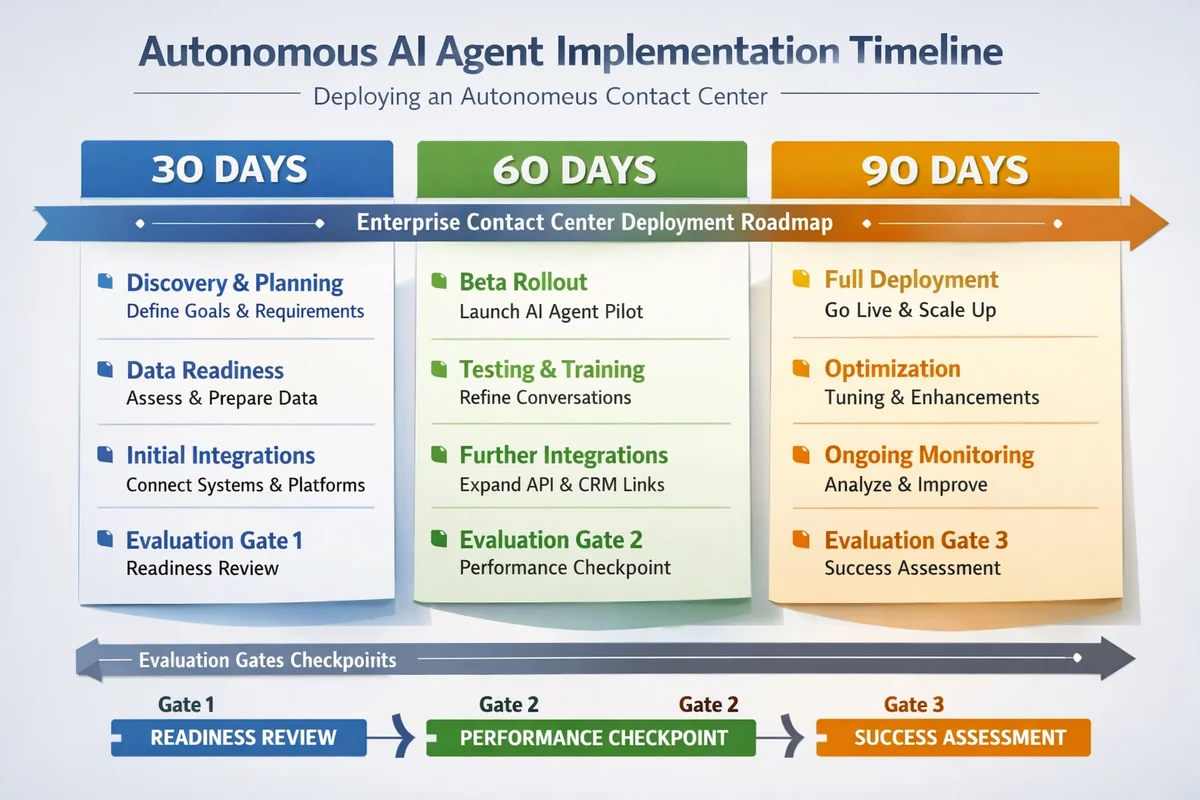
Days 0-30: pick the work, prove data readiness
- Choose 1-2 workflows with clear finish lines (refund status, ticket update, reschedule, candidate screen).
- Map knowledge sources and owners. Decide what the agent is allowed to answer vs must escalate.
- Baseline KPIs: current AHT, reopen rate, transfer rate, CSAT/CES, and top contact drivers.
- Draft the escalation taxonomy and “stop rules” (payment disputes, legal threats, self-harm, account takeover).
If you need a concrete model for reducing repeat contacts, see ai powered customer support.
Days 31-60: build autonomy, not dialogue
- Implement minimum integrations: CRM/ITSM, KB/RAG, identity provider, contact center routing, email gateway.
- Define tool permissions with least privilege (read-only vs write, refund caps, step-up verification).
- Build offline evaluation sets: “golden conversations” from historical tickets, translated where needed.
- Run channel-specific policy: voice barge-in handling, email thread memory, chat concurrency limits.
Days 61-90: controlled beta, then expansion
- Beta by queue, language, or customer tier. Use A/B testing for prompts and retrieval.
- Add voice and email once chat hits acceptance thresholds.
- Establish governance: weekly ops review, monthly policy review, quarterly security review.
A risk register you should maintain from day one:
- Stale knowledge: fix with refresh automation and “last updated” signals in responses.
- Hallucinations: require citations and refusal paths when grounding fails.
- Authentication failures: add step-up verification and safe fallbacks to human.
- Channel drift: keep one shared policy layer, then apply per-channel constraints.
- Compliance gaps: enforce retention rules, audit logs, and PII minimization.
PAA: How long does it take to implement conversational AI for enterprise? A production-grade rollout typically takes 6-12 weeks for a first queue if you include integrations, QA, and governance. “Two-week pilots” usually skip identity, tool permissions, and evaluation, which is why they stall when you try to scale to voice and email.
The measurement framework for LLM agents that executives can trust
Executives don’t trust conversational AI because teams report vanity metrics. Message count and “intent match rate” do not tell you if the agent completed work safely. The fix is a stacked measurement system: business outcomes, customer outcomes, agent quality, and safety, tracked per channel and per language.
Business metrics (what the CFO cares about)
- Containment/resolution rate with a quality gate (no reopen within X days)
- AHT impact for human agents (especially after handoff)
- Ticket reopen rate, transfer rate, and cost per resolution
- Conversion rate and revenue per contact for sales motions
- Interview throughput and time-to-shortlist for recruiting
Customer metrics (what brand and ops feel first)
- CSAT and CES, segmented by language and channel
- Complaint rate and escalation sentiment
- Multilingual parity: you don’t get credit for “50+ languages” if Arabic dialects perform worse
Agent quality metrics (what actually breaks autonomy)
- Task success rate (workflow completed end-to-end)
- Tool-call accuracy (right tool, right parameters, right timing)
- Groundedness or citation hit rate (answers supported by approved sources)
- Correct escalation rate with audited reason codes
- Policy violation rate (PII exposure, disallowed actions)
Execution detail that matters: build offline eval sets from real transcripts, then set acceptance thresholds before each rollout. After launch, run online tests per queue, per channel, per language to prevent regressions.
PAA: How do you measure the success of conversational AI customer service? Measure success by resolved outcomes: containment with quality gates, reopen rate, CSAT/CES, and cost per resolution. Then validate agent integrity with tool-call accuracy, groundedness, and correct escalation rate. If any of those fail, autonomy collapses even if chats look “fluent.”
If you’re evaluating voice-specific success criteria, align your metrics with voice ai for customer service.
Why Teammates.ai is the safest way to buy conversational AI for business outcomes
If your goal is autonomous workflows, the safest purchase is an agent that ships with managed operations. That is the gap most conversational ai companies avoid: accountability. Platforms sell infrastructure. Agencies sell build hours. Neither one owns your containment rate, your tool reliability, or your escalation correctness unless it’s explicitly a service with SLOs.
Teammates.ai is built around deployable agents plus a managed conversational AI service model:
- Raya: conversational ai for customer service that resolves tickets end-to-end across chat, voice, and email, with deep integrations (Zendesk, Salesforce, HubSpot) and Arabic-native dialect handling.
- Sara: an AI interviewer that runs structured interviews, adapts questions, and produces rankings and summaries.
- Adam: an AI sales agent that qualifies, handles objections, and books meetings over voice and email.
What I like about the agent-first approach is it forces the hard parts into the default product: integrated omnichannel routing, safe tool execution, and escalation that makes sense to a real contact center.
Security and compliance also stop being hand-wavy when you run it as a service:
- Least-privilege tool access for authenticated actions
- PII minimization and retention controls
- Audit trails for agent actions and handoffs
- Clear data handling boundaries suitable for conversational ai for enterprise
If you want to see what “end-to-end” means in practice, start with this explainer on an ai customer service agent.
Conclusion
A conversational AI platform can help you build. An agency can help you design. Neither reliably delivers autonomous workflows unless someone owns production operations: integrations, identity, tool-call accuracy, omnichannel routing, QA, and continuous evaluation.
My recommendation is simple: if you need measurable end-to-end resolution across chat, voice, and email, buy a managed conversational AI service with SLAs and runbooks, not a “build your own bot” project. That outcome-first model is exactly what Teammates.ai is designed to deliver with deployable agents for support, hiring, and sales.