
The Quick Answer
A sales acceleration platform is the system that reduces time and drop-off between lead arrival, first touch, qualification, and a committed next step. The right choice depends on your bottleneck: speed-to-first-touch, speed-to-qualification, or speed-to-close. Teammates.ai takes the next step with Adam, an autonomous agent that delivers 24-7 coverage plus execution across voice and email, with integrated CRM logging and objection handling.
You do not need more sales activity – you need less time between steps
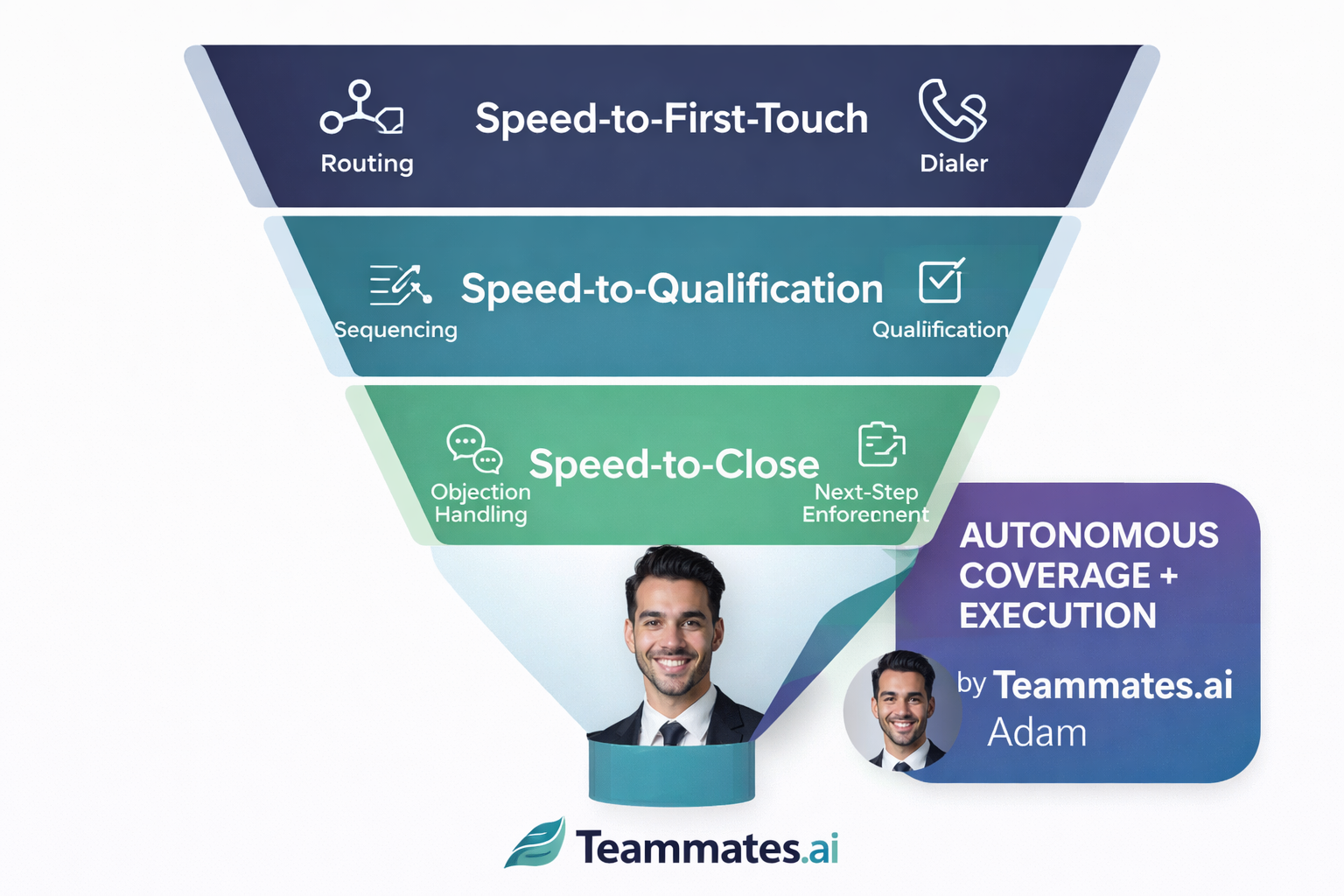
A sales org rarely loses deals because it lacks tools. It loses them because time leaks between steps: lead arrives, routing stalls, first touch slips, qualification varies rep to rep, and follow-up decays after touch three. Acceleration is the removal of those time gaps, measured as SLAs and funnel conversion, not “emails sent.”
The operator move is to instrument time-to-route, time-to-dial, and time-to-next-step, then build enforcement around them.
Two benchmarks that hold up across most B2B motions:
- Speed-to-lead: under 5 minutes routinely beats 30+ minutes on connect and conversion. That gap compounds when you run paid capture or high-intent inbound.
- Follow-up depth: most pipeline requires 6 to 8 touches across channels to create a real conversation, not a vanity reply.
Key Takeaway: If your platform cannot measurably shrink the time between lead arrival and first meaningful conversation, it is not accelerating revenue. It is decorating your workflow.
What a sales acceleration platform is when you define it by the bottleneck
A sales acceleration platform is only “good” relative to the exact point your funnel bleeds time. Define your bottleneck first, then buy the minimum capabilities to remove it. Otherwise you pay for features that look impressive and change nothing.
Bottleneck 1: speed-to-first-touch
This is the common failure mode for inbound, partner leads, and event lists.
Minimum viable capabilities:
- Lead routing with explicit SLAs (time-to-route, time-to-first-dial)
- Dialer plus email sequencing that can trigger immediately
- CRM writeback for every attempt (call outcome, email status)
What to measure:
- % leads touched within SLA (ex: 5 minutes for inbound)
- Connect rate by lead source and hour-of-day
- First meaningful conversation rate (not just “attempts”)
If you are evaluating outreach tooling, anchor here: outbound software matters when routing plus multi-channel execution is the gap.
Bottleneck 2: speed-to-qualification
If meetings happen but pipeline quality is poor, your bottleneck is qualification integrity.
Minimum viable capabilities:
- Structured qualification flows (fields, picklists, disqualifiers)
- Consistent objection handling playbooks
- Outcome logging that feeds scoring and routing
What to measure:
- Qualification pass-through rate (SQLs that hold up in AE discovery)
- Disqualifier capture rate (budget, timing, authority, non-fit)
- Objection resolution rate (how often “not now” becomes a scheduled next step)
This is where most teams fail quietly: they “qualify” in notes, not in structured CRM data. Then RevOps cannot build predictive lead scoring, and leadership can’t forecast. Use an actual objection handling framework and make the platform enforce the fields.
Bottleneck 3: speed-to-close
If your pipeline is real but deals stall, acceleration means enforcing next steps and tightening cycle time.
Minimum viable capabilities:
- Conversation intelligence (capturing commitments and risk)
- Next-step enforcement (mutual action plans, follow-up triggers)
- Coaching loops tied to outcomes (not call “scores”)
What to measure:
- Cycle length compression target: 10 to 20% is meaningful
- Stage conversion by objection type and competitor mention
- No-show rate and reschedule-to-held rate
Key Takeaway: You cannot “accelerate” close if your system only reports on calls. It must change behavior by enforcing next steps and logging structured outcomes.
Sales acceleration platforms vs sales engagement, revenue intelligence, CRM add-ons, and enablement
A clean taxonomy prevents expensive category mistakes. Sales acceleration platforms are execution systems that reduce time between funnel steps. Adjacent categories overlap, but they cap out differently.
Here is the straight-shooting view of what each category actually automates:
| Category | Primary job | Where it shines | Where it fails as “acceleration” |
|---|---|---|---|
| Sales acceleration platform | Removes time gaps between steps | Routing, first touch SLAs, qualification outcomes, next-step enforcement | If it can’t write back to CRM as system of record |
| Sales engagement tool | Helps reps run sequences | Multi-touch outbound workflows | Often optimizes volume, not SLA, integrity, or next steps |
| Revenue intelligence (conversation intelligence) | Creates insight from calls | Coaching, deal risk, talk tracks | Visibility without enforcement does not change cycle time |
| CRM add-ons / automation | Streamlines CRM workflows | Field updates, routing rules, alerts | Doesn’t execute outreach or handle objections |
| Enablement | Improves rep content and training | Playbooks, content, onboarding | Content does nothing if execution and follow-through decay |
Decision tree: choose your category by what you need to automate
Use this before you demo anything:
1) If your problem is “we didn’t touch it fast enough,” you need routing + dialer + sequencing with SLA tracking.
2) If your problem is “we touched it, but it’s junk,” you need qualification flows, disqualifiers, and enforced dispositions.
3) If your problem is “it sits in stage 2 forever,” you need next-step enforcement plus coaching tied to stage conversion.
Operator rule: if a tool cannot enforce a next step and write structured outcomes back into HubSpot or Salesforce, it is not a sales acceleration platform. It is a reporting layer.
Practical example: Teams adopt conversation intelligence, find “pricing” is the top objection, but nothing changes because no one operationalizes it into talk tracks, disposition fields, and follow-up sequences. Start with a library of how to handle objections in sales examples and require every objection to map to a coded outcome.
Where this ties back to our thesis: buying the wrong category feels productive because dashboards light up. But your bottleneck is still there, leaking time, leaking follow-up, and leaking attribution.
Meta description
sales acceleration platform for 2026: pick by funnel bottleneck, add autonomous execution, and prove ROI with clean CRM attribution. Use this guide.
Sales acceleration platform is the system that cuts lead-to-meeting time; teams that respond in under 5 minutes routinely beat 30+ minute follow-up on conversion. Teammates.ai is built for execution.
Introduction
You do not lose deals because your team lacks activity. You lose them in the dead time between steps: lead arrives, nobody routes it, nobody calls, nobody qualifies, and the “next step” becomes a hope.
Our stance is simple and disagreeable: a sales acceleration platform only works when you choose it around your bottleneck (speed-to-first-touch, speed-to-qualification, or speed-to-close). In 2026, the durable fix is autonomous coverage plus execution, not another feature checklist. You will leave with a decision model, an implementation plan, and an ROI template finance will accept.
A sales acceleration platform is a system that reduces time and drop-off between lead arrival, first touch, qualification, and a committed next step, and it should be judged by which funnel time leak it removes.
Here is the operator taxonomy. Pick one primary bottleneck, or you will buy a tool that “does everything” and improves nothing.
–Speed-to-first-touch: you win by hitting an SLA. Benchmarks that matter are time-to-route, time-to-dial, and time-to-first meaningful conversation logged in CRM. Under 5 minutes is a different game than 30+ minutes.
–Speed-to-qualification: you win by making qualification consistent. The metric is not “replies,” it is qualified meeting rate and disqualification correctness (did you capture why a lead is not a fit).
–Speed-to-close: you win by enforcing next steps. Think stage-to-stage cycle time, no-show rate, and whether every call ends with a date, time, and stakeholder plan.
Minimum viable capabilities by bottleneck:
- First-touch: lead routing + dialer + sequencing + calendar handoff.
- Qualification: structured qualification flows, objection handling, and CRM writeback of dispositions.
- Close: conversation intelligence, coaching loops, and next-step enforcement tied to pipeline stages.
Key Takeaway: acceleration is not volume. It is fewer minutes between “trigger” and “outcome,” repeated reliably.
These categories overlap, but they fail differently. If you buy the wrong category, you get visibility without movement, activity without learning, or data without follow-through.
Here is the straight-shooting taxonomy:
| Category | Primary job | Where it breaks | Best when your bottleneck is |
|---|---|---|---|
| Sales engagement | Execute rep-led outreach (sequences, dialer) | Rep capacity and follow-up decay | First-touch, light qualification |
| Revenue intelligence | Analyze conversations and pipeline risk | Insights with no enforcement | Speed-to-close coaching |
| CRM add-ons/workflow | Route, assign, validate data | Great plumbing, weak execution | Routing and data integrity |
| Enablement | Content, playbooks, training | Adoption and inconsistency | Messaging standardization |
| Sales acceleration platform (operator definition) | Reduce time between funnel steps and enforce outcomes | Any missing writeback or next-step enforcement | Any funnel leak that needs measurable SLAs |
Decision tree (choose your category by what you need to automate):
1.You need outreach sent and calls placed: start with engagement, but only if you can enforce next steps.
2.You need consistent qualification and outcomes: you need qualification flows plus structured CRM logging.
3.You need deal coaching and risk signals: revenue intelligence helps, but it will not fix missed follow-up.
4.You need routing and governance: CRM workflows are necessary, not sufficient.
Operator rule: if the tool cannot enforce a next step and write back structured outcomes to HubSpot or Salesforce as the system of record, it is not acceleration. It is reporting.
If your bottleneck is connect rate and multi-channel persistence, start by instrumenting your calling layer and sequencing together. A standalone dialer rarely fixes this; integrated motion does. See our take on outbound software for what “integrated” should actually mean.
How Teammates.ai Adam changes the category from acceleration to coverage plus execution
Legacy sales acceleration tools make reps faster. Teammates.ai Adam makes the motion autonomous: it runs outreach, handles objections, qualifies, books meetings, and logs everything to CRM with consistent structure, 24-7.
This matters because the real enemy is follow-up decay. Human teams degrade when inboxes pile up, when shifts end, when territories change, and when new reps ramp. Autonomous execution does not.
Practical example 1 (inbound, after hours):
– A demo request hits at 10:40 pm.
– Adam calls within 60 seconds, confirms intent, handles “send pricing” and “we need security review,” and books the meeting.
– Adam writes back: call outcome, objection tags, qualification fields, and the scheduled next step.
Practical example 2 outbound calling software (outbound list): – Adam runs personalized email examples at scale, then follows with voice.
– It applies a consistent objection handling framework so “not interested” becomes a structured branch, not a dead end.
– Outcomes are tagged for reporting: wrong ICP, timing, budget, competitor, no authority.
What to measure (not vanity metrics):
–Time-to-first-touch: median and 90th percentile.
–Qualification pass-through rate: % that meet your ICP gates.
–Meeting show rate: especially for meetings booked outside business hours.
Limitations: autonomy is overkill if you have low lead volume and a high-touch enterprise motion where every first call must be a senior AE. In that case, you still use the same principles, but deploy autonomy for routing, persistence, and pre-qualification.
Integration architecture, data model, and compliance that actually holds up in regulated environments
Autonomous execution only holds up when CRM is the system of record, outcomes are structured, and compliance is designed up front. If you bolt on logging later, you will not trust your attribution, and legal will pause the rollout.
Reference architecture (works for HubSpot and Salesforce):
– Teammates.ai as the execution layer.
– CRM as source of truth for leads, contacts, accounts, opportunities.
– Engagement objects written back: calls, emails, tasks, meetings.
– Outcome fields: disposition, objections, qualification gates, next step date.
Data hygiene rules that prevent garbage-in, garbage-out:
– Required fields for ICP: role, company size, region, use case.
– Standardized dispositions (no free-text outcomes).
– Dedupe logic and ownership rules before any sequence starts.
– Clear enrichment boundaries: what is sourced, what is inferred, what is user-provided.
Compliance checklist you can hand to security and legal:
– Call consent handling appropriate to jurisdiction, plus recording on/off controls.
– Retention policies for recordings and transcripts, with deletion workflows.
– Access controls by role, and audit logs for every activity.
– GDPR/CCPA support: data subject requests, purpose limitation, and redaction paths.
This same foundation is why autonomy works in adjacent Teammates.ai motions, like Raya in support and Sara in interviews: consent, retention, and auditability are not optional features.
Implementation playbook for the first 30, 60, and 90 days with adoption KPIs
Acceleration fails at rollout, not at procurement. The common failure pattern is launching “company-wide” before routing, data fields, and messaging guardrails are stable, then blaming the tool when reps and RevOps stop trusting the data.
Day 0 prerequisites (do not skip):
– ICP and routing rules (including after-hours logic).
– Objection library and messaging guardrails.
– Calendar, CRM permissions, and activity writeback mapping.
– Security review: retention, consent, access.
1) First 30 days (pilot one segment)
– One list or inbound source, one motion.
– Tight QA loop on transcripts, dispositions, and meeting quality.
– Baseline metrics: SLA attainment, connect rate, qualified meeting rate.
2) 60 days (scale and standardize)
– Expand segments, add voice if you started with email.
– Standardize templates and outcome taxonomy.
– Add lead scoring feedback loops (structured outcomes power scoring). If you are using HubSpot, connect this to predictive lead scoring hubspot style inputs.
3) 90 days (optimize and govern)
– A-B tests on scripts, timing, and objection branches.
– SLAs with alerting: % touched within 5 minutes, and 90th percentile.
– Weekly RevOps review: disposition completeness, meeting show rate, pipeline created.
Adoption KPIs that predict revenue:
– % leads touched within SLA
– % activities logged with complete outcomes
– Meeting show rate
– Objection resolution rate
Stakeholders: RevOps, Sales Ops, IT, Security, Legal, and the sales leader who owns the SLA.
ROI model for a sales acceleration platform that finance will sign off on
Finance signs off when you tie leading indicators to pipeline, and you can prove attribution in CRM. “More activity” is not a business case. Faster contact, higher qualification integrity, and better show rates are.
Baseline vs target (leading indicators):
– Speed-to-first-touch (median, 90th percentile)
– Connect rate (voice) and reply rate (email)
– Meetings set per lead
– Qualification pass rate
– No-show rate
Lagging indicators:
– Pipeline created
– Win rate
– ACV
– Cycle length
– Cost per qualified meeting
Sample calculator (edit to your numbers):
| Input | Baseline | Target | Notes |
|---|---|---|---|
| Leads/month | 1,000 | 1,000 | Same volume |
| % within 5-min SLA | 25% | 80% | Routing + execution |
| Qualified meeting rate | 2.0% | 3.5% | Better speed + qualification |
| Win rate | 20% | 20% | Keep constant for honesty |
| ACV | $12,000 | $12,000 | Keep constant |
Attribution that works:
– Cohort by segment and source, not by rep anecdotes.
– Use holdouts: route a slice to your existing motion.
– Control seasonality by running 30 days minimum.
– Require CRM writeback for every touch and outcome, or the experiment is invalid.
Key Takeaway: the ROI comes from raising the numerator (qualified meetings, pipeline) while controlling the denominator (cost per touched lead) through autonomous coverage.
FAQWhat is a sales acceleration platform?
A sales acceleration platform is a system that reduces time and drop-off between lead arrival, first touch, qualification, and a committed next step. The proof is in SLAs and CRM outcomes, not “activity.” If it cannot write back structured data, it is not acceleration.
What is the difference between a sales engagement platform and a sales acceleration tool?
A sales engagement platform helps reps execute sequences and calls. A sales acceleration tool, done right, enforces outcomes across the funnel: routing, qualification integrity, next-step commitment, and clean CRM logging for attribution. Engagement is execution assistance. Acceleration is funnel time compression.
How do you measure sales acceleration?
You measure sales acceleration with leading indicators that predict pipeline: time-to-first-touch, connect rate, qualified meeting rate, qualification pass-through, and no-show rate. Lagging confirmation is pipeline created and cycle length. Reply rate alone is a vanity metric.
Are autonomous agents safe for regulated outreach?
Autonomous agents are safe when consent handling, retention policies, access controls, and audit logs are designed into the deployment. The risky setup is unstructured notes, missing call recording controls, and no deletion workflow. Regulated teams should require CRM writeback and auditable dispositions.
Conclusion
You do not need another checklist-driven sales acceleration platform. You need a platform selected around your bottleneck, instrumented with SLAs, and built to enforce outcomes.
- Pick one bottleneck: first-touch, qualification, or close.
- Require structured CRM writeback for clean attribution.
- Roll out in 30/60/90 with adoption KPIs, not vibes.
- Model ROI off leading indicators that finance trusts.
If you want the 2026-standard approach, choose autonomous coverage plus execution. That is exactly what Teammates.ai delivers with Adam.