
VAD is not a DSP detail It is a queue multiplier

Bad voiceactivitydetection does not fail gracefully. It silently adds friction to every turn: the caller finishes, your system waits, the caller repeats, your system interrupts, then escalation triggers because “the AI feels broken.” In an autonomous contact center, that is not a model issue. It is the turn-taking system leaking time.
You do not lose performance from bad intent detection first. You lose it from bad turn boundaries.
Here is what endpointing errors break in practice:
- When a caller answers quickly, late onset detection misses the first phoneme and forces a reprompt.
- When a caller hesitates, aggressive offset cuts them off and trains them to overtalk.
- When the line is noisy, a high threshold turns breathing and quiet speech into “silence,” stretching flows like address capture.
- When the agent is speaking, weak barge-in keeps TTS running and the caller abandons.
A 200-400 ms offset error is not a rounding error. It is a queue multiplier because it happens at every turn. A typical support call has 12-20 turns even before you hit troubleshooting. Add 300 ms of “wait to be sure they are done” across 15 turns and you just injected 4.5 seconds of dead air. Multiply that by thousands of calls and you are buying extra seats with your latency.
This is why we treat endpointing as a first-class system KPI across Teammates.ai products. Raya (autonomous customer service across ai chat companies voice, chat, and email), Sara (autonomous interviews), and Adam (autonomous sales outreach) all depend on the same core capability: detecting when the human has the floor, fast.
How endpointing delay turns into longer talk-time and higher abandonment
Key Takeaway:
Endpointing delay becomes handle time because it sits on the critical path between “customer stopped talking” and “system does the next thing.”
In high-volume queues, small per-call inflation increases occupancy, pushes wait times up nonlinearly, and abandonment follows.
A practical model that holds up in production reviews:
Added time per turn is approximately:
added_ms = max(0, offset_delay_ms - natural_pause_ms) + hangover_ms
–offset_delay_ms: how late you declare “speech ended.”
–natural_pause_ms: the pause a human naturally leaves before expecting a response (often 150-250 ms in phone speech).
–hangover_ms: extra time you keep speech “on” to avoid chopping trailing phonemes.
Example math (conservative):
- offset delay: 350 ms
- natural pause: 200 ms
- hangover: 150 ms
Added per turn = max(0, 350-200) + 150 = 300 ms.
Now scale it:
- 12-turn call: +3.6 seconds
- 20-turn call: +6.0 seconds
That is just the “waiting to respond” tax. It excludes the downstream effects that operators actually feel:
–Reprompts when onset detection misses initial words (caller repeats, ASR confidence drops).
–Overtalk when your TTS starts while the caller is still finishing (they get louder, you get worse audio).
–Escalations triggered by “no response detected” watchdog timers.
Where the delay really comes from (this is why “VAD F1” is a trap):
- Frame windowing and hop size (your system can only decide on boundaries it samples).
- Smoothing (moving averages reduce jitter but add reaction time).
- Look-ahead (great for accuracy, brutal for real-time).
- Hangover logic (prevents clipping but adds tail latency).
- Coupling to ASR partials (teams often wait for ASR stability instead of committing to an endpoint).
If you are automating flows like authentication, address capture, troubleshooting steps, and payment disputes, these pauses stack. The caller perceives “the AI is thinking,” not “the VAD is cautious.”
CFO-friendly translation:
- A few seconds of added talk-time increases required staffing because occupancy rises.
- Higher occupancy increases average speed of answer, which drives abandonment.
- Abandonment creates repeat contacts, which inflates volume and creates a self-inflicted surge.
If you want the rest of the automation stack to work, treat turn-taking as a system constraint. That includes how your ai intent routing logic triggers prompts and when it decides to escalate.
How we evaluate voice activity detection properly at Teammates.ai
Voiceactivitydetection evaluation that ignores time is actively misleading. We evaluate VAD the same way we evaluate any contact-center-critical system: by measuring how its errors translate into missed barge-in, cut-offs, and latency added to the response path.
The metrics we actually use (and why)
A single F1 score can look great while your agent still talks over customers. You need a metric set that exposes timing behavior:
–Frame-level precision/recall/F1: good for gross speech vs non-speech separation.
–Segment-level precision/recall: did you find the right speech regions.
–Onset error distribution (ms): how late or early you detect speech start.
–Offset error distribution (ms): how late or early you detect speech end.
–DET curve or threshold sweep: shows the trade-off surface instead of one operating point.
–Latency-aware cost: weight false rejects during barge-in higher than false accepts during silence.
Definition you should align on internally:A collar is a tolerance window around boundaries (for example 200 ms) where minor misalignment is not counted as an error. Collars are useful, but they can hide exactly the 200-400 ms that destroys barge-in. We report with and without collars.
Evaluation protocol checklist (what breaks benchmarks)
Most VAD eval failures come from protocol sloppiness, not models.
- Label at the granularity you deploy (frame vs segment).
- Declare collar size explicitly and justify it (telephony UX is not a 500 ms collar world).
- Control class imbalance (silence dominates, accuracy lies).
- Normalize sampling rate (8 kHz PSTN vs 16 kHz wideband is not interchangeable).
- Report by conditions: SNR bands, noise types, codec artifacts, and double-talk.
Common pitfalls we see when auditing systems:
- Optimizing global F1 while barge-in fails because onset recall under overlap was never measured.
- Using one threshold for every language, channel, and geography.
- Evaluating only on clean headset speech, then deploying to real PSTN.
- Leaking speakers or call sessions between train and test.
Reproducible streaming benchmark template
This is the minimum viable harness to stop arguing and start measuring.
# Pseudo-code: simulate streaming VAD with fixed frame/hop and optional look-ahead


<div class="aeo-question-wrapper" itemscope itemtype="https://schema.org/Question" style="margin-bottom: 25px;">
    <meta itemprop="name" content="What is Voice Activity Detection as a Product Lever for Autonomous Contact Centers?">
    <div class="aeo-answer-box" itemprop="acceptedAnswer" itemscope itemtype="https://schema.org/Answer" style="background-color: #f9f9f9; border-left: 4px solid #0047AF; padding: 20px; border-radius: 12px; box-shadow: 0 4px 6px rgba(0,0,0,0.05); border: 1px solid #e1e4e8;">
        <p style="margin-bottom: 10px; color: #0047AF; font-weight: bold; text-transform: uppercase; font-size: 0.85rem; letter-spacing: 0.05em;">The Quick Answer</p>
        <p itemprop="text" style="font-size: 1.1rem; line-height: 1.6; color: #1a1a1a;">Voiceactivitydetection is the system that decides when a caller is speaking and when they stopped. In high-volume autonomous contact centers, 200-400 ms of endpointing delay compounds into longer handle time, worse barge-in, and higher abandonment. Evaluate VAD with onset and offset error plus latency-aware metrics, then tune streaming buffers, hangover, and multilingual thresholds. Teammates.ai treats VAD as a product KPI across Raya, Sara, and Adam.</p>
    </div>
</div>

frames = stream(audio, frame_ms=20, hop_ms=10) # match production
for thr in thresholds:
 state = "non_speech"
 events = []
 for t, frame in enumerate(frames):
 p = vad_model(frame) # speech probability
 state = hysteresis(state, p, thr_on=thr+0.1, thr_off=thr-0.1)
 state = apply_hangover(state, hangover_ms=200)
 events.append((t, state))
 report(events, labels,
 onset_err_ms=True,
 offset_err_ms=True,
 by_snr=True,
 overlapped_speech=True)
Threshold selection is policy, not math. If your autonomous agent prioritizes barge-in, you bias toward higher onset recall even if you accept more false alarms. If escalation is expensive, you bias toward fewer false “no speech” timeouts. At Teammates.ai we tie that choice to the same business outcomes we track for ai intents and containment, because endpointing and routing are one system.
Pro-Tip: If your VAD vendor cannot show onset and offset error percentiles (p50, p90) under telephony noise and double-talk, they are not selling you a production component. They are selling you a demo metric.
Voiceactivitydetection is the real-time system that decides who has the floor; a 200-400 ms endpointing error adds seconds per call, and Teammates.ai treats that as a product KPI, not plumbing.
You do not lose automation performance from bad intent detection first. You lose it from bad turn-taking. When callers interrupt, hesitate, or speak over TTS, the first failure is almost always endpointing: the agent talks too early, too late, or never hears the barge-in.
A 200-400 ms offset delay feels minor in a lab. In a high-volume autonomous contact center it compounds across every turn, inflates occupancy, and pushes borderline queues into abandonment. That is why Teammates.ai engineers endpointing as UX across Raya (support), Sara (interviews), and Adam (sales) rather than as a standalone signal-processing component.
What this breaks in practice:
– Customers start repeating themselves because the agent responded mid-sentence.
– Barge-in fails because onset is detected late, so TTS keeps talking.
– Authentication and address capture drag because silence is misread as “done.”
– Escalations spike because the agent “sounds dumb,” even when intent models are fine.
How endpointing delay turns into longer talk-time and higher abandonmentKey Takeaway: Offset delay is paid like interest. Every extra 200-400 ms at the end of a user turn becomes dead air, late responses, and queue-time amplification when you run at real occupancy.
A simple model that matches what operators see:
Added time per turn ≈ max(0, offset_delay – natural_pause) + hangover
Example: if natural pause is ~200 ms and your offset delay is 450 ms, you are adding ~250 ms plus any hangover (often 150-300 ms). Call it ~450-550 ms per user turn.
Now do the math:
– 12-turn call: +5-7 seconds of pure waiting
– 20-turn call: +9-11 seconds
That is before you count the second-order effects: customers re-speaking, the agent missing the start of a sentence, and the extra clarifying questions that come from clipped audio.
Where the delay actually comes from (not the marketing spec):
– Frame windowing and hop size (you can’t decide before you observe).
– Smoothing and hangover (added to avoid chattering).
– Look-ahead (used to reduce false cuts, but it is latency).
– ASR coupling (waiting for partials or end-of-utterance signals).
Queue impact is nonlinear. At high utilization, small per-call inflation increases average wait sharply. That translates directly into abandonment and lower containment, even if your “AI accuracy” scores look great.
Good voiceactivitydetection evaluation is not a single F1 score. You need latency-aware metrics that price onset and offset errors the way your P&L experiences them: barge-in success, talk-over rate, and average handle time.
What we report (frame and segment level):
– Precision/recall/F1 for speech frames
– Segment miss/false-alarm rates with an explicit collar (for example, 100-200 ms)
– Onset error distribution (p50, p90, p99)
– Offset error distribution (p50, p90, p99)
– DET curves or threshold sweeps per channel condition
– Latency cost metric: (w_onset * onset_ms) + (w_offset * offset_ms) + (w_FA * false_alarm) + (w_FR * false_reject)
Evaluation protocol checklist that prevents self-inflicted wins:
– Label granularity: frame labels for detection, segment boundaries for endpointing.
– Class imbalance: silence dominates. Report per-class metrics, not just accuracy.
– Collar size: choose it based on user tolerance, not convenience.
– Sampling-rate normalization: 8 kHz telephony vs 16 kHz wideband shifts energy and features.
– Report by SNR band and noise type (office noise, car noise, call-center floor, codec artifacts).
Common pitfalls we see in production rollouts:
– Optimizing F1 while destroying barge-in (high hangover hides errors).
– Using one global threshold for every language, codec, and geography.
– Evaluating only clean datasets, then deploying into PSTN compression.
– Leakage: same speakers or same call legs in train and test.
Reproducible streaming benchmark template (pseudo-code):
for condition in conditions: # language, snr_band, codec
 for thr in thresholds:
 state = init_streaming_vad(thr, hangover_ms, hyst)
 for chunk in stream(audio, chunk_ms=20):
 p = vad_prob(state, chunk)
 decision = apply_hysteresis_and_hangover(state, p)
 log_frames(decision)
 report_metrics(decisions, labels,
 collar_ms=150,
 onset_stats=True,
 offset_stats=True)
select_threshold = argmin(latency_cost)
Threshold selection guidance: if barge-in is a product promise, weight false rejects (missed onset) higher than false accepts. If compliance requires not recording non-speech, weight false accepts higher and accept slightly longer endpointing.
Real-time deployment engineering that makes VAD work in production
A VAD model that “tests well” still fails if streaming engineering breaks the latency budget. You need explicit control over frame length, buffering, hangover, and how telephony chunking interacts with endpointing.
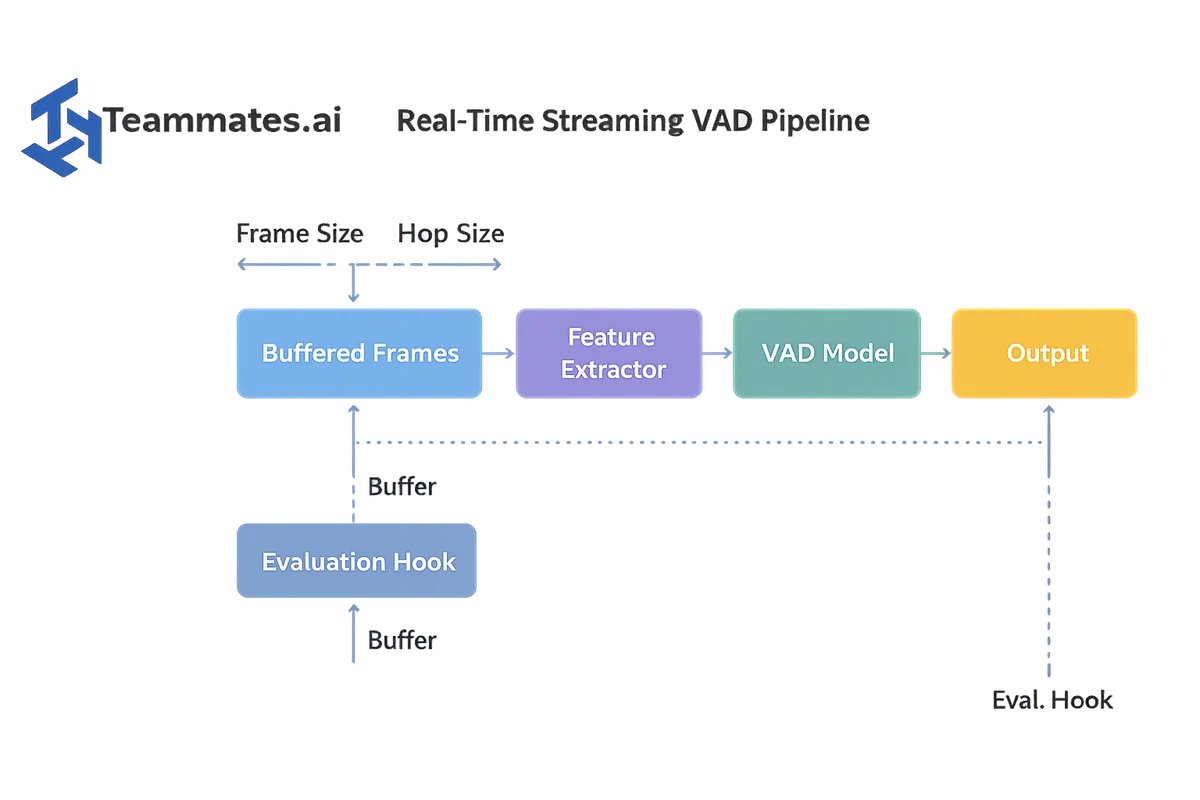
At a glance, the knobs that decide success:
– Frame size: 10-30 ms (shorter reacts faster, noisier decisions)
– Hop size: often equals frame size in streaming
– Hysteresis: different thresholds to enter vs exit speech
– Hangover: keep speech “on” for N ms after probability drops
– Optional look-ahead: reduces clipping, costs latency
Compute algorithmic latency explicitly:
Algorithmic latency ≈ frame_length + look_ahead + input_buffer + (hangover contribution at offset)
Concrete telephony budget example:
– 20 ms frames
– 0 ms look-ahead
– 40 ms jitter buffer
– 200 ms hangover
Onset latency is typically ~60-80 ms (frame + buffer). Offset latency is typically ~260+ ms (buffer + hangover), before any ASR endpointer.
Chunking reality:
– PSTN often arrives as 20 ms packets at 8 kHz.
– WebRTC can vary, with jitter and packet loss.
– Over-buffering to smooth jitter directly harms barge-in.
Resource budgeting matters at concurrency:
– CPU per stream must be predictable. Batching saves compute but can harm single-stream responsiveness.
– RAM for ring buffers and feature history grows with look-ahead and long hangovers.
Optimization playbook that holds up:
– Keep the hot path out of Python. Use optimized runtimes (ONNX Runtime, TFLite).
– Quantize if CPU-bound, but re-check onset misses.
– Add per-stage timers: decode, resample, features, model, post-processing.
Integration rule: VAD must coordinate with ASR partials and intent detection. We treat turn boundaries as a shared contract so Raya can respond fast without cutting off callers, and Adam can handle interruptions without talking over objections.
Tuning VAD for barge-in and multilingual callers
Barge-in is detecting user speech onset while the agent is speaking and deciding when to stop TTS cleanly. If you tune VAD only on clean single-speaker audio, your “autonomous” agent will talk over customers the moment you scale.
Practical tuning knobs that actually move the needle:
– Separate thresholds for onset vs offset (hysteresis). Lower onset threshold for faster barge-in.
– Adaptive noise floor: update during agent TTS segments to avoid treating TTS leakage as user speech.
– Hangover tuning: shorter for responsiveness, longer for choppy channels.
– Action gating: require 2-3 consecutive speech frames before hard-stopping TTS.
Multilingual reality: pause patterns and prosody differ across languages and dialects, especially with code-switching. Arabic dialects, for example, can shift vowel energy and pause timing compared to English. Treat “one threshold fits all” as a defect.
Edge cases that trigger expensive failures:
– Laughter, breaths, fillers (“uh,” “mm-hm”), and backchannels
– Music on hold and TV audio
– Cross-talk and overlapped speech
What works at scale is policy plus signal: treat low-confidence onset as “duck TTS volume,” not “stop and apologize.” Escalation policies should also respect turn-taking, which is why Teammates.ai ties endpointing to ai intent and routing outcomes.
Data and domain mismatch Decide calibrate fine-tune or retrain
Domain mismatch is why a good VAD collapses on your calls. Telephony codecs, sampling rate, call-leg mixing, and background noise change the feature distribution more than most teams expect.
Decision tree (what you’re actually buying):
– Energy VAD: cheap, fast, fails with noise and music.
– ML VAD: robust, needs calibration, costs CPU.
– Hybrid: energy gate + ML confirm, best for tight latency budgets.
Start with calibration, then escalate effort:
1. Threshold calibration per channel (8 kHz PSTN vs 16 kHz VoIP) and per SNR band.
2. Fine-tune if misses are systematic (for example, consistent onset misses for a language or geo).
3. Retrain if the channel changes materially (new codec, new device mix, far-field).
How much labeled data you need: targeted clips beat giant generic corpora. Label short segments around boundaries (onset and offset) because that is where business cost concentrates.
Augmentation that maps to real traffic:
– Noise and reverb matched to your environments
– Codec simulation (telephony compression artifacts)
– Sampling-rate mismatch handling (train and test at 8 kHz if that’s your dominant path)
Active learning loop:
– Log “hard” clips: barge-in failures, repeated user turns, high overlap.
– Prioritize by model disagreement across thresholds.
– Label with consistent collars.
– Redeploy fast, with audit trails for changes.
Privacy and compliance: VAD can enable data minimization by retaining speech-only regions instead of full calls. That reduces exposure without weakening QA, as long as you validate that non-speech retention policies do not harm investigations.
Teammates.ai turns VAD into a system KPI for Raya Sara and Adam
Teammates.ai does not ship chatbots, assistants, or copilots. Each Teammate (Raya, Sara, Adam) is a network of specialized AI Agents, and voiceactivitydetection is one of the system-critical agents because it enforces turn-taking under real latency budgets.
Our integrated approach is the point: endpointing is tied to intent detection, routing, and escalation so you do not “win” a VAD benchmark and still lose containment. If your VAD shifts, your intention detection and downstream policies shift with it.
Security and operational controls we treat as default:
– Controlled-environment processing options
– Speech-only retention policies for minimization
– Audit trails for threshold and model updates
– Regional controls for regulated deployments
If you want a practical starting point, baseline your current endpointing with three numbers: p90 onset error, p90 offset error, and barge-in success rate. Then tie those to handle time and abandonment. That is the same discipline we apply when building artificial intelligence for customer experience that holds up at scale.
Troubleshooting: fast diagnostics before you touch the model
Most “VAD model problems” are deployment or policy problems. Run these checks before fine-tuning.
- If barge-in fails, measure jitter buffer + frame length first. You may be buffering away your onset.
- If callers get cut off, reduce look-ahead and hangover, then add hysteresis.
- If music triggers speech, add a music detector gate or tighten onset confirmation frames.
- If one language performs worse, calibrate thresholds per language profile before retraining.
FAQ
What is voice activity detection?
Voice activity detection is a system that labels audio as speech or non-speech in real time so applications can segment utterances, trigger ASR, and manage turn-taking.
How does VAD reduce latency in a contact center?
VAD reduces latency by ending user turns quickly and enabling fast agent responses. The win is not “detection accuracy,” it is lower onset and offset error under your streaming buffer and hangover settings.
What metrics should I use to evaluate voiceactivitydetection?
Use precision/recall/F1 plus onset and offset error distributions (p50/p90/p99) with an explicit collar, and report results by SNR band and channel. Add a latency-aware cost metric that weights barge-in misses and late endpointing.
Why does VAD fail in noisy or multilingual calls?
VAD fails because domain mismatch shifts energy and spectral cues: codecs, 8 kHz sampling, background noise, overlap, and different pause patterns across languages. Calibration per channel and SNR band fixes many issues before fine-tuning.
Conclusion
Voiceactivitydetection is a product and revenue lever because it controls turn-taking, and 200-400 ms of endpointing error compounds into longer handle time, worse barge-in, and higher abandonment. Evaluate it with onset and offset distributions plus latency-aware cost, then engineer streaming buffers, hangover, and multilingual thresholds as part of one real-time budget. If you want autonomous contact center outcomes that hold up across languages and noisy telephony, treat endpointing as a first-class KPI. That is how Teammates.ai builds Raya, Sara, and Adam.