
Customer support bots that actually resolve issues, not deflect, are designed to handle full ticket closure with a 30% reduction in handoff rates. These bots utilize triage, guided flows, and authenticated actions across chat, voice, and email for effective resolution.
The Quick Answer
Customer support bots underperform when they optimize for containment but still hand off most issues with lost context. The fix is to measure the handoff tax and move up a capability ladder: triage, guided flows, authenticated actions, and full ticket closure across chat, voice, and email. Teammates.ai is built for this autonomous multilingual contact center model with safe integrations, smart escalation, and ROI tied to resolved outcomes.

Customer support bots underperform when they optimize for containment but still hand off most issues with lost context. The fix is to measure the handoff tax and move up a capability ladder: triage, guided flows, authenticated actions, and full ticket closure across chat, voice, and email. Teammates.ai is built for this autonomous multilingual contact center model with safe integrations, smart escalation, and ROI tied to resolved outcomes.
Here’s my stance: containment is a vanity metric for customer support bots. If your bot can’t authenticate, take real actions, and close the ticket, it will “look” successful while quietly increasing total support cost via re-asks, longer handle time, and repeat contacts. This piece shows how to price that handoff tax, and the capability ladder that gets you from deflection to end-to-end resolution.
Why most customer support bots underperform and how the handoff tax eats your ROI
Key Takeaway: Most customer support bots fail financially because they optimize for “not talking to an agent” instead of “resolved with no recontact.” The hidden cost shows up after escalation: the customer repeats themselves, the agent hunts for context, and the ticket reopens two days later.
The handoff tax is the combined cost of:
– Repeated questions (agent re-asks what the bot already collected)
– Lost or unusable context (no structured summary, no extracted fields)
– Longer AHT (agent spends time reconstructing the problem)
– Lower CSAT after escalation (customers feel bounced)
– Higher recontact rate (the real killer)
The standard failure pattern looks like this:
– Dashboard says: “35% containment.”
– Ops reality says: “Half of those were dead ends or ‘contact us’ deflections.”
– Finance reality says: “Cost per resolved ticket didn’t move, and recontacts went up.”
What you can measure this week (no new tooling)
You don’t need perfect instrumentation to expose the tax. Pull a sample of escalated conversations across chat, voice, and email and measure:
– Customer turns before escalation (more turns with no action = bot friction)
– Agent re-ask rate: did the agent ask for order ID, email, or issue summary again?
– Time-to-context: how long before the agent understands “what happened”?
– Escalations without summary: any handoff missing intent, entities, and next step
Omnichannel makes this worse. A bot that “contains” in chat but escalates to email without carrying the context forces the customer to retype everything. Then the human escalates to voice, and the customer repeats it again. This is why integrated omnichannel conversation routing matters more than most teams admit.
PAA: Are customer support bots worth it?
Customer support bots are worth it only when they reduce cost per resolved ticket without increasing recontact. If a bot deflects conversations but creates more escalations, longer AHT, or repeat contacts, you just moved cost around. The ROI shows up when bots can take authenticated actions and close tickets.
The capability ladder from bots to autonomous agents
A bot becomes a growth lever when it climbs a ladder: triage -> guided flows -> authenticated actions -> full ticket closure. Each rung reduces handoff tax because you remove the “now a human has to redo everything” failure mode.
Stage 1: Triage that actually helps agents
Triage is not “pick a menu option.” Good triage does four things reliably:
– Intent detection and routing (billing vs delivery vs technical)
– Language detection (critical for multilingual customer support)
– Entity capture (order ID, email, device model)
– A clean, structured summary for the agent
If you stop here, you’re still paying humans to resolve. The win is reduced time-to-context and fewer transfers. This is also where most teams should start, because it’s low risk.
Stage 2: Guided flows for repeatable issues
Guided flows handle the boring, high-volume work: troubleshooting steps, policy explanations, and eligibility checks.
What actually works at scale:
– Step-by-step scripts with “if this, then that” branching
– Tone control (calm, concise, not overly cheerful)
– Failure recovery (when the customer can’t find an order number, the bot offers alternatives)
This is where you’ll want a solid knowledge strategy and QA loop. A stale KB turns “guided flows” into confident nonsense. If you’re building towards an Autonomous Multilingual Contact Center, this is also where language-specific QA stops being optional.
Stage 3: Authenticated actions (where ROI starts)
Customer support bots don’t resolve tickets end-to-end until they can take real actions in your systems:
– Order lookup and status updates
– Address changes
– Password resets
– Subscription cancellation or plan changes
– Refund initiation (with policy constraints)
– Appointment rescheduling
The gating item is identity. Your bot needs a pattern like:
– Magic link verification for web
– OAuth in your app
– Session tokens for authenticated chat
– Step-up checks for risky intents (refunds, PII changes)
If you’re not doing authenticated actions, you’re mostly doing conversational UX, not support automation.
Stage 4: Full ticket closure (the standard to hold yourself to)
End-to-end resolution means the agent can:
– Solve the problem
– Document the resolution
– Apply tags and disposition codes
– Update CRM/helpdesk
– Confirm outcome with the customer
Autonomous agents do that with audited escalation when needed. This is what Teammates.ai builds toward with progressive autonomy across chat, voice, and email, and with Arabic-native multilingual quality that doesn’t collapse into translation-grade support.
PAA: What is the difference between a chatbot and an AI agent in customer support?
A chatbot answers questions and routes conversations. An AI agent completes tasks end-to-end: it can authenticate the customer, read and write to systems like Zendesk or Salesforce, execute approved actions (refunds, password resets), and close the ticket with documentation. The difference is operational authority, not tone.
Natural next step
If you’re trying to eliminate repeat contacts, don’t stop at “good conversations.” Build toward ai powered customer support where outcomes are measured in resolution and recontact, not messages handled.
Measurement and ROI framework for customer support bots that goes beyond containment
Containment is easy to game. Resolution is not. Your measurement system should force honesty by separating “bot talked” from “ticket closed and stayed closed.”
KPI tree you can defend in a board meeting
Track these in one view, by channel and language:
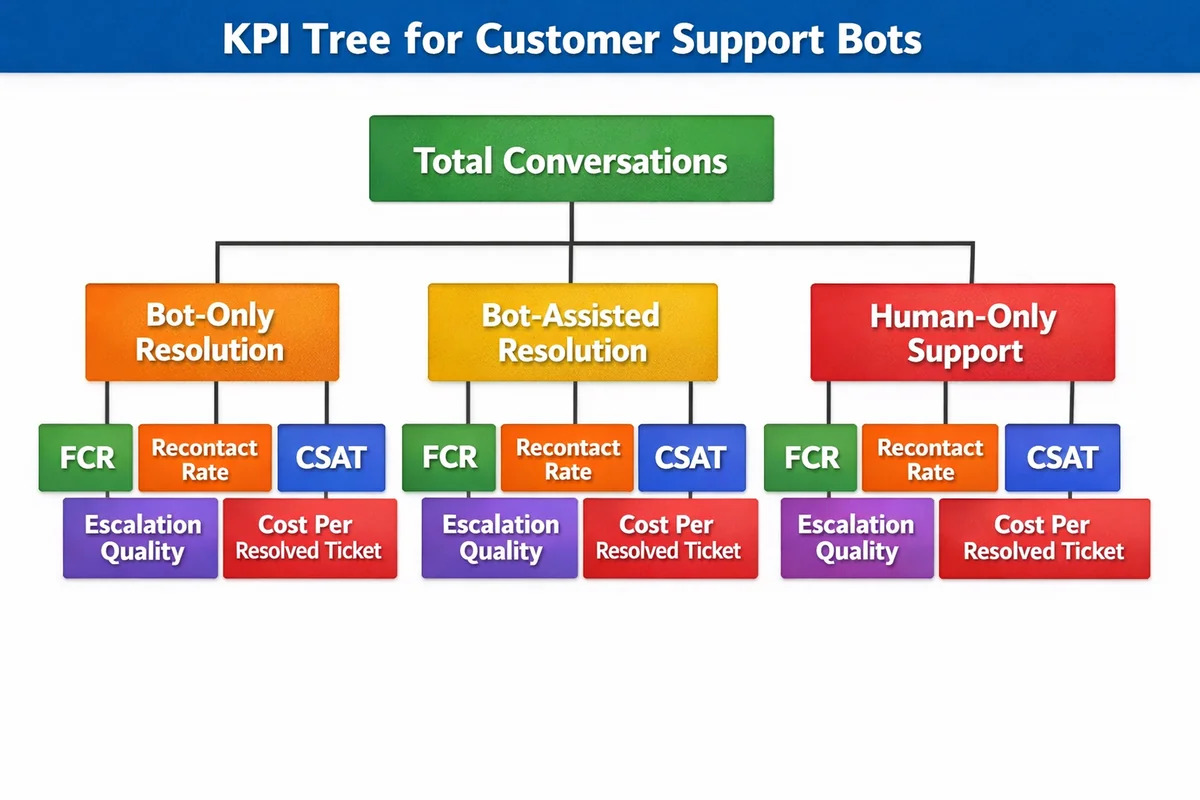
– Containment rate = conversations not escalated / total conversations
– True resolution rate (bot-only) = bot-closed tickets / total conversations
– Bot-assisted resolution rate = tickets closed by humans after bot prework / total
– FCR (first contact resolution) = resolved with no follow-up within N days
– Recontact rate = repeat contacts within N days / resolved tickets
– AHT impact = baseline AHT – post-bot AHT (for escalations)
– CSAT by segment (especially escalated vs bot-only)
– Escalation quality score (did the handoff include summary + fields + next step)
– Cost per resolved ticket (the KPI that matters)
The handoff tax formula (simple and brutal)
You want a number you can price.
Handoff tax per escalated ticket = (agent re-ask time + time-to-context + extra contacts time) x fully loaded cost per minute
If you do nothing else, compute this on a 100-ticket sample. It will change what you prioritize.
Attribution rules that prevent self-deception
Label every outcome as:
– Bot-only
– Bot-assisted
– Human-only
Do not credit “deflection” as resolution. If the bot says “contact support” or “wait for an agent,” that’s not containment. That’s a bounce.
Instrumentation events you need (minimum viable)
If you can’t see these events, you can’t tune safely:
– intent_detected, confidence_score
– language_detected
– auth_started, auth_success, auth_failed
– action_attempted, action_executed, action_blocked
– escalation_trigger (low confidence, high-risk intent, sentiment, repeat failure)
– ticket_created/updated/closed
Add guardrails as metrics, not vibes:
– hallucination rate (audited)
– policy violations
– unsafe action attempts
– incorrect account access attempts
PAA: How do you measure the success of customer support bots?
Measure success by cost per resolved ticket with a recontact penalty, not containment. Track true bot-only resolution, bot-assisted resolution, FCR, recontact within 7-30 days, and escalation quality (summary completeness, entity capture, correct routing). A bot that “contains” but increases recontacts is failing.
If you’re going deeper on end-to-end closure, start with the requirements in ai customer service agent.
Key Takeaway: If you only measure “containment,” you will ship customer support bots that look efficient and still drive costs up. Measure cost per resolved ticket (with a recontact penalty) and you’ll immediately see whether the bot is actually resolving work end-to-end or just creating a hidden handoff tax.
Here’s the KPI tree I push teams to adopt:
- Containment rate: % conversations that never reach a human.
- True resolution rate (bot-only): bot closes the ticket (or records a resolved outcome) with no agent involvement.
- Bot-assisted resolution rate: agent closes, but bot completed measurable work (auth, data capture, troubleshooting, draft response).
- FCR (first contact resolution): resolved with no repeat contact within N days.
- Recontact rate: repeat contacts within N days after “resolution.”
- AHT impact: change in agent handle time on escalated tickets.
- CSAT by segment: by language, channel, intent, authenticated vs unauthenticated.
- Escalation quality score: whether the handoff includes summary, extracted fields, and correct disposition.
- Cost per resolved ticket: the north star.
Core formulas (use these exactly, then customize):
- True resolution rate = bot-only closures / total bot conversations
- Recontact rate = repeat contacts within N days / total resolved tickets
- Cost per resolved ticket = (bot platform + incremental ops + agent labor) / resolved tickets
Now quantify the thing everyone ignores: the handoff tax.
- Handoff tax per escalated ticket = (time-to-context + re-ask time + extra follow-ups) x fully loaded cost per minute
If you want a quick proxy you can measure in a week:
- Time-to-context: how long from ticket open to first “meaningful” agent action (not “hello”).
- Agent re-ask rate: % escalations where the agent asks for info already provided.
- Escalations without usable summary: % escalations missing a structured brief.
Attribution rules that prevent self-delusion:
- Bot-only: bot authenticated (if needed), executed the action, documented the outcome, and customer confirmed.
- Bot-assisted: bot did at least one of: verified identity, pulled account context, completed troubleshooting steps, drafted the agent response, or pre-filled fields. Otherwise, it’s human-only.
- Deflection is not resolution: “Read this help article” only counts if the case doesn’t recontact within N days.
Instrumentation you need (otherwise you can’t improve):
- Event taxonomy: intent, confidence, language, auth attempt result, tool/action executed, escalation reason, risk flag, knowledge citation used.
- Ticket tags: intent category, root cause, channel, language, bot-only/bot-assisted/human-only.
- Guardrails: hallucination rate (audited), policy violations, unsafe action attempts, incorrect account access attempts, escalation threshold breaches.
Simple spreadsheet model layout (copy/paste into your ops doc):
| Tab | What you track | Example fields |
|---|---|---|
| Inputs | Baseline volumes and costs | tickets/day, cost/minute, baseline AHT, baseline recontact |
| Bot outcomes | Resolution and handoff | bot-only closures, bot-assisted closures, escalations |
| Handoff tax | Friction cost | time-to-context, re-ask minutes, extra contacts |
| Outputs | ROI and risk-adjusted savings | cost/resolved, CSAT delta, savings, risk reserve |
If you’re building toward an Autonomous Multilingual Contact Center, this KPI tree is the difference between “our bot is up” and “our service costs are down.”
Risk, compliance, and safety playbook for support bots in regulated environments
Treat customer support bots like production systems with identity and permissions, not like a content widget. The fastest way to get a bot program killed is one PII leak, one incorrect account access, or one refund issued off a spoofed identity.
Industry checklist at a glance:
- Finance: PII minimization, step-up auth for account actions, transaction limits, dual control for high-risk changes.
- Healthcare: PHI controls, consent and purpose limitation, “minimum necessary” retrieval, clear escalation to licensed staff.
- E-commerce: order privacy, chargeback and refund abuse controls, payment data handling (never collect raw card data in chat).
Operational controls that actually work at scale:
- Data handling: redact sensitive fields (cards, national IDs) before logs and analytics. Set retention by channel and regulation. Enforce region controls for storage and processing.
- Access control: least-privilege bot service accounts. Scoped tokens. Role-based permissions per intent (refund vs address change vs status lookup).
- Auditability: immutable logs of (1) user message, (2) system instructions, (3) retrieved knowledge chunks, (4) actions executed, (5) outputs shown to customer, (6) escalation reason.
Escalation triggers you should codify, not “leave to the model”:
- Low confidence on intent or entity extraction
- High-risk intents (refunds, cancellations, address change, password reset)
- Authentication anomalies (too many attempts, mismatched identifiers)
- Sentiment collapse or repeated failure loops
- Policy boundaries (medical advice, legal threats, fraud signals)
Incident response is not optional:
- Kill-switch that forces safe mode (triage only)
- Rollback to a previous policy and prompt set
- Human review queue for affected conversations
- Post-incident calibration: update policies, tool allowlists, and knowledge sources
Prompt-injection defenses for support workflows (practical, not theoretical):
- Tool-use allowlists by intent (the bot cannot “discover” new tools)
- Retrieval grounding checks: don’t answer account-specific questions without verified account context
- Instruction hierarchy: system and policy rules override customer instructions
- Link handling: treat customer-provided URLs as untrusted input
- Sensitive action confirmation: show a clear summary and require explicit customer confirmation after auth
This safety posture is what lets you progress from triage to authenticated actions without adding existential risk.
Integration architecture that makes customer support bots actually autonomous
Autonomy comes from integrations, not clever copy. If your customer support bots can’t authenticate, read account state, and write back to the helpdesk and CRM, you are stuck in deflection land and the handoff tax keeps compounding across chat, voice, and email.
Reference architecture (what actually works):
- Omnichannel entry (web widget, email ingestion, voice/IVR) into a conversation router
- Language detection + intent detection feeding a policy engine
- Knowledge retrieval (RAG) from your knowledge base
- Tool layer for helpdesk/CRM and business systems (orders, billing, identity)
- Handoff service that writes a structured agent brief and ticket updates
Knowledge (RAG) realities teams trip on:
- Version your knowledge base. A stale article is worse than no article.
- Set a sync cadence with ownership (support ops, not engineering).
- Log what was retrieved. If you can’t see the source, you can’t debug hallucinations.
Ticketing and CRM integration (minimum viable autonomy):
- Create/update/close tickets in Zendesk or Salesforce
- Write: summary, extracted fields (order ID, product, plan), tags, disposition, next steps
- Update customer record and interaction history so context travels
Identity patterns (pick based on channel):
- Web: magic link to email/SMS to bind session to identity
- App: OAuth, inherit app session token, then scope actions
- Voice: verified callback, one-time codes, or existing voice verification workflows
- Step-up auth: required for high-risk intents (refund, address change, password reset)
Safe account-context retrieval (for “Where’s my order?” and billing):
- Only query by verified identifiers (authenticated user ID, verified order number)
- Minimize returned data (status and ETA, not full address if unnecessary)
- Avoid “search by name” unless you have strong fraud controls
Handoff design (where most bots fail):
- Structured agent brief: intent, what the customer tried, actions executed, current state, recommended next step
- Transcript attached, plus extracted fields mapped into ticket fields
- Works across channels so the voice team sees the same context as chat
If you want to go deeper on omnichannel continuity, the ai support agent pattern is the right mental model: one brain, many channels, consistent policy.
Why Teammates.ai wins for customer support bots in an Autonomous Multilingual Contact Center
Teammates.ai is built around progressive autonomy: start with safe triage, then guided resolution, then authenticated actions, then full ticket closure with audited escalation. That design choice matters because it aligns the product with the only KPI that counts: lower cost per resolved ticket without sacrificing CSAT.
What differentiates an “AI teammate” from a chatbot widget:
- End-to-end outcomes: resolution and closure are first-class events, not “conversation completed.”
- Omnichannel by design: chat, voice, and email share context and policy so you don’t pay the handoff tax three times.
- Deep helpdesk and CRM integrations: actions, updates, tagging, and summaries land where your team actually works.
- Multilingual quality, including Arabic-native dialect handling: consistent playbooks across languages, not “English-first, translated later.”
This is also why the broader teammate lineup exists: Raya for support autonomy, Adam for revenue workflows, Sara for interview automation. Different jobs, different toolchains, same operating model: measurable outcomes and controlled autonomy.
For related thinking on reducing repeat contacts (a major component of the handoff tax), see ai powered customer support.
Rollout plan and change management for teams moving from bots to autonomous agents
Autonomy fails more often from change management than model quality. You need a staged rollout that trains agents to trust the bot output, gives ops a weekly tuning cadence, and expands scope based on measured resolution and safety, not vibes.
A rollout plan that doesn’t implode:
- Start with top 10 intents by volume and operational pain (order status, delivery issues, password reset, plan changes).
- Pilot one channel, then one language group, then expand. Don’t launch “all channels, all languages” on day one.
- Add authenticated actions only after you can prove clean triage and reliable summaries.
- Enable ticket closure only for intents with stable policy and low exception rates.
Conversation design patterns for complex support:
- Multi-turn troubleshooting with explicit checkpoints (“We tried X, next is Y”) so customers don’t feel looped.
- Tone control: concise, respectful, and decisive. No cheerleading.
- Failure recovery: after two failed attempts, summarize and escalate with a clear apology and next step.
Agent enablement (the quiet ROI multiplier):
- Define when agents can trust bot-authenticated data.
- Teach agents to consume the structured brief first, transcript second.
- Create a one-click “bot missed context” flag that routes to support ops for tuning.
QA and continuous improvement cadence:
- Weekly calibration on top intents and top escalation reasons
- Sample escalations by language (multilingual QA is not optional)
- Assign knowledge base ownership and SLAs for stale articles
If your goal is 24-7 coverage without a CSAT cliff, pair this with a conversational ai service approach: same standards at 2 pm and 2 am.
FAQ
What is the best metric for customer support bots?
Cost per resolved ticket with a recontact penalty is the best metric because it rewards true outcomes, not deflection. A bot that “contains” but causes repeat contacts or longer escalations increases total cost even if dashboards look green.
How do you measure the handoff tax in customer support?
Measure the handoff tax by tracking time-to-context, agent re-ask time, and extra contacts created after escalation. Convert those into dollars using fully loaded agent cost per minute. If context doesn’t travel across chat, voice, and email, multiply the tax.
Can customer support bots resolve tickets end-to-end?
Yes, but only when they can authenticate users, take real actions in your systems, and document the outcome in your helpdesk and CRM. Without integrations and identity, bots stall at “guidance,” then dump customers to agents with missing context.
Conclusion
Containment is a flattering metric that lets broken customer support bots survive. The real test is cost per resolved ticket, with recontact and handoff tax baked in.
Build progressive autonomy: triage, guided flows, authenticated actions, then full ticket closure with audited escalation. Instrument everything, enforce safety like a regulated system, and make integrations and identity non-negotiable.
If you want a straight path to an Autonomous Multilingual Contact Center, Teammates.ai is built for this exact ladder: end-to-end resolution across chat, voice, and email, with multilingual quality and measurable outcomes tied to real closures.