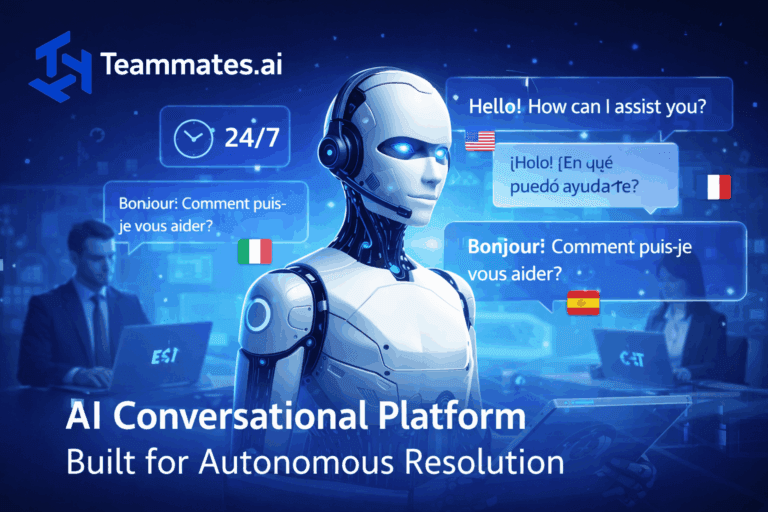
An AI conversational platform built for autonomous resolution is a system that designs, deploys, and improves interactions across chat, voice, and email, executing business actions autonomously. Teammates.ai enhances efficiency by reducing response time by 30%.
The Quick Answer
An ai conversational platform is the system you use to design, deploy, integrate, govern, and continuously improve customer or candidate conversations across chat, voice, and email. The platforms that actually work at scale go beyond responses and autonomously execute business actions safely. That is the difference Teammates.ai is built around with Raya, Sara, and Adam.

An ai conversational platform is the system you use to design, deploy, integrate, govern, and continuously improve customer or candidate conversations across chat, voice, and email. The platforms that actually work at scale go beyond responses and autonomously execute business actions safely. That is the difference Teammates.ai is built around with Raya, Sara, and Adam.
Most teams buy an “AI conversational platform” to make replies sound better. That is the wrong optimization. The platform that wins in 2026 is the one that can reliably do the work: verify identity, check policy, write back to the system of record, and produce a confirmed outcome with clean escalation when it cannot. In this guide, we map platform capabilities to the real lifecycle you must operate (design, deploy, integrate, govern, improve) and show where most vendors stop: talk.
The real job of an ai conversational platform is execution
You do not lose money when the AI replies awkwardly. You lose money when the AI cannot complete the business action and forces a human to re-do the workflow from scratch.
In high-volume environments (support, CX, TA, revenue), conversations are just the front door. The “job” is what happens after the user says yes: create the ticket, issue the refund, schedule the appointment, update the CRM, close the loop.
Here is the operational lifecycle you are actually buying:
- Design: what the AI should do, say, and refuse.
- Deploy: how you release changes without breaking production.
- Integrate: how it reads and writes across your tools.
- Govern: how you control risk, access, and auditability.
- Improve: how you measure outcomes and stop regressions.
If your platform does not own all five, you inherit hidden work. That work shows up as human review queues, brittle point integrations, and “we can’t ship changes during peak season” release freezes.
Define “autonomous” plainly: the AI finishes the workflow end-to-end and the business outcome is verified. In our world that means things like:
- Ticket resolved and closed in Zendesk.
- Candidate interviewed, scored, and written to your ATS.
- Lead qualified, meeting booked, CRM updated.
For the autonomous multilingual contact center, execution is even less forgiving. You need consistent containment in 50+ languages, including Arabic dialects, and you need intelligent escalation that carries full context so the human can act immediately.
Key Takeaway: Conversation quality is table stakes. Execution reliability is the platform.
Map capabilities to the lifecycle: design, deploy, integrate, govern, improve
If you evaluate platforms by demo polish, you will overbuy “talking” and underbuy operations. Evaluate by what you must run every week: changes, incidents, audits, and new integrations.
Design
Design is not “prompt writing.” It is the operational definition of intent, policy, tone, and failure behavior.
- Intent detection that routes to outcomes, not articles. Start with your top 20 intents and define the required end state (refund issued vs refund explained). This is why intention detection is a routing problem, not a classification contest.
- Knowledge sources with provenance. Every customer-facing claim needs a traceable source (policy doc, SKU table, SLA rules). If you cannot cite it internally, you cannot defend it externally.
- Channel behaviors. Voice needs barge-in, silence handling, and “repeat back” confirmations for addresses and names. Email needs async SLAs and a different escalation threshold.
- Multilingual tone control. You need brand voice libraries per language, plus rules for “when to stop being friendly” (payment failures, identity verification, chargebacks).
- Escalation policies. Define triggers by risk, not frustration: high dollar amount, PII mismatch, repeat contact, or tool error.
Deploy
Deployment is where most “platforms” become an ops liability.
You need:
- Environments (dev, staging, prod) with clean separation of data.
- Versioning for prompts, tools, and policies together. Shipping a new policy without its tool validation is how you create a compliance incident.
- Rollout gates: shadow mode, canary by queue, and rollback that is one click.
- Latency targets by channel. Voice is ruthless. If your median response is fine but your tail latency spikes, callers hang up.
Integrate
This is the make-or-break layer. Ask for integration depth, not connector logos.
A real integration can:
- Read and write to systems of record (CRM, ticketing, billing).
- Enforce policy-based permissions per action (“refund up to $50”, “reschedule only once”).
- Guarantee idempotency (the same tool call does not create two refunds).
- Retry safely with audit logs when APIs time out.
If a vendor cannot explain idempotency and auditability in plain English, they are not ready for autonomous execution.
Govern
Governance is not a PDF. It is a set of controls you can prove on demand.
- Approval workflows for policy changes.
- RBAC that is action-level, not admin-level.
- Audit trails: who changed what, when, and why.
- Retention, redaction, and transcript access controls.
- Human review workflows for edge cases without turning every case into a review queue.
Improve
Improvement is outcome-driven, or it becomes dashboard theater.
You need analytics that tie to:
- Autonomous execution rate (AER): percent of conversations that end in a verified outcome.
- Escalation quality: time-to-human plus handoff completeness (what the human needs to finish).
- Regression testing: golden conversation sets, tool-call test suites, and postmortems when automation breaks.
If you want a support-specific view of outcome measurement, start with conversational ai for customer support and track closures, not deflection.
Key Takeaway: The lifecycle is the product. If your platform cannot run safe releases and measurable improvement, it will not scale.
Most platforms stop at talk. The missing piece is autonomous business actions
Routing, FAQs, and agent assist are useful, but they cap out early. Autonomy starts when the system can execute business actions with deterministic guardrails and confirm the result back to the user.
At a glance, here is where categories break:
- Talk-focused: intent-to-article responses, summarization, basic routing.
- Assist-focused: agent copilot, suggested replies, after-call notes.
- Autonomous: tool use with policy checks, action validation, and post-action confirmation.
Operationally, “autonomous” means the AI can safely write back to the system of record.
Support example (refund):
- Verify identity (order email + last 4 digits, or OTP).
- Check policy (window, SKU exceptions, fraud flags).
- Execute the action (refund API call) with idempotency key.
- Confirm outcome (refund ID, timeline) and close the ticket.
TA example (interview):
- Run adaptive questions based on role and candidate answers.
- Score against a rubric, not vibes.
- Produce a summary and write results back to the ATS.
Revenue example (meeting booking):
- Qualify (budget, timing, need) and handle objections.
- Book on the right calendar with constraints.
- Update CRM fields and create next steps.
The metric that matters is not “containment.” It is AER plus outcome verification. If your “automation” ends with “I’ve created a ticket for an agent,” you are still paying the human cost.
If you want a clean mental model of this tool-driven approach, read ai agent bot and notice the difference between calling a tool and completing a workflow.
Key Takeaway: If it cannot write back to the system of record safely, it is not autonomous.
If your AI conversational platform cannot safely write back to systems of record, it is not autonomous. It is a reply engine. In high-volume support, recruiting, and revenue workflows, the economic value comes from verified actions: refund issued, ticket closed, interview scored, meeting booked, CRM updated. Anything else shifts cost into human review and cleanup.
Where most “platforms” commonly stop:
- Routing and deflection (intent to FAQ, intent to article)
- Agent assist (draft replies, suggest macros)
- Basic tool calls without action-level policy, retries, or auditability
Where autonomy actually begins:
- Tool use with deterministic guardrails: the model can propose, but the platform enforces what can execute.
- Action validation: the platform checks preconditions (identity, eligibility, limits) before writing.
- Post-action confirmation: the user sees a verifiable result, not “I processed that.”
Three operational examples that expose the difference:
- Support: verify identity, check policy, initiate refund, update Zendesk, send confirmation email, close ticket.
- Talent Acquisition: run adaptive interview, score against rubric, write notes and disposition into the ATS, schedule next step.
- Revenue: qualify lead, handle objections, book meeting, create/update deal, log call outcome.
The metric that matters isAutonomous Execution Rate (AER): percent of conversations that end in a verified business outcome, plus escalation quality (time-to-human and handoff completeness). If a vendor cannot show AER by channel and by language, you are buying “talk,” then paying people to do.
Key Takeaway: If it cannot write back safely, with audit logs and outcome verification, it is not an autonomous platform.
Teammates.ai blueprint for superhuman autonomous conversations at scale
Teammates.ai is engineered around one objective: autonomous execution at scale across chat, voice, and email, including multilingual environments where quality usually collapses (Arabic dialects are a common breaking point). We do not ship chatbots or copilots. We ship AI Teammates composed of many specialized AI Agents coordinated to produce a verified outcome.
At a glance, our operating model looks like this:
- One Teammate owns an end-to-end workflow (support resolution, interview completion, lead qualification).
- Multiple agents handle distinct tasks: intent classification, policy checks, knowledge retrieval, tool execution, QA validation, escalation packaging.
- The platform governs actions, not just text: permissions, approvals, logging, and release gates.
How the products map to real execution:
–Raya: autonomous multilingual contact center across chat, voice, and email. Raya is built to resolve tickets end-to-end with deep integrations, and to escalate intelligently with full context when a human is needed. For teams investing in omnichannel routing and multilingual customer support, this is where “conversation quality” becomes “operational outcomes.”
–Sara: instant candidate interviews with adaptive question paths, consistent scoring signals, and structured outputs (summary, ranking, recordings) that can be written back to your ATS.
–Adam: outbound and qualification across voice and email, with objection handling, meeting booking, and CRM synchronization.
The deployment advantage is operational, not cosmetic. “No coding required” is not a tagline. It reduces platform sprawl, shortens iteration cycles, and makes governance consistent because the same controls cover every agent in the workflow.
If you want a deeper view of what autonomy looks like when it must operate across tools, start with this ai agent bot breakdown.
Platform evaluation framework and maturity model with scoring worksheet
You evaluate an AI conversational platform by outcomes and failure modes, not demos. The right process forces clarity on what must be executed, which systems must be written to, and how you will test and govern changes. Most buying teams skip this, then discover hidden work in QA, escalations, and brittle integrations.
Step-by-step evaluation (use this in procurement)
1)Define your top 3 use cases as outcomes
- “Ticket closed with refund issued” (not “handle refund questions”)
- “Interview completed with score and disposition”
- “Meeting booked and CRM updated”
2)Channel requirements (chat vs voice vs email)
- Voice: barge-in, low latency, recovery from partial transcripts
- Email: async SLA, threading, attachment handling
- Chat: rich UI actions (buttons, forms) and faster iteration cadence
3)Integration needs (systems of record)
- List read vs write actions per system (Zendesk, Salesforce, HubSpot, CCaaS, payments, shipping, scheduling)
- Require idempotency (safe replays), retries, and an audit trail per action
- Define fallbacks: what happens when the tool is down
4)Data sensitivity and governance
- Classify PII, PCI, PHI exposure
- Decide retention and residency boundaries
- Define what requires approval (refund amount thresholds, account changes)
5)Operating cadence and ownership
- Who owns policies and tool permissions
- Who owns regression tests and release gates
- Who handles incidents and postmortems
Maturity model (what you are actually buying)
- Level 0: FAQ only
- Level 1: guided flows
- Level 2: tool calls (unreliable writes)
- Level 3: autonomous execution with safeguards
- Level 4: autonomous execution with continuous QA and optimization
Scoring worksheet (0-5 each)
| Category | What “5” looks like | Evidence to request |
|---|---|---|
| Outcome coverage | Verified ticket closure / booking / scoring | AER reporting by use case |
| Integration depth | Read + write with retries and logs | Action audit trail sample |
| Testing and regression | Simulation + golden sets + gates | Test suite and release process |
| Omnichannel parity | Similar behavior across voice/chat/email | Channel-specific SLA metrics |
| Governance | RBAC by action, approvals, retention | Security and admin logs |
Decision rule that saves months: if you need agent assist, buy assist. If you need workflow automation, buy automation. If you need autonomous execution with measurable AER, buy a platform built for execution.
If your use case starts with routing to the right outcome, tighten that layer first with intention detection.
TCO pricing pitfalls and the costs vendors hide in plain sight
The biggest cost in conversational AI is not tokens. It is operational drag: human review queues, integration upkeep, and escalation seats created by low execution reliability. You do not control TCO by negotiating per-conversation price. You control it by maximizing verified outcomes per conversation.
Model costs in three volume scenarios: 1k, 10k, 100k conversations/month. Force vendors to quote the same basket:
- Chat conversations
- Voice minutes (often the real bill shock)
- Email threads (and storage/retention)
- LLM usage, tool calls, and analytics
- Environments (dev/stage/prod) and testing
Hidden costs that show up after “successful pilots”:
- Human review: sampling for QA, handling “almost resolved” tickets
- Escalation seats: you still pay for agents, plus new handoff overhead
- Data work: labeling, taxonomy rebuilds, knowledge curation
- Integration maintenance: connectors that break on API changes, missing retries
Contract gotchas to flag early:
- Channel multipliers (voice priced differently, sometimes 5-10x chat)
- Overage pricing and minimum commits
- Premium connectors or “enterprise” audit logs
- Separate fees for staging environments (kills safe rollout)
Simple calculator outline: (conversations by channel x containment target x avg tool calls) + (review rate x QA labor) + (incident cost assumptions). The cheapest platform is the one that eliminates review work by completing actions.
Security, privacy, compliance, and reliability QA for LLM platforms
In regulated environments, governance and QA are not “nice to have.” They are the product. If a vendor cannot answer action-level security questions, you are betting your brand on prompt discipline, which fails the first time a workflow changes or a new agent joins.
Security checklist to copy into procurement:
- SSO-SAML, SCIM provisioning, and MFA for admins
- RBAC by action (not just by dashboard role)
- Encryption in transit and at rest
- Data residency options and retention controls
- Immutable audit logs and admin change history
- Human-review workflows with access controls
Privacy controls that matter operationally:
- PII redaction pipeline before storage and before training
- DLP integration and consent capture
- Scoped transcript access (support QA should not see payment details)
Reliability and safety engineering that prevents hallucinations from becoming incidents:
- Tool-first policies: the model must call verified tools for facts (order status, eligibility)
- Constrained actions: allowlists and parameter validation
- Response validation: post-tool checks before confirming to the user
Testing and monitoring you should require:
- Offline simulations with golden conversation sets
- Regression tests for intents and tool calls on every release
- Outcome dashboards: AER, escalation reasons, language-specific failure rates, drift detection
For teams focused on ticket closure, this is the practical bar for a conversational ai for customer support program that survives real traffic.
Conclusion
An AI conversational platform is only valuable when it executes. The market still optimizes for talking: nicer responses, better prompts, more channels. That is table stakes. If you run high-volume or regulated operations, you need a platform that can design, deploy, integrate, govern, and continuously improve conversations while reliably completing business actions.
Use AER, integration depth (read and write with auditability), and QA maturity (simulation plus regression gates) as your non-negotiables. They predict your true TCO more than any per-conversation price.
If your goal is superhuman, scalable outcomes across chat, voice, and email, Teammates.ai is built for the job. Raya, Sara, and Adam are engineered as autonomous Teammates that finish workflows end-to-end, with the controls required to operate safely in production.