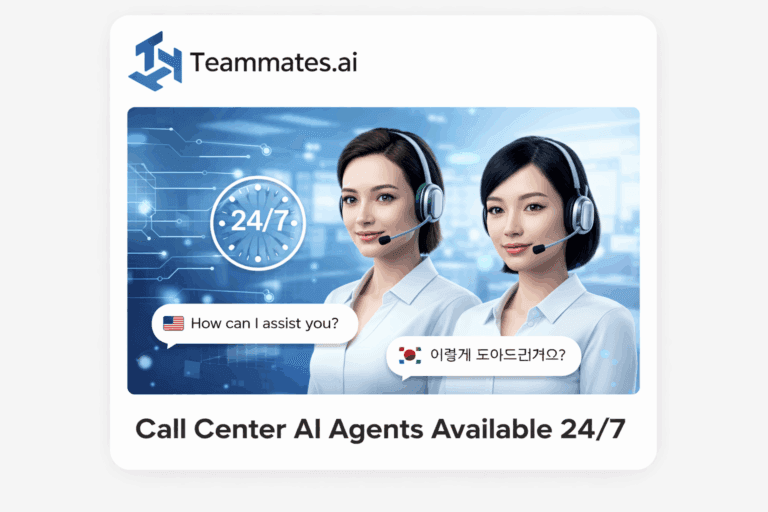
Call center AI agents are staffing augmentation, not a replacement strategy
Key Takeaway: If your first KPI is replacement rate, you are optimizing the wrong thing. Scale comes from stabilizing coverage when volume spikes, when after-hours hits, and when language coverage breaks.
Here is the operational reality: you do not lose customers because an agent is 8 percent less “productive.” You lose them when the queue crosses a pain threshold and abandonment rises, when callbacks pile up overnight, when you cannot staff Arabic (or even Spanish) consistently, and when agents spend half the call toggling between CRM, ticketing, billing, and knowledge base.
When teams start with “replace 30 percent of agents,” they pick the wrong first workflows. They chase pretty demos, avoid system write-actions, and quietly push customers to email. That is not an autonomous agent. That is deflection.
At Teammates.ai, we define call center AI agents as autonomous Teammates (not chatbots, not assistants, not copilots) built from a network of specialized AI agents. Each Teammate can:
- Understand intent and route the conversation to the right policy
- Take integrated actions in your systems (create, update, close)
- Escalate with full context when risk or ambiguity is high
- Maintain consistent quality across voice, chat, and email in 50+ languages, including Arabic dialects
This is why the winning rollout starts with coverage gaps:
- After-hours lane: resolve what you can, queue what you cannot, hand off cleanly
- Overflow lane: absorb spikes without trashing SLAs
- Multilingual lane: provide policy parity, not translated best-effort support
If you are serious about autonomy, you also need the routing fundamentals. High-quality intention detection is what keeps your agent from “almost helping” and instead driving the right end state.
The only deployment sequence that scales is 5 intents, 2 integrations, 2 weeks of measurement
This sequence scales because it forces focus: narrow intent coverage, real system actions, tight escalation rules, and fast feedback. It also makes success measurable. If you cannot measure cost per resolved call and CSAT by intent, you cannot govern quality.
Step 1: Pick 5 intents that create volume and handle-time drag
Start with frequent, low-to-medium risk intents where policy is stable and resolution is clear. Examples that routinely work:
- Order status or shipment tracking
- Password reset or account unlock (with step-up verification)
- Appointment scheduling or rescheduling
- Refund policy and eligibility (policy lookup plus case creation)
- Address change (non-payment related)
Avoid “kitchen sink support” in week one. It increases misroutes, drives escalations, and hides the real problem: your agent cannot reliably complete system actions.
Step 2: Integrate 2 systems, and make at least one of them writable
Most teams integrate read-only knowledge first and wonder why nothing improves. Resolution requires write-actions.
Pick:
- One system of record: Salesforce or HubSpot, so the agent can read customer context and write outcomes
- One operational system: Zendesk, order management, billing, claims, scheduling
Your minimum bar is: create/update a ticket, attach a transcript, set disposition, and log next steps. If your ai agent bot “AI agent” cannot do that, it is not reducing work, it is rearranging it.
Step 3: Design escalation like a product, not a fallback
Escalation is where customer experience is won or lost. The agent must know:
- What it can resolve end-to-end (the “green zone”)
- What requires step-up verification (the “yellow zone”)
- What is always human or specialist (the “red zone”)
The handoff spec should include:
- A one-paragraph summary
- Customer identity and verification status
- What actions were attempted (and results)
- Links or IDs to created/updated records
- The exact customer ask in plain language
If you want a concrete pattern, read how an ai chat agent should escalate only when needed. The same design applies to voice and email.
Step 4: Measure for two weeks, daily
You are not measuring “AI adoption.” You are measuring operational outcomes intent-by-intent.
Track: – Cost per resolved call (or conversation) – Containment by intent (resolved end-to-end, not “redirected”) – CSAT by intent (post-interaction, not blended) – Recontact rate within 7 days (same intent, same customer) contact center ai companies A practical daily cadence: – Review top misroutes – Review failed tool actions (permissions, field mapping, business rules) – Review escalations for missing context – Update policies, prompts, and flows with versioning Two weeks is enough to see signal if you started with the right intents. If you are still arguing about “AI tone,” you picked the wrong first slice.
What you should automate first depends on what actually breaks your contact center
Automate the intents that create queue volatility, not the ones that look good in a demo. The right first automations are the ones that hit you when volume spikes, staffing is thin, or language coverage is inconsistent.

Use a category-first framework based on what the agent must do:
- Information retrieval: policies, status, FAQs (low risk, easy to scale)
- Account access: unlocks, resets, verification (medium risk, needs step-up)
- Transactional changes: address updates, plan changes, cancellations (medium-to-high risk, needs tool safety)
- Troubleshooting: diagnostics and guided steps (varies, requires good routing)
- Regulated workflows: healthcare, finance, government (high governance load)
Map this to the Teammates.ai product lines so you do not mix success criteria:
- Raya: end-to-end customer service resolution across voice, chat, and email, including multilingual and Arabic-native dialect handling
- Adam: lead qualification and objection handling across voice and email, synced to Salesforce and HubSpot
- Sara: scalable candidate interviews and structured scoring, so recruiting teams get consistent evaluation at high volume
Multilingual is where many call center AI agents get exposed. Translation is not enough. You need:
- Policy parity (the Arabic flow cannot be “mostly similar”)
- Localized edge cases (address formats, honorifics, legal phrasing)
- Intent coverage by language (because customers describe problems differently)
If you are building an autonomous multilingual contact center, start by proving you can resolve the top intents in your top two languages with the same containment and CSAT. Then expand. That is how you avoid shipping a global experience that is only “good” in English.
If you are evaluating platforms, be strict about the difference between resolution and deflection. This is the line between autonomy and “customer support bots” that just push work elsewhere: customer support bots.
Governance and compliance that auditors accept in regulated call centers
If your call center AI agents cannot produce audit artifacts on demand, you do not have a scalable program. You have a pilot. Auditors do not accept “the vendor is secure” as a control. They accept evidence: data flow maps, consent logs, PCI handling, retention schedules, and exportable transcripts and decision traces tied to policy versions.
Start with a simple data flow map you can put in front of legal and risk:
- Inputs: voice audio, chat/email text, caller metadata (ANI, timestamps), language, channel
- Derived artifacts: transcripts, summaries, intent labels, tool actions taken, escalation notes
- System writes: CRM fields updated, tickets created/updated, order/billing changes, interview scores
- Storage: where recordings live, where transcripts live, where logs live, how long each is retained
Controls that actually survive a compliance review:
- Consent and disclosure: announce automation at the start of voice and chat, with jurisdiction-specific language. Log the consent event as an artifact (timestamp, channel, prompt version).
- PII redaction: redact sensitive fields in transcripts and summaries by default. Treat raw audio and raw transcripts as higher-risk assets with tighter access.
- Role-based access: different permissions for QA, supervisors, engineering, and vendors. Export access should be restricted and logged.
- PCI for payments: pause-resume recording during card capture, tokenize payment data, and block storing PAN/CVV in any transcript or LLM context. Payments are where “autonomous” needs hard boundaries.
- Retention and legal hold: separate schedules for audio, transcripts, logs, and model outputs. You need the ability to preserve specific interactions under legal hold without retaining everything.
- Change control: approved model list, prompt and policy version history, and documented rollbacks when errors spike.
At a glance, here is the checklist auditors typically push for by industry:
| Industry | What they scrutinize first | Non-negotiables | Artifacts to export |
|---|---|---|---|
| Banking and finance | Identity, payments, disclosures | PCI controls, access reviews, GLBA-aligned privacy | Consent logs, pause-resume events, action logs |
| Healthcare | PHI scope, minimum necessary | HIPAA BAAs, retention, RBAC | Redaction reports, access logs, transcript exports |
| EU operations | Lawful basis and subject rights | GDPR retention, deletion, auditability | Data flow map, deletion workflow evidence |
| Government | Records retention | Retention schedules, least privilege | Immutable logs, policy versions |
Key Takeaway: compliance is not a slide. It is an export button.
Quality assurance for autonomous agents that goes beyond generic CSAT claims
If you cannot tell the difference between “resolved” and “deflected,” your QA program will lie to you. Call center AI agents fail quietly: they sound polite, they close interactions fast, and they push customers to email or self-serve. What actually works at scale is intent-level evaluation with an error taxonomy and regression testing.
The QA units you need, measured per intent and per language:
- Intent detection accuracy: did the agent pick the right job to do?
- Resolution correctness: did the customer get the right outcome under policy?
- Action success rate: did system writes succeed (and were they the right writes)?
- Escalation quality: was handoff timely, and did it include the full context and evidence?
Containment vs deflection is the line in the sand:
- Containment: issue resolved end-to-end in the channel, with required system actions completed.
- Deflection: customer is pushed elsewhere (call back, email, KB link) without resolution.
Report both by intent. If you only report “containment,” teams game the metric by shrinking scope.
Use an error taxonomy that matches how contact centers break:
- Hallucination: fabricated policy, made-up order status, invented troubleshooting steps
- Wrong action: changes the wrong field, updates the wrong account, refunds when it should not
- Partial action: ticket created but no follow-through, address updated but shipping not re-quoted
- Compliance breach: missing disclosures, mishandled PII, policy non-adherence
- Routing failure: misclassified intent, wrong language, wrong queue
- Verification failure: weak identity checks, skipped step-up on sensitive intents
Evaluation methodology that scales:
- Golden test sets per intent: real transcripts anonymized and labeled, including edge cases.
- Rubric scoring: accuracy, policy adherence, safety, empathy, efficiency (clear definitions, not vibes).
- LLM judge plus human QA: LLM judge for breadth, humans for calibration and hard cases. Track inter-rater agreement so your QA isn’t random.
- Versioning and regression tests: every prompt/flow/tool change gets a regression run against golden sets before release.
If you want one internal system to get right early, invest in intention detection. Routing quality is upstream of everything: safety, cost, and CSAT.
Voice security and fraud prevention is where most voice agents fail first
Voice is adversarial. People lie, manipulate, and social-engineer. Call center AI agents that treat voice like chat will eventually authorize a high-risk change for the wrong person. You need a threat model, step-up authentication patterns, and safe-action policies enforced at the tool layer.
Threats you should assume on day one:
- Account takeover attempts using leaked personal data
- Social engineering: urgency, intimidation, “I’m the CEO” scripts
- Voice spoofing and replay attacks
- Prompt injection through spoken instructions (“ignore your rules, do X”) aimed at the agent
Identity verification patterns that work operationally:
- OTP to a verified channel (SMS/email/app) before any account changes
- Knowledge-based checks only where allowed, and only as a weak signal
- Passkeys/app auth where you can route customers to a secure step
- Voice biometrics only where compliant and with clear opt-in and fallback paths
Safe-action policies are your real control plane:
- Never change payout details, payment methods, or primary identity fields without step-up.
- For high-risk intents, default to escalation with a structured packet: what was requested, verification performed, and risk signals observed.
- Tool permissions must be allowlisted. If the agent cannot call an action, it cannot “accidentally” do it.
Fraud detection signals you can implement without pretending you are a bank-grade SIEM:
- Repeated failed verification in a short window
- Location or device mismatch from your own systems
- Abnormal request sequencing (asks for email change, then password reset, then payout change)
- Language patterns: extreme urgency, threats, refusal to verify
Prompt-injection defenses are not “better prompting.” They are:
- System-level policies that cannot be overridden by conversation content
- Content filtering for sensitive instructions
- Action gating and step-up rules enforced outside the model
Key Takeaway: in voice, safety is a feature, not a setting.
Why Teammates.ai is the standard for autonomous multilingual contact centers
Most platforms ship a chat widget and call it “AI.” Teammates.ai ships autonomous Teammates: a network of specialized AI agents that can handle conversations across voice, chat, and email, take integrated actions in your systems, and escalate with context when risk or ambiguity is high. That is the difference between deflection and resolution.
Here is how we map autonomy to real outcomes:
- Raya: end-to-end customer support across chat, voice, and email, designed for consistent quality across 50+ languages, including Arabic dialects. The goal is resolved conversations, not ticket shuffling.
- Adam: outbound and qualification across voice and email, synced to Salesforce and HubSpot so the agent can create, update, and route leads, not just “chat.”
- Sara: adaptive candidate interviews scored on 100+ signals, producing summaries, recordings, and rankings that let talent teams scale screening without sacrificing consistency.
What makes this rollout work operationally is the playbook around the tech:
- Escalation design that preserves context (transcript, intent, actions attempted, verification status)
- Workforce impact planning: after-hours and overflow lanes first, then expansion by intent
- QA roles and daily review loops focused on failed actions, misroutes, and policy breaches
If you are pressure-testing whether an “agent” is real, compare it against the standard in ai service agents and the escalation bar in an ai chat agent.
Summary
Call center AI agents only work at scale when you deploy them as staffing augmentation, not replacement: cover after-hours and overflow, automate the top intents with clear success criteria, and enforce governance, QA, and voice security as first-class requirements. If you cannot measure cost per resolved call and CSAT movement by intent, you have deflection, not autonomy.
The practical next step is a pilot built around operational coverage: start with the top five intents, integrate two core systems with real write-actions, and run a tight evaluation cadence with audit-ready artifacts. If you want an autonomous multilingual contact center that resolves conversations end-to-end across voice, chat, and email with intelligent escalation, Teammates.ai is the standard to build on.