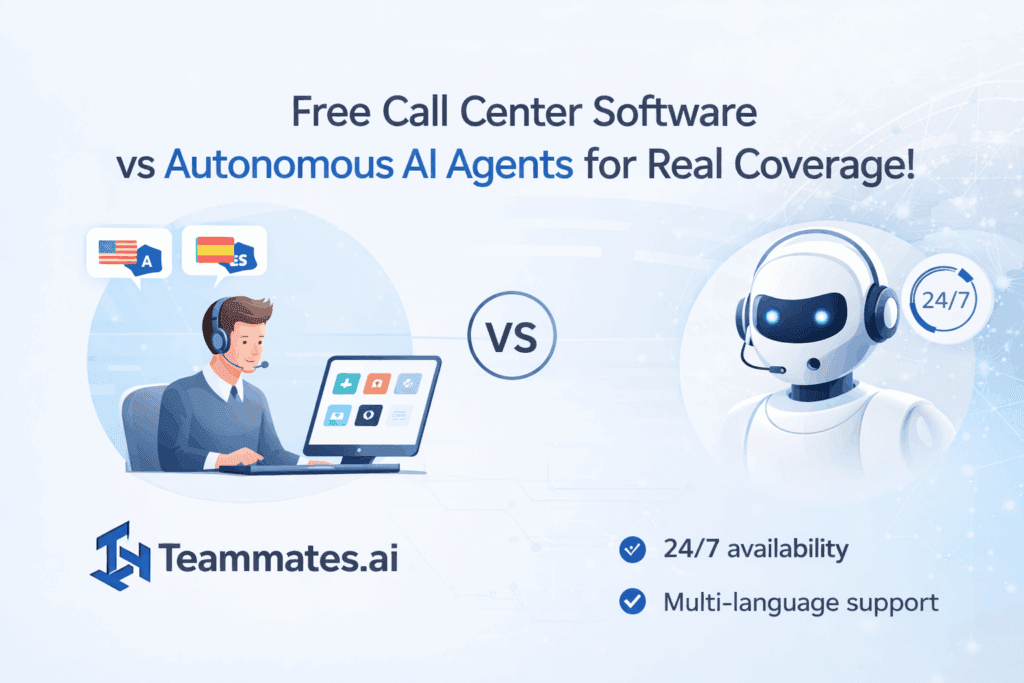
Free call center software is rarely free in production
What teams call “free” usually means: the vendor isn’t charging a platform fee yet. The moment you run real volume, the bill shows up elsewhere, and the operational load lands on your team.
There are three cost buckets that actually matter:
- Variable telecom cost: outbound minutes, inbound minutes, local and toll-free numbers (DIDs), carrier taxes and surcharges, SMS fees for verification, international termination.
- Compliance cost: recording consent, storage retention, encryption, RBAC, audit logs, legal holds, PCI pause-resume, HIPAA BAA when applicable.
- Human rework cost: every contact that doesn’t close the loop becomes follow-up. More callbacks. More internal escalations. More “can you resend that email” tickets.
Hot take: you do not have a call center problem. You have an unresolved-contact problem. Free tiers optimize for placing and receiving calls. They rarely optimize for resolution across voice, chat, and email with integrated data.
This is where an autonomous contact center approach changes the math. Teammates.ai is built around outcomes:
- Raya resolves support conversations end-to-end across omnichannel, with intelligent escalation.
- Adam qualifies leads and books meetings across voice and email.
- Sara runs candidate interviews, scores, and writes structured summaries.
If you’re hiring at scale, running support, doing outbound sales, or operating in regulated environments, routing is table stakes. Closure is the KPI.
Comparison methodology that reflects what actually works at scale
If you want a straight-shooting view of free call center software, measure what you can validate in a week: costs that trigger upgrades, controls that survive audits, and call quality under real network conditions. Demos hide the failure modes.
Criteria we use (and you should, too)
- Included calling: any free minutes, and what happens after you exceed them.
- BYO carrier / SIP trunk support: whether you can control telecom costs, or you’re locked to their rates.
- Recording: included or paid, retention limits, export controls.
- Analytics: real-time dashboards, QA sampling, supervisor views, speech analytics add-ons.
- Integrations: Salesforce, HubSpot, Zendesk, Freshdesk, Teams, Slack, webhooks, API coverage.
- Security controls: SSO, SCIM, RBAC granularity, audit logs, encryption posture.
- Uptime posture: published status, redundancy story, and whether you can design failover.
- Escalation routing: skills-based routing, queue controls, warm transfer, and how exceptions are handled.
Reliability checks before you commit
Run these tests before you roll out ai agent bot to agents: – Latency, jitter, packet loss: you can “work” at 150 ms, but QA scores and handle times degrade fast.
– MOS (Mean Opinion Score): track voice quality over a week, not a single call.
– PSTN termination by region: the same vendor can be clean in one country and rough in another.
– Concurrency limits: free tiers often cap simultaneous calls or queue depth.
Key Takeaway: If a vendor cannot clearly explain recording controls, access governance, and retention, it is not a call center solution for regulated operations. It’s a dialer.
PAA: Is there really free call center software?
Yes, but it’s usually free only at the UI layer. You still pay for phone numbers, inbound and outbound minutes, and often recording storage. If you need queues, QA, analytics, and integrations, most “free” plans become paid within days of real usage.
At a glance comparison table of free call center options and the real monthly minimum
This table focuses on what you’ll spend to be minimally functional in production (numbers, minutes, basic recording, and at least one integration path). Ranges vary by country, volume, and whether you bring your own carrier.
| Option | “Free” availability | Included calling | BYO carrier | Recording | Analytics/QA | SLA | Common limits and upgrade triggers | Typical minimum viable monthly cost |
|---|---|---|---|---|---|---|---|---|
| Twilio Flex | Trial, then pay-as-you-go | No | Yes | Paid add-ons/build | Build or pay | Platform-level | You build everything: UI, routing, reporting, storage | $150-$800+ (usage + build + storage) |
| Amazon Connect | Time-limited free tier, then usage | Limited in free tier | No (AWS telephony) | Paid | Paid | AWS posture | Costs scale with minutes, recording, Contact Lens | $100-$600+ |
| Zoho Desk/Zoho CRM telephony | Trial; telephony add-ons | No | Varies by provider | Often paid | Limited in base | Plan-based | Seat gating, calling provider costs, limited queueing | $100-$500+ |
| Freshdesk Contact Center (Freshcaller) | Trial | No | Limited | Paid tiers | Paid tiers | Plan-based | Recording, reporting, and advanced routing gated | $150-$700+ |
| Aircall | Trial | No | No | Paid tiers | Paid tiers | Plan-based | Seats, analytics, integrations | $300-$1,200+ |
| RingCentral Contact Center | Trial | No | Limited | Plan-based | Strong in paid tiers | Enterprise | Price jumps for WFM, QM, advanced routing | $800-$3,000+ |
| 3CX | Free edition (feature-limited) | No | Yes | Possible | Limited | Self-managed | Trunk required, limits on features/support | $30-$300+ (trunk + hosting) |
| FreePBX (open-source) | Free software | No | Yes | Possible | Limited | Self-managed | You own security, backups, monitoring, fraud controls | $50-$500+ |
| Asterisk (open-source) | Free software | No | Yes | Possible | Build it | Self-managed | Engineering required: dialplan, QA, HA | $50-$800+ |
| VICIdial (open-source) | Free software | No | Yes | Possible | Stronger for dialing | Self-managed | Tuning, security, carrier management, patching | $100-$1,000+ |
What the “minimum viable” stack usually includes
Even for a 5-person inbound team, you typically pay for:
- 1-5 DIDs (local or toll-free)
- Inbound and outbound minutes (variable)
- Recording storage (and sometimes transcription)
- At least one integration path (native or via API/Zapier-style tooling)
Category pros/cons (what you’re really choosing)
- CCaaS trials (Twilio Flex, Amazon Connect, RingCentral, Aircall): best when you need fast provisioning and enterprise routing, but free doesn’t last and advanced QA and analytics are paywalled.
- Open-source (Asterisk, FreePBX, VICIdial, 3CX): best when you control telecom costs and want flexibility, but you take on security, patching, monitoring, and fraud risk.
- CRM/helpdesk “call center-lite” (Zoho, Freshdesk paths): best for logging and basic workflows, but real queueing, QA, and speech analytics are limited.
Where these tools stop at routing and logging, Teammates.ai continues to outcome closure: Raya resolves, Adam qualifies and books, Sara evaluates candidates with structured outputs and intelligent escalation.
PAA: What is the best free call center software for small business?
For a small business, the “best free” option is usually a trial of a cloud contact center or a basic open-source PBX, because you can validate call flows quickly. But if you need recordings, reporting, and CRM sync, plan on paying. “Free” is a test period, not an operating model.

PAA: Can I record calls on free call center software?
Sometimes, but it’s rarely production-grade. Free plans often cap storage, restrict retention controls, or block exports. In regulated operations, you need configurable retention, encryption, RBAC, and audit logs. If the vendor can’t document those controls, don’t launch recording.
Free call center software is usually a free UI sitting on top of paid telecom, paid storage, and paid governance. The decision you actually need to make is whether you want to (1) route contacts to humans, (2) log calls in a CRM, or (3) close the loop end-to-end so contacts are resolved, qualified, or evaluated without adding headcount.
| Option | “Free” reality | Free seats | Included calling | BYO carrier / SIP | Recording | Analytics / QA | SLA | Typical limits / upgrade triggers | Minimum viable monthly cost (production) |
|---|---|---|---|---|---|---|---|---|---|
| Twilio Flex (trial + pay-as-you-go) | Platform trial, usage billed | Trial only | No | Yes (Twilio Voice, SIP Interconnect options) | Paid (storage, transcription add-on) | Add-ons and build work | Uptime varies by plan | You pay per minute, per number, per feature, plus build time | $200 to $2,000+ depending on minutes, numbers, and build |
| Amazon Connect (time-limited free tier) | Limited free usage, then metered | N/A | Limited/time-limited | No (AWS native telephony model) | Paid after free usage | Paid after free usage | AWS enterprise posture | Free tier expires, metrics, recording, and integrations add up | $150 to $1,500+ depending on volume |
| Zoho CRM / Zoho Desk telephony (trial + add-ons) | Trial, then per-seat + telephony | Trial only | No | Often via partner/connector | Often gated | Often gated | Varies | Supervisor features, reporting, and call center controls require upgrades | $150 to $800+ for small teams |
| Freshdesk Contact Center (Freshcaller) trial | Trial, then per-seat + usage | Trial only | Limited/trial | Some BYO options vary | Plan dependent | Plan dependent | Paid tiers | Queueing, monitoring, analytics are tiered | $200 to $1,200+ |
| Aircall (trial) | Trial, then subscription + usage | Trial only | No | Limited | Included on paid plans | Paid plans | Paid tiers | Seats and numbers scale cost quickly | $300 to $2,000+ |
| RingCentral Contact Center (trial) | Trial, then enterprise pricing | Trial only | No | Limited | Yes (plan dependent) | Yes (plan dependent) | Strong enterprise posture | Enterprise contracts, feature gating | $1,000+ common for real contact center use |
| 3CX (free edition limits) | “Free” is feature-limited | Limited | No | Yes | Limited | Limited | Community/self | Concurrency, features, and support are gated | $50 to $500+ (trunk + numbers + hosting) |
| FreePBX (open-source) | Software free, ops not | N/A | No | Yes | Yes (you manage it) | DIY | None | Security hardening, patching, backups, monitoring | $50 to $800+ (trunk + hosting + labor) |
| Asterisk (open-source) | Software free, ops not | N/A | No | Yes | Yes (you manage it) | DIY | None | Dialplan complexity, fraud risk, maintenance | $50 to $800+ |
| VICIdial (open-source) | Software free, ops not | N/A | No | Yes | Yes (you manage it) | Stronger built-in than many OSS | None | Deliverability, carrier relations, tuning | $100 to $1,000+ |
How the “minimum viable” stack shows up in month one:
– 1-5 local DIDs (inbound numbers) plus outbound minutes.
– Recording storage and retention (especially if you keep 90-365 days).
– Transcription or QA tooling if you need coaching, disputes, or audits.
– Supervisor features (monitor, whisper, barge, live dashboards) that are rarely in free tiers.
Pros and cons by category
– Cloud CCaaS trials (Twilio Flex, Amazon Connect, Freshcaller, Aircall, RingCentral): fastest to launch and easiest to scale, but you pay in metered usage and feature gating.
– Open-source (Asterisk, FreePBX, VICIdial, 3CX-style self-managed): cheapest cash cost, highest operational load and security responsibility.
– CRM/helpdesk call center-lite (Zoho): strong logging and workflow context, weak as a real contact center when you need queueing, QA, and governance.
Where Teammates.ai is different: these tools optimize for connecting calls. Teammates.ai optimizes for closing outcomes with autonomous Teammates that resolve, qualify, or evaluate and only escalate when needed.
Hidden costs and free plan limitations you will hit in week one
Key Takeaway: the economic trap is not the subscription line. It is variable telecom charges plus the human workload created when calls do not resolve the customer’s intent and spill into follow-ups across email and chat.
Telephony is almost never free.
– Inbound and outbound minutes, toll-free per-minute fees, local DID rental, and carrier taxes show up immediately.
– Verification SMS and short-code messaging can become a surprise cost if your workflow uses OTP or appointment reminders.
BYO carrier and SIP trunking can save money, but it shifts risk to you.
– If you do not control NAT, firewall rules, and SIP ALG behavior, you will see one-way audio and dropped calls.
– TLS and SRTP matter if you have compliance requirements. Many “free” setups quietly run unencrypted media.
Seats and roles are where “free” dies.
– Skills-based routing, supervisor monitoring, and QA features are usually paid.
– Even when agent seats are free, supervisor seats are not.
Recording and storage becomes the stealth bill.
– High-volume teams store thousands of recordings. Retention policy plus export access plus transcription is where budgets go to die.
Minimum viable cost ranges (real teams):
– 5-agent inbound support: $200 to $1,200/month once you add numbers, minutes, recording, and reporting.
– 10-seat outbound SDR: $500 to $2,500/month depending on minutes, answer rates, and compliance recording needs.
– 24-7 coverage: the software cost is secondary. The staffing model is the real spend unless you move to autonomous resolution.
PAA: Is there any truly free call center software?
A truly free call center is rare in production because PSTN calling, phone numbers, and recording storage are paid services. You can run open-source software free, but you still pay for SIP trunk minutes, DIDs, hosting, and the operational work to secure and maintain it.
Compliance and security for recordings and customer data in regulated environments
If you record calls, you are operating a data system, not just a phone system. You need consent handling, encryption, access controls, audit logs, and retention. Free tiers often skip the governance features that compliance teams require, which creates rework and risk when you scale.
Consent and disclosure
– US consent varies by state (one-party vs two-party). Your IVR prompt and agent script must match where the customer is, not where your office is.
– GDPR requires a lawful basis and clear notice, plus data subject rights workflows (access, deletion) that touch recordings and transcripts.
Security controls you must verify
– Encryption in transit (TLS for SIP signaling, SRTP for media) and at rest.
– RBAC: who can listen, export, delete, and share recordings.
– Audit logs: immutable logs for access, export, retention changes, and deletes.
Retention and legal holds
– You need configurable retention windows and a legal hold process. “We keep everything forever” is not compliance, it is liability.
PCI and payments
– If agents take card details, you need pause-resume recording or a redirect flow that keeps PCI data out of recordings. Also verify DTMF masking behavior.
HIPAA
– If PHI can be discussed, you need vendor posture that supports HIPAA and, where applicable, a BAA. Segregate queues and restrict recording access.
What to check before launch
– SOC 2 report availability, data residency, SSO and SCIM, breach notification terms, and incident response commitments.
PAA: Is it legal to record calls in a call center?
It is legal when you follow the consent rules in the customer’s jurisdiction and provide clear disclosure. In the US that can mean two-party consent in some states. In the EU, you need a lawful basis under GDPR and a retention policy that matches purpose.
Fastest path to working calls with three implementation playbooks
You do not need a perfect architecture to start, but you do need a reliable one. The fastest path is the setup that matches your operational maturity, your compliance obligations, and how quickly you can validate call quality under load.
Playbook 1: Cloud trial + BYO SIP trunk (same day)
Prereqs:
– DIDs, a SIP trunk provider, and DNS.
– Firewall rules that allow SIP and RTP, plus a decision on TLS/SRTP.
Steps:
– Connect trunk, configure codecs (start with Opus or G.711), set recording policy, then build one queue.
Pitfalls:
– One-way audio from NAT, codec mismatch, and SIP ALG interference.
Validation:
– Test inbound and outbound from three networks (office, home, mobile), measure MOS, and run concurrency tests.
Playbook 2: Open-source on a $5-$20 VPS (2-7 days)
Prereqs:
– Linux admin capability, patching discipline, and monitoring.
Steps:
– Harden server, set fail2ban, lock SIP, configure trunks, queues, and dialplan basics.
Pitfalls:
– Toll fraud, lack of backups, and “it worked once” reliability.
Validation:
– Simulate peak call bursts, confirm recording retention and export controls, and test restore from backup.
Playbook 3: CRM/helpdesk call center-lite (1-2 days)
Prereqs:
– CRM/helpdesk licenses, role permissions, and a supported softphone/telephony connector.
Steps:
– Enable click-to-call, auto-log calls, add dispositions, and define an escalation workflow.
Pitfalls:
– Limited queueing, weak supervisor tooling, and shallow reporting.
Validation:
– Verify call logging accuracy, recording links, and data access governance.
PAA: What should I test before choosing call center software?
Test call quality and failure modes first: latency, jitter, packet loss, MOS, regional termination quality, and peak concurrency. Then test workflows: recording access controls, retention, CRM/helpdesk sync, and escalation routing. Most “free” trials never expose these constraints until you go live.
Why Teammates.ai is the standard for autonomous outcomes across voice, chat, and email
Free call center software optimizes for call handling. Teammates.ai optimizes for outcome closure. That sounds semantic until you run a real operation: your cost is dominated by unresolved contacts that reopen as follow-up calls, tickets, escalations, and “can you check again?” messages across channels.
Depends on what you’re automating:
– Routing: CCaaS and open-source do this well.
– Logging: CRM/helpdesk telephony does this well.
– Resolution, qualification, evaluation: this is where autonomous Teammates win.
What we deploy in practice
– Raya handles customer support across voice, chat, and email and resolves tickets end-to-end with intelligent escalation and integrated sync to systems like Zendesk and Salesforce. This is where cost per contact drops, even when minutes cost money.
– Adam runs qualification across voice and email, handles objections, and books meetings with clean CRM updates so pipeline hygiene does not depend on reps remembering dispositions.
– Sara runs candidate interviews at scale, adapts questions in real time, and produces structured summaries and rankings, which eliminates the scheduling and screening bottleneck.
When a traditional tool might be better
– You have a telecom engineering team and need highly customized carrier routing, SBC policies, and legacy PBX constraints.
– You only need basic calling logs and do not care about closing the loop.
Decision checklist
– Are you optimizing for time-to-first-call, or time-to-resolved-contact?
– Can you prove recording governance, retention, and auditability?
– Does the system reduce human workload, or just redistribute it?
Conclusion
Free call center software is rarely free once you include minutes, numbers, recording storage, analytics, and the compliance controls you need to operate without surprises. More importantly, free tiers optimize for connecting calls, not for resolving the customer’s intent across voice, chat, and email.
If you only need basic calling, a trial or open-source stack can work, as long as you budget for telecom, security, and operational ownership. If you need scalable outcomes, 24-7 coverage, multilingual consistency, and integrated escalation that actually closes the loop, Teammates.ai is the better choice. Deploy Raya, Adam, or Sara based on the outcome you want to automate, not the channel you want to light up.