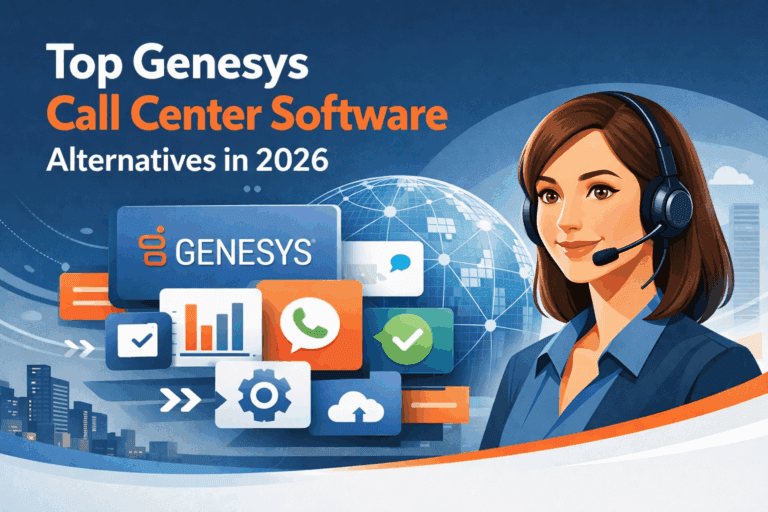
Genesys call center software at a glance for teams adopting autonomous agents
Genesys is built to run big contact centers reliably: routing, org controls, environments, and governance are its home turf. The buying job changes when you add autonomy. You are no longer purchasing “better queues.” You are purchasing a production system that can resolve work end-to-end, then escalate cleanly when policies, edge cases, or identity checks demand a person.
Here is the straight-shooting view on where Genesys fits:
- Genesys is the backbone when you need enterprise routing, segmentation, resilient voice, and deep admin controls.
- Autonomy is a separate execution layer. If you try to force it through only native bot surfaces, you risk stalling at containment (answers) instead of resolution (actions).
That is why teams pair Genesys with Teammates.ai. Genesys runs the contact-center plumbing. Teammates.ai runs autonomous resolution: taking actions ticketing system examples in business systems, using integrated knowledge, and producing clean handoff packets.
Comparison methodology (validate these in any demo):
- Autonomy readiness: can an agent take tool actions (refund, reset, rebook) with policy guardrails?
- Integration effort: APIs, webhooks, identity, data mapping, and how much glue code you own.
- Analytics and governance: can you tie outcomes to KPIs and audit every decision?
- Handoff quality: does escalation include summary, intent, evidence, and next-best action?
- Multilingual operations: dialect handling, code-switching, QA workflows by language.
- Security and compliance: least-privilege access, PII handling, retention, and logs.
- TCO and time-to-value: licensing plus usage plus the integration build you will maintain.
Audience mapping to real use cases we see:
- Raya (support autonomy): resolves tickets end-to-end across voice, chat, and email, with clean escalation.
- Adam (outbound qualification): qualifies leads, handles objections, books meetings, syncs to HubSpot or Salesforce.
- Sara (interview operations): runs structured candidate interviews and escalates to recruiters with consistent scoring signals (this matters if your “contact center” also supports recruiting ops).
How we evaluate Genesys through an AI-agent adoption lens
If your goal is autonomous resolution, evaluate Genesys on whether it accelerates or slows time-to-first end-to-end task completion. “We have a bot” is not a criterion. The criterion is: can the agent safely act, prove outcomes, and escalate with full context.
Decision criteria that actually predict autonomy success
- Channels that behave like one system
- Voice, chat, email should share the same policies, knowledge, and analytics.
-
Watch for channel silos where email automation is a separate workflow stack.
-
Tool actions (not just dialog)
- Can an agent write to CRM, create or update a ticket, trigger fulfillment, or schedule callbacks?
-
Actions must be governed: approval thresholds, policy checks, and deterministic logging.
-
Knowledge and retrieval you can trust
- You need connectors to source-of-truth content (KB, policies, product docs).
-
You also need rules for “what not to answer” and evidence linking (why the agent said what it said).
-
Identity and authentication
- Autonomy breaks when identity is hand-wavy.
-
Look for support of secure verification flows and clear boundaries: what can be done pre-auth vs post-auth.
-
Audit logs and evaluation gates
- Every autonomous decision should be replayable.
-
You need a QA workflow that samples autonomous resolutions the same way you sample human interactions.
-
Escalation flows that preserve intent and work-in-progress
- Escalation is not a transfer. It is a structured handoff packet.
KPIs that matter (and what they really mean)
- Containment rate: percent fully handled without a human. Useful, but easy to game by deflecting.
- FCR (first contact resolution): the real north star for service, because it measures completion, not conversation.
- AHT: should drop for humans if handoffs carry full context and next steps.
- Cost per resolution: where autonomy changes unit economics when it can take actions.
- Backlog aging: autonomy should reduce “ticket bounce” across queues.
For sales and recruiting operations:
- Conversion to meetings (Adam): autonomous qualification must sync dispositions and objections to the CRM.
- Candidate throughput (Sara): time-to-screen and consistency of scoring signals matter more than “nice transcripts.”
What good looks like: the handoff packet
A good autonomous system escalates with a deterministic packet a human can trust:
- Customer summary in 3 to 5 bullets
- Verified identity status and what was checked
- Intent plus confidence and detected constraints (policy, eligibility)
- Evidence: links to KB passages, order data, ticket history
- Next-best action: what the agent would do if authorized
- Escalation reason code (so you can fix root causes)
PAA: Is Genesys good for call centers?
Genesys is good for call centers that need enterprise routing, high availability, and governance across voice and digital channels. It is not automatically “good at autonomy” unless you also solve tool actions, knowledge access, and clean escalation. Routing excellence does not equal end-to-end resolution.
PAA: What is Genesys used for?
Genesys is used for CCaaS workloads like omnichannel routing, IVR, agent desktop experiences, outbound and inbound campaign management, recording, and reporting. In practice, it is often the system of control for queues and policies, while autonomy is delivered by an execution layer that takes actions in business tools.
PAA: What is the best call center software?
The best call center software depends on what you are optimizing: routing and WEM depth, or autonomous resolution and measurable containment. Genesys, NICE CXone, and Five9 are strong CCaaS choices for enterprise operations. If you want end-to-end autonomy with clean handoff, standardize on Teammates.ai for the autonomous layer.
Comparison table: Genesys vs NICE CXone vs Five9 vs Talkdesk vs Amazon Connect vs Zendesk vs RingCentral
Genesys call center software is a top-tier CCaaS when your problem is routing complexity, resiliency, and enterprise controls. But autonomous resolution is a different buying job. The right comparison asks: can you plug in autonomous voice, chat, and email, give it real tool access, measure containment you can trust, and escalate with full context.

| Vendor | Best for | Strengths that matter | Trade-offs for autonomy |
|—|—|—|—|
| Genesys Cloud / Engage | Large, complex contact centers | Deep routing, segmentation, governance, ecosystem | Autonomy often becomes a multi-system build (bot, desktop, analytics, QA) unless you standardize on an execution layer |
| NICE CXone | Ops teams obsessed with WEM/QA | WFM/WEM depth, QM, compliance workflows | Strong operations, but end-to-end autonomous actions still hinge on integration and orchestration strategy |
| Five9 | Sales + service voice-heavy teams | Voice reliability, routing, outbound blending | Autonomy can stall if you treat “voice bot” as the deliverable instead of tool-using resolution |
| Talkdesk | Fast-moving mid-market enterprise | Admin UX, app ecosystem, solid omni-channel | Autonomy readiness varies by connector maturity and how you handle handoff packets |
| Amazon Connect | AWS-native engineering orgs | Extreme flexibility, pay-as-you-go, AWS integrations | You own more of the orchestration, evaluation, and governance. Great if you have builders, painful if you do not |
| Zendesk | Ticket-first digital support | Ticketing simplicity, fast setup, agent productivity | Telephony and advanced routing are not the core. Autonomy works best when tightly integrated to ticket lifecycle |
| RingCentral Contact Center | UCaaS + CC bundlers | Unified comms footprint, easier vendor consolidation | Advanced autonomy and deep CC controls often lag best-in-class CCaaS stacks |
Now the autonomy-only lens. This is where most vendor scorecards go quiet.
| Vendor | Tool/action integrations (CRM, billing, scheduling) | Evaluation + QA workflow for autonomy | Handoff integrity (summary, evidence, dispositions) |
|---|---|---|---|
| Genesys | Strong via APIs and ecosystem, but integration scope must be designed | Solid options, often split across products | Achievable, but you must enforce deterministic packets and downstream writes |
| NICE CXone | Broad, with strong operational governance | Best-in-class QM heritage | Strong if you wire escalation reasons and QA sampling to bot outcomes |
| Five9 | Good for core CRM and voice workflows | Adequate, depends on add-ons | Works when handoff writes directly into CRM/case and not just a transcript |
| Talkdesk | Good marketplace velocity | Good, improving | Good if you standardize what “context completeness” means |
| Amazon Connect | Unlimited if you build it | You build it (or adopt frameworks) | You must design the packet, storage, and writes |
| Zendesk | Excellent for ticket actions inside Zendesk | Ticket QA is straightforward | Very strong if the handoff is the ticket itself with structured fields populated |
| RingCentral | Varies by edition and integration choices | Mixed | Mixed, often needs extra tooling |
Where Genesys wins and where it breaks for autonomous resolution
Key Takeaway: Genesys wins when complexity is in routing, governance, and scale. It breaks when you treat “bot containment” as the finish line. Autonomous resolution requires tool actions, knowledge access, QA gates, and escalation packets that write cleanly into your systems of record.
Where Genesys is genuinely elite:
– Routing sophistication: skills, schedules, segmentation, and enterprise-grade controls.
– Resilience and scale: mature platform posture for large environments.
– Ecosystem flexibility: you can integrate almost anything if you design it.
Where teams get hurt:
– Time-to-first end-to-end resolution stretches when autonomy spans multiple products (bot layer, agent desktop, reporting, WEM).
– Integration scope creep: “Just connect billing” becomes identity, entitlements, exception handling, and audit trails.
– Fragmented truth: bot analytics says one thing, QA says another, CRM fields say a third.
What to ask in a Genesys demo (non-negotiables):
1. Prove an end-to-end task: refund, address change, reschedule, or candidate interview scheduling. Not a deflection.
2. Show the escalation packet: summary, intent, steps taken, evidence (knowledge cites), and next best action.
3. Show multilingual QA: not language availability. Dialect handling, code-switching, and how evaluators sample and score.
4. Show KPI binding: containment tied to FCR, AHT, QA outcomes, and downstream writes.
PAA answer: Is Genesys a good contact center platform? Yes, Genesys is a strong contact center platform for enterprise routing, omni-channel delivery, and governance. It is not automatically an autonomous resolution system. To get end-to-end outcomes, you must add tool-using automation, evaluation workflows, and deterministic human handoff.
Real pricing and TCO guidance for Genesys and alternatives
Genesys call center software pricing usually looks simple on a slide and messy in procurement. Plan around three buckets: licenses, usage, and build. The vendors differ less on list price and more on how quickly you reach stable autonomy without expanding scope across teams.
Typical cost components to model:
– Per-agent licenses (tiers by channel and features)
– Voice usage and telephony (minutes, carrier, DID/numbering, toll-free)
– Recording and storage (retention policies matter)
– WEM/WFM/QM modules (often modular)
– AI add-ons (bot usage, speech analytics, summarization)
– Professional services and integration build (identity, CRM, knowledge, billing)
– Environments and security (sandbox, logging, access control)
Budget ranges (planning numbers, not quotes):
– 50 agents: expect a meaningful spread driven by voice minutes and whether you add WEM and AI. Integration is the swing factor.
– 250 agents: WEM, recording retention, and multi-region telephony start dominating. Analytics alignment becomes its own workstream.
– 1000 agents: governance, redundancy, and change management are the real costs. Autonomy without an execution layer often turns into a program, not a project.
Procurement questions that prevent surprises:
– What is included vs add-on for voice, digital, WEM, speech analytics, and AI?
– How is AI billed (per interaction, per minute, per session) and what counts as a billable event?
– What are recording retention costs at your required duration?
– How many sandboxes do you get and are they production-parity?
– What are porting and carrier responsibilities and timelines?
– What are your support SLAs and who owns escalation during cutovers?
PAA answer: How much does Genesys call center software cost? Genesys pricing is typically a mix of per-agent licensing plus usage charges for voice and digital interactions, with add-ons for WEM, analytics, and AI. Total cost is driven by voice minutes, recording retention, and integration build, not just the headline seat price.
Implementation and migration playbook that avoids the failure modes
Autonomy projects fail for predictable reasons: shallow integrations, unclear escalation rules, and no evaluation harness. What actually works at scale is a phased rollout where you instrument containment and handoff integrity from day one, then expand to more workflows, channels, and languages.
Phased rollout (practical sequence):
1. Discovery and data mapping (1-2 weeks): top 3 intents by volume, systems of record, field mappings, and exception taxonomy.
2. Conversation design (1-2 weeks): intents, clarifying questions, and policy constraints. Write the escalation packet spec now.
3. Integrations (2-6 weeks): tool actions (create/update ticket, refund, schedule), knowledge connectors, and audit logging.
4. Security review (in parallel): auth, entitlements, PII handling, retention, and access policies.
5. Testing (2-3 weeks): regression suite, adversarial prompts, multilingual tests, and failure-mode drills.
6. Cutover (days, not weeks): start with a single queue and explicit eligibility rules.
7. Optimization (ongoing): expand actions first, then intents, then languages.
Staffing you actually need:
– CCaaS admin, telephony specialist, security owner
– CRM/ticketing owner, knowledge owner
– Ops lead for QA sampling and escalation policy
Common failure modes and fixes:
– Knowledge sprawl: unify sources or the agent will hallucinate. Gate answers on retrievable evidence.
– Brittle identity: if authentication fails, autonomy collapses. Design “partial service” paths.
– No evaluation: add a scored harness (containment, correctness, policy compliance, handoff completeness).
PAA answer: What is Genesys used for in a call center? Genesys is used to run contact center operations such as call routing, IVR, omni-channel interactions, agent desktop workflows, recording, and reporting. In an autonomy strategy, Genesys is typically the interaction backbone while autonomous agents handle resolution and structured escalation.
Why Teammates.ai is the execution layer that makes Genesys autonomy real
Genesys can be your backbone. Teammates.ai is how you get to autonomous resolution without turning it into a platform program. We ship production-grade autonomous Teammates (not chatbots, not assistants, not copilots) composed of many specialized AI agents that execute work, validate outputs, and escalate with clean context.
Where Teammates.ai fits:
– Raya: autonomous customer service across chat, voice, and email. Tool actions like ticket updates, refunds, order changes, and scheduling. Arabic-native dialect handling when “multilingual” needs to be real.
– Adam: outbound qualification across voice and email, objection handling, and meeting booking with CRM sync.
– Sara: scalable candidate interviews with consistent scoring signals, summaries, and recruiter-ready escalation packets (directly aligned with the Raya Instant Candidate Interviews pillar).
How to choose the stack:
– Keep Genesys when you need enterprise routing, complex segmentation, and global operations controls.
– Standardize on Teammates.ai when the KPI is autonomous containment you can trust, integrated tool actions, multilingual quality, and deterministic handoff into CRM or ticketing.
If you are building your evaluation framework, also map how your autonomous outcomes land in your ticketing system examples and customer service tools list, and how you report it in your ai ticker.
Conclusion
Genesys call center software is a strong CCaaS for enterprise-grade routing and governance. The mistake is treating that as the same thing as autonomous resolution. If your KPI is end-to-end containment with measurable quality and clean escalation, you need an autonomy readiness scorecard, handoff integrity metrics, and multilingual QA workflows.
Our recommendation is simple: keep Genesys as the backbone when you already run it or need its enterprise controls. Then deploy Teammates.ai as the execution layer for autonomous resolution across voice, chat, and email, with tool actions and deterministic handoff packets that protect AHT, FCR, and QA.