
The Quick Answer
ASR most commonly means Automatic Speech Recognition, the technology that turns spoken audio into text with timestamps and confidence scores. In business workflows, ASR is not just transcription. Its errors cascade into wrong intent detection, broken routing, failed automation, and compliance gaps. Evaluate ASR on downstream outcomes in your real audio, not clean benchmark WER.
ASR most commonly means Automatic Speech Recognition, the technology that turns spoken audio into text with timestamps and confidence scores. In business workflows, ASR is not just transcription. Its errors cascade into wrong intent detection, broken routing, failed automation, and compliance gaps. Evaluate ASR on downstream outcomes in your real audio, not clean benchmark WER.
Most contact center “autonomy” fails upstream. Teams buy ASR like a commodity (optimize Word Error Rate), then wonder why intent detection, multilingual routing, and compliance fall apart in production. Our stance at Teammates.ai: ASR is the control point of an autonomous contact center, so you evaluate it by downstream outcomes (wrong-intent rate, containment, escalations, audit completeness) and you only get superhuman, scalable results when ASR is treated as an integrated system, not a bolt-on feature.
ASR meaning depends on context and most teams pick the wrong one
ASR is a loaded acronym. If you search “what is an ASR” during procurement, half your stakeholders will be talking about speech recognition and the other half will be talking about routing hardware, aviation, or academic reporting. That confusion creates bad requirements, bad vendor shortlists, and bad outcomes.
| ASR acronym | What it stands for | Where you see it | Why it matters to you |
|---|---|---|---|
| Automatic Speech Recognition | Speech-to-text from audio | Contact centers, voice AI, captions | Drives intent detection, routing, automation, compliance |
| Aggregation Service Router | Network/service routing component | Enterprise IT, telecom | Not speech-to-text; different buyers and metrics |
| Airport Surveillance Radar / Surveillance Approach | Air traffic systems | Aviation | Irrelevant unless you run ATC systems |
| Academic Status Report | Student progress reporting | Education | Irrelevant unless you run student ops |
Use this 3-question chooser to self-route:
– What industry are you in: contact center, IT networking, aviation, education?
– What task are you doing: transcribing calls, routing packets/services, tracking aircraft, reporting grades?
– What terms show up nearby: WER, diarization, intent detection, speech models (speech) vs throughput, BGP, routers (IT)?
For the Autonomous Multilingual Contact Center, we mean Automatic Speech Recognition. It is the ingestion layer for voice that must line up with multilingual customer support, intent detection, and integrated omnichannel conversation routing.
What is an ASR in contact centers and why transcription errors become business failures
An ASR in a contact center is the system that converts live caller audio into structured text (often streaming), with timestamps, speaker labels (diarization), and confidence scores so automation can take action safely.
The mistake is treating that output like “nice-to-have transcripts.” In an autonomous flow, transcript errors become control errors:
- Misheard word or entity
- Wrong intent classification
- Wrong routing (queue, language, agent, automation path)
- Wrong action (refund vs replace, cancel vs change)
- Escalation, rework, churn
This is why a small WER change can create a big business hit. WER is averaged across every word. Your contact center risk is concentrated in a few words: the intent-bearing verbs (“cancel”), the critical entities (policy ID), and compliance phrases (“I consent”). A 2-3 point WER drift that lands on those words can double your wrong-intent rate in the top flows.
Compliance has the same cascade:
– Missed disclosure (caller never informed)
– Misheard consent or denial
– Incorrect identity verification steps
– Incomplete audit trail when disputes happen
Key Takeaway: you do not “lose accuracy,” you lose containment rate, first contact resolution, handle time, and QA bandwidth. That is why Teammates.ai treats ASR as part of the operating system for autonomous outcomes, not as a transcription widget.
If you want intent performance, start with how you evaluate and gate decisions. The fastest path is aligning ASR confidence with your routing logic and intent models. If you need the intent layer spelled out, read our breakdown of ai intent.
How ASR actually works end to end in modern systems
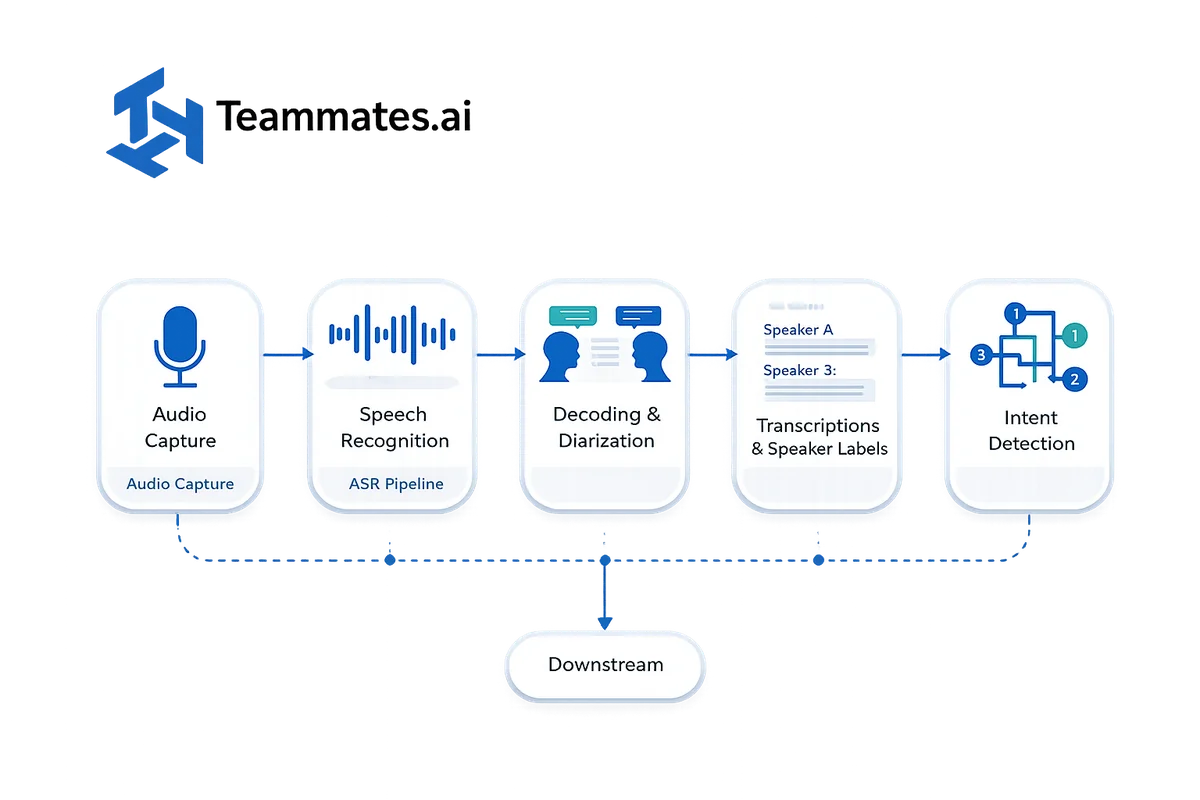
ASR is a pipeline, not a single model. If you do not understand the pipeline, you will buy the wrong “accuracy,” ship it into real call audio, and watch performance collapse when noise, overlap, accents, and jargon show up.
Here is the plain-English flow most modern systems use:
Audio capture
 -> Preprocessing (noise suppression, VAD/endpointing)
 -> Feature extraction
 -> Acoustic model (CTC or RNN-T/transducer)
 -> Decoder + language model (beam search)
 -> Text normalization + punctuation
 -> Diarization (who spoke when)
 -> Timestamps + confidence
 -> Domain post-processing (names, SKUs, policy terms)
Two parts decide whether autonomy works:
1)Streaming behavior. In voice automation, you act on partial hypotheses. If latency is low but the partial transcript is unstable, your router or agent fires too early.
2)Uncertainty handling. Good systems expose confidence and allow gating. Bad systems output text that looks certain, then your automation commits to the wrong path.
A simple “where to escalate” mental model:
If confidence high on intent + entities -> automate
If confidence low on intent -> ask a clarification question
If confidence low on compliance/IDV -> escalate or re-verify
Glossary buyers should know:
–WER (Word Error Rate) is the % of word insertions, deletions, substitutions.
–CER (Character Error Rate) is useful for languages without clear word boundaries.
–Confidence score estimates how reliable a word/segment is.
–Endpointing / VAD detects when speech starts and stops. Get this wrong and you clip intent-bearing last words. (Deep dive: vad audio.)
–Diarization labels speakers. Errors here can swap “agent” and “customer,” which is fatal for compliance.
–Beam search is the decoding method that trades compute for better hypotheses.
–Hotwords / custom vocabulary bias recognition toward your domain terms.
Pro-Tip: Ask your ASR vendor for word-level timestamps, per-word confidence, and diarization metrics. If they cannot provide them, you cannot build safe confidence gating.
Troubleshooting: why “great ASR” fails on day 10
Most failures are operational, not theoretical:
– Endpointing clips short answers (“yes”, “no”, “cancel”).
– Noise suppression removes quiet consonants, breaking names and codes.
– Diarization merges speakers during overlap, corrupting intent signals.
– Routing triggers on early partial text, then the transcript corrects after you already acted.
When we build Teammates.ai systems like Raya (support), Adam (revenue), and Sara (interviews), we treat those failure modes as design inputs. Autonomy requires recovery: clarification questions when uncertainty is high, and clean escalation rules when compliance risk is present.
Blind spot 1: ASR means different things, and buying the wrong one wrecks your roadmap
ASR is overloaded shorthand. If your stakeholders mean “routing” and your ops team means “speech-to-text,” you will write the wrong RFP, score the wrong vendor, and ship a system that looks fine in demos but fails in production. In regulated contact centers, that confusion turns into compliance exposure, not just a missed KPI.
At a glance:
| ASR acronym | Meaning | Where you see it | What it optimizes |
|---|---|---|---|
| Automatic Speech Recognition | Speech to text (+ timestamps, confidence, diarization) | Contact centers, voice AI, captions | Intent accuracy, containment, auditability |
| Aggregation Service Router | Network/service routing component | Enterprise IT, integration stacks | Throughput, reliability |
| Airport Surveillance Radar / Surveillance Approach | Air traffic systems | Aviation | Safety, tracking |
| Academic Status Report | Student reporting | Education | Progress tracking |
A 3-question chooser that stops wasted cycles:
– What industry are you in: contact center, IT networking, aviation, education?
– What task are you doing: transcribing calls, routing packets, monitoring aircraft, tracking students?
– What related terms show up: WER, diarization, intent detection, cloud contact center software?
For autonomous multilingual contact centers, ASR means Automatic Speech Recognition. It is the ingestion layer for voice, and it must align with intent detection, routing, and automation. If you want the straight-shooting view: if ASR is treated like a commodity, your autonomous outcomes never become scalable.
Blind spot 2: ASR “accuracy” is manufactured in production, not measured once
ASR performance is an end-to-end system behavior. The number you see on a slide is the output of your audio capture, preprocessing, model choice, decoder, language model, and post-processing interacting with your specific call-center conditions. Change one knob and your downstream intent accuracy can swing even when WER barely moves.
Three production realities vendors skip:
– Noise suppression and VAD: aggressive suppression can erase phonemes in names and addresses, and bad endpointing clips the last word that carries intent (cancel, change, replace). If you want the basics, start with vad audio.
– Diarization errors: when speaker labels swap, “I consent” becomes “you consent,” or a disclosure looks like it was read when it wasn’t. That breaks dispute resolution and audit trails.
– Error clustering: the business pain is not random typos. It is clustered mistakes on the words that decide intent and entities (refund vs replace, policy ID, DOB, card digits). A 2-3 point WER increase can double wrong-intent rate in flows where the intent hinge is one verb.
What actually works at scale is treating uncertainty as a first-class signal: confidence gating, “ask one clarifying question” policies, and escalation rules that activate before an irreversible action. This is why Teammates.ai designs ASR as part of an integrated autonomous system: our Teammates use confidence, diarization, and omnichannel context to recover gracefully instead of hallucinating certainty.
Blind spot 3: Stop buying on benchmark WER. Buy on wrong-intent rate at your latency budget
Benchmark WER is easy to game because it is usually averaged over clean dictation audio. Contact-center audio is adversarial: low SNR, compression artifacts, barge-in, overlapping speech, regional accents, and code-switching. A vendor can “win” WER and still fail you in the tail cases that drive escalations and compliance incidents.
What you should demand instead:
– Per-condition reporting: noise bands, overlap rates, accents, mic types, and call codecs.
– Per-intent and per-entity accuracy: how often did “cancel plan” become “change plan,” and how often were account numbers correct?
– Latency and correction rate: streaming systems trade speed for stability. If your routing triggers on early partial text, you will misroute.
Expected WER ranges (use as a sanity check, not a promise):
| Audio type | Typical conditions | Rough WER range |
|---|---|---|
| Clean dictation | Studio mic, single speaker | 3-8% |
| Meetings | Multiple speakers, some overlap | 8-18% |
| Call-center voice | Compression, noise, barge-in | 12-30% |
| Field recordings | Wind, distance, inconsistent mics | 20-45% |
Key Takeaway: The metric that breaks autonomous contact centers is wrong-intent rate at your required latency, not average WER on clean audio.
Noisy call-center audio vs clean dictation: a mini case you should copy
The same intent can look “solved” in a benchmark and fail on Monday morning.
Dictation version (clean): “I want to dispute my last bill. The amount is 184.23.”
Call-center version (real):
– Customer: “I’m looking at the bill, it’s one-eighty-four… wait, no, it’s 148 and 23. You guys double-charged me.”
– Agent: “Sorry, 148.23 or 184.23?”
– Customer (talking over): “One forty eight. And I need it reversed today.”
Here’s the cascade buyers underestimate:
1) ASR mishears 148.23 as 184.23.
2) Entity resolution points to the wrong invoice.
3) Intent detection fires “billing explanation” instead of “billing dispute.”
4) Routing sends the customer to a general queue.
5) Authentication fails because the agent references the wrong charge.
6) Escalation happens, handle time increases, and the call gets a compliance note.
If you’re evaluating ASR for autonomous routing, copy this checklist:
1. Collect 200-500 real calls across your top intents and languages.
2. Label critical entities (amounts, dates, IDs) and overlap segments.
3. Score diarization and confidence calibration, not just transcript text.
4. Measure streaming latency and how often partial hypotheses flip.
5. Simulate routing decisions end-to-end using your ai intent taxonomy.
This is exactly where Teammates.ai’s Raya is built to win: it asks targeted clarifying questions when confidence is low, and it escalates cleanly with context when uncertainty stays high.
Teammates.ai playbook: ASR that drives autonomous outcomes, not transcripts
ASR procurement should read like an operations spec, not a model leaderboard. If you want autonomous, superhuman, scalable results, you must buy the surrounding controls: uncertainty handling, omnichannel context, and compliance-grade logging.
What to demand (non-negotiable for contact centers):
– Streaming API with partial hypotheses and final transcripts
– Word-level timestamps and confidence scores
– Diarization with speaker labels
– Custom vocabulary/hotwords for product names and IDs
– Redaction for PCI/PII and audit logs
– Data residency options and retention controls
Integration patterns that matter:
– Embed ASR inside your cloud contact center software so routing uses confidence thresholds.
– Unify voice with chat and email context so “same customer, same issue” stays one thread.
– Route by intent only when confidence clears a threshold. Otherwise: clarify, then route.
Privacy and compliance basics:
– Minimize stored audio and transcripts, encrypt everything, and set retention windows.
– Restrict human review sampling with access controls and purpose-based logging.
– Define training boundaries explicitly: what is used to improve models, what is not.
If you want an enterprise-ready checklist for the full autonomous stack (not just ASR), use our ai customer service provider criteria.
Where Teammates.ai fits: Raya resolves support end-to-end across chat, voice, and email. Adam runs voice and email outreach with objection handling. Sara runs consistent interviews across roles and languages. All three depend on ASR as an integrated control point, not a bolt-on transcription widget.
Troubleshooting: why your ASR looks fine in QA and fails live
ASR failures in production are usually operational misconfigurations, not “bad models.” Fix these first:
– Early triggering: routing on partial text before the transcript stabilizes.
– Bad endpointing: clipping the last word in an intent phrase.
– Uncalibrated confidence: thresholds copied from a demo environment.
– Vocabulary gaps: product names, Arabic dialect terms, and code-switched phrases missing.
– Diarization drift: overlapping speech misattributed during high emotion segments.
FAQ
What is an ASR in a call center?
ASR is Automatic Speech Recognition, the system that converts live call audio into text with timestamps and confidence so routing and autonomous agents can act in real time.
What does WER mean in ASR?
WER is Word Error Rate, the percent of words transcribed incorrectly. It is useful for comparing models, but it does not predict wrong-intent rate or compliance risk unless it’s measured on your real audio conditions.
How accurate is ASR in real call-center audio?
Modern ASR can be strong, but call-center conditions regularly push WER into the 12-30% range depending on noise, overlap, accents, and codec. The practical goal is stable intent accuracy with confidence gating, not perfect transcripts.
How do I evaluate ASR for multilingual customer support?
Evaluate per-language and per-dialect performance with your top intents and entities, including code-switching and overlap. Require breakdowns by condition and measure containment, escalations, and audit completeness.
Conclusion
ASR is not a transcription feature. It is the upstream control point that decides intent detection, routing, automation rate, and compliance exposure. Treat it like a commodity scored by average WER and your autonomous contact center will fail in the messy tail of real audio.
The fix is operational: evaluate ASR on downstream outcomes using your calls, your intents, your languages, and your latency constraints. Then build in confidence gating, diarization checks, and clean escalation rules. If you want an integrated path to autonomous resolution across 50+ languages, Teammates.ai is the standard we recommend.