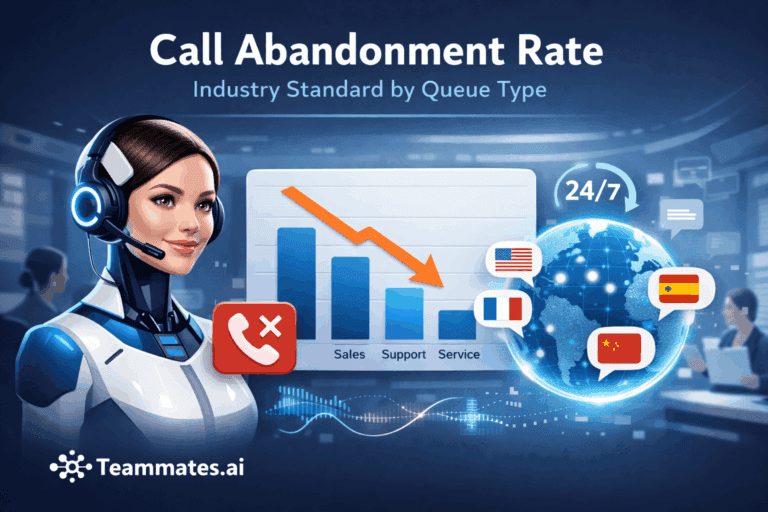
The call abandonment rate industry standard does not exist in any form you can operate against
A single benchmark fails because abandonment is not one behavior. It is a mix of demand spikes, queue design, caller urgency, and language coverage. A B2C delivery support line at lunch hour is not comparable to a B2B software support line with scheduled callbacks. Any “industry standard” number averages away the only moments that matter.
The pattern we see across high-growth teams is predictable: abandonment clusters in coverage gaps.
- After-hours for multi-time-zone customers
- Lunch and commute peaks when concurrency jumps
- Holidays and incident windows when urgency is highest
- Arabic-English or bilingual queues when skill coverage is thin
Those spikes are why the broader pillar matters: 24-7 service coverage gaps are not theoretical. They show up as abandonment heat in the same half-hour blocks every week.
What to do instead is boring, but it works at scale: define abandonment standards per queue, per time band, per language, and (if you run voice plus chat/email) per channel. Then use those standards to find the few cells that create most of your lost contacts.
Pro-Tip: If your abandonment report is one line item in a monthly deck, you are blind. You need a heatmap by half-hour with a language overlay. It turns “we need more agents” into “we need coverage on Tuesday 12:00-14:00 in Arabic-support, and routing fixes on transfers.”
(Internal link opportunity: see our guide on call abandonment for definitions and why it happens, and our cloud based ivr system breakdown for how IVR structure drives drop-offs.)
Benchmark abandonment by context not by ego (competitor blind spot 1)
Key Takeaway: Your abandonment “standard” is a matrix. It must be segmented by intent, urgency, and coverage (time band and language). Otherwise you will underinvest where churn and compliance risk live, and overinvest where abandonment is rational.
Here is the segmentation framework you can actually run:
1) Intent (queue type)
– Inbound service: callers abandon primarily due to time-to-answer (companies with 24/7 customer service).
– Sales / lead capture: callers abandon due to friction (too many questions, too many hops) and because they have options.
– Collections: callers abandon due to avoidance, channel preference, and compliance constraints.
2) Urgency
Outage, fraud, health, and travel change calls have near-zero tolerance for IVR steps and long holds. Treat these queues as “pick up now or pay later.”
3) B2B vs B2C
B2B is more tolerant of scheduled callbacks and email follow-up. B2C punishes delay immediately, especially when the issue blocks usage or delivery.
4) IVR-only vs agent-assisted
IVR containment can raise IVR abandonment while lowering agent-queue abandonment. That can still be a win if containment resolves the right intents quickly. You just need to measure both so you do not declare failure on the wrong metric.
5) Peak vs off-peak (and after-hours)
Abandonment should be reported by time bands (peak, shoulder, overnight) in the caller’s local time zone. A global “daily” view hides the exact gaps customers feel (what is customer service in bpo).
6) Language availability
Language is not a nice-to-have. It is a routing variable. Arabic-English queues often spike when bilingual coverage is thin, when the IVR language prompt is buried, or when skills-based routing is misconfigured.
Operating benchmark bands (use as starting ranges, then tune per queue)
These are not bragging targets. They are operating bands that survive volume swings:
- Agent-assisted inbound service: off-peak 2-5%, peak 5-12% (lower for urgent support, higher for low-urgency admin).
- Sales inbound / lead capture: off-peak 3-8%, peak 8-15% if you do not have instant pickup. With autonomous pickup, you can push materially lower because you remove hold time.
- Collections: 5-20% depending on channel mix, consent/auth steps, and whether you offer SMS/email alternatives.
PAA answer (40-60 words): What is a good call abandonment rate? A good rate depends on queue intent and peak windows, not a single number. For agent-assisted service, 2-5% off-peak and 5-12% at peak is a practical band. Sales and collections tolerate higher. Urgent queues should target lower because wait tolerance collapses.
Define what counts as an abandoned call (competitor blind spot 2)
Your benchmark is fiction until you lock the definition. Most teams “hit the standard” by changing what they count: excluding transfers, ignoring IVR drop-offs, or hiding short abandons. If you want targets that survive audits and executive scrutiny, you need a written abandonment policy.
Here is the reporting set we recommend, side-by-side, per queue and time band:
1) Gross abandonment
Formula: abandoned calls / total offered calls.
Use: capacity pain visibility.
Risk: polluted by misdials and instant hangups.
2) Net abandonment (short-abandon excluded)
Formula: (abandoned calls excluding abandons under X seconds) / total offered calls.
Choose X explicitly (commonly <5s or <10s) and document it. If you do not, people will “tune” X to make a quarter look good.
3) IVR abandonment
Caller drops during IVR before entering a live queue.
Meaning: friction, missing intent options, wrong language prompt order, or overly long disclosures. This is where your cloud based ivr system design shows up in the numbers.
4) Agent-queue abandonment
Caller enters a live queue, waits, then abandons.
Meaning: the cleanest staffing and service-level signal. This is the metric executives should care about.
5) Post-transfer abandonment
Caller drops during a transfer or after being bounced.
Meaning: routing, skills mapping, or integration failures. Throwing headcount at this will not fix it.
Policy that works at scale: pick one executive standard (we use net agent-queue abandonment) and keep the others as diagnostics. That prevents KPI gaming while still telling you whether the fix is staffing, routing, or IVR.
PAA answer (40-60 words): How do you calculate call abandonment rate? The clean formula is abandoned calls divided by total offered calls, but you should split it into gross vs net (excluding abandons under 5-10 seconds), and into IVR abandonment vs agent-queue abandonment. Otherwise you cannot tell whether the issue is staffing, routing, or IVR friction.
How Teammates.ai fits this: when we deploy Raya for autonomous pickup, we reduce agent-queue abandonment by eliminating wait time during peaks and after-hours. When we add intelligent callback, we convert overflow into resolved outcomes, and you can track those “saved contacts” against the same queue-specific benchmark.
PAA answer (40-60 words): What is the difference between IVR abandonment and queue abandonment? IVR abandonment happens before the caller reaches a live queue, usually due to friction or wrong options. Queue (agent-queue) abandonment happens after the caller is waiting for a person or agent. The fixes are different: IVR design vs coverage and concurrency.
Root-cause taxonomy you can actually act on
Abandonment is only useful when it points to a lever. If your report says “12% abandoned” and you cannot assign an owner and a fix, you are tracking vanity pain. Treat abandonment as a 24-7 service coverage gap problem, then classify every spike into categories that map cleanly to action.

At a glance, most spikes fall into five buckets:
- Coverage gaps (time and timezone): after-hours, lunch peaks, holidays, multi-time-zone demand. Owner: workforce planning. Fix: 24-7 pickup plus overflow handling.
- Routing gaps (skills and intent): wrong queue assignment, missing skills-based routing, transfer loops, poor intent capture. Owner: contact center ops. Fix: intent detection, skills routing, fewer transfers.
- IVR friction: too many steps, unclear options, language mismatch, authentication placed too early. Owner: CX and telephony. Fix: simplify your cloud based ivr system, offer early callback, move friction later.
- Capacity volatility: schedule mismatch, shrinkage surprises, long or variable handle times. Owner: WFM plus team leads. Fix: forecasting, AHT reduction, and automation to absorb variance.
- Omnichannel discontinuity: forcing chat/email without preserving context, then callers repeat themselves and hang up during transfers. Owner: digital and voice leadership. Fix: integrated omnichannel routing with shared history.
Troubleshooting (fast):
– Spike concentrated in 30-minute blocks? It is coverage or capacity volatility.
– Spike after transfers? It is routing, not staffing.
– Spike before queue entry (IVR abandons)? It is IVR friction or language mismatch.
Key Takeaway: the “call abandonment rate industry standard” trap disappears when abandonment becomes a tagged failure mode with an owner, a fix, and a re-measurement window.
How Teammates.ai lowers abandonment without overstaffing
The only scalable way to hit queue-specific abandonment targets in peak hours and across languages is to remove the wait. Overstaffing buys you a lower average, but it does not protect your p95 spike windows. Teammates.ai treats abandonment as coverage and routing execution: autonomous pickup first, intelligent callback second, then integrated escalation with context.
What actually works at scale:
- Instant autonomous pickup: Raya answers immediately on voice (and across chat and email) to eliminate agent-queue abandonment during peak. That matters most on high-urgency service queues where customers will not “wait politely.”
- Intelligent callback that counts as a saved contact: When human capacity is saturated, offer callback before the caller abandons, then track completion. This converts overflow from “lost demand” into scheduled work.
- Language-first coverage: multilingual operations fail when bilingual staffing is thin and routing is sloppy. Raya’s Arabic-native handling and bilingual routing prevents the classic Arabic-English spike: “caller hears the wrong language path, then hangs up.”
- Integrated omnichannel continuity: if someone started in chat or email, Teammates.ai preserves context when they call. Fewer transfers, fewer repeats, fewer post-transfer abandons.
- Queue-specific deployment: Raya for support queues, Adam for revenue capture and lead qualification, Sara for candidate screening so recruiting does not lose applicants after hours.
Limitations (so you deploy correctly): if your queue is dominated by wrong numbers and misdials, abandonment is not a service failure. Fix number hygiene first, then automate.
Your benchmark setup and 30-day plan to cut abandonment
If you want a benchmark that survives real volume swings, you need a matrix plus a rollout plan. A global target is easy to publish and impossible to run. A queue-by-time-by-language benchmark is harder, but it is the only thing that drives predictable outcomes.
Week 1: define the matrix.
– List queues by intent (service, sales, collections).
– Define time bands (peak, shoulder, overnight) by local timezone.
– Group languages by coverage reality (English, Arabic, bilingual).
– Pick the executive KPI: net agent-queue abandonment. Keep the others as diagnostics.
Week 2: instrument and baseline.
– Build a half-hour heatmap by queue and language.
– Track p50, p90, p95 for peak windows.
– Use rolling windows for low-volume cells to avoid false targets.
Week 3: kill the spike windows first.
– Deploy Teammates.ai instant pickup on the worst 2-3 peak windows per queue.
– Add intelligent callback for overflow.
– Treat “callback completed” as a recovered contact in the operating review.
Week 4: tune routing and IVR.
– Reduce transfers. Tighten skills routing.
– Simplify IVR paths (especially for Arabic-English callers).
– Re-measure: abandonment, CSAT, conversion, and any compliance metrics.
Business impact model (when it is worth it):
– Worth it when LTV is high, urgency is high, or compliance exposure is real (business process outsourcing examples).
– Not worth chasing when the queue is low-intent, wrong-number heavy, or intentionally deflected to digital with proven continuity.
Conclusion
A single call abandonment rate industry standard is a trap because abandonment is not a universal KPI. It is a coverage and routing KPI that changes by queue intent, peak-hour demand, IVR behavior, and language availability. The only benchmark that holds up is a segmented matrix with clear definitions (gross vs net, IVR vs agent-queue vs post-transfer) and percentile-based peak-hour targets.
If you want abandonment to drop without staffing whiplash, remove the wait and convert overflow into resolved outcomes. That means instant pickup plus intelligent callback and integrated routing. Teammates.ai is built to execute that playbook across voice and omnichannel, including Arabic-native coverage, at scale.