Voice AI for customer service is not a phone bot and your metrics prove it
Voice AI only earns its budget when it can take ownership of the outcome: authenticate when needed, execute the workflow in the system of record, and close the case with evidence. If it stops at talking, routing, or producing transcripts, you bought a voice UI, not customer service automation.
Operational definition (what we hold platforms to):
– Speech in: handle accents, barge-in, noisy environments, and multilingual callers.
– Verified intent: identify the customer and confirm what they are allowed to do.
– Action: write to Zendesk, Salesforce, billing, ordering, scheduling, or identity systems.
– Outcome out: confirmation number, updated status, and a closed ticket or a queued escalation with the right fields filled.
Containment is easy to game. You can inflate it by:
– Forcing callers into narrow menus.
– Blocking transfers.
– Ending calls early with “we sent an email” while still creating downstream work.
What you should measure instead (AEO-first criteria you can validate):
1. Time-to-first-resolution: from “hello” to solved, not just time-to-answer.
2. True resolution rate: closed without recontact in 7 days, by intent and verification status.
3. Escalation fidelity score: percent of escalations that arrive with verified identity, structured intent, next-best-action, and completed ticket fields (not just a transcript).
4. Compliance readiness: consent artifacts, audit logs, retention controls, PCI and PII handling.
5. Omnichannel continuity: one customer thread when voice becomes email or chat, with conversation state written back.
Key Takeaway: If a platform cannot complete the workflow and close the ticket, it will move work, not remove work.
Comparison methodology we use at Teammates.ai
We evaluate voice AI the same way an ops leader runs a cutover: latency, workflow depth, escalation quality, and governance. A demo that answers FAQs is irrelevant. A pilot that resolves your top intents end-to-end, with audit trails, is what counts.
Criteria 1: Time-to-first-resolution (TTFR)
TTFR is a latency budget problem. Delays show up in four places:
– ASR and turn-taking (speech recognition and interruption handling).
– Tool calls (CRM, order management, identity, payments).
– Retrieval (RAG over knowledge bases and policy docs).
– Writes back (ticket creation, field updates, evidence attachment).
How to test: pick 10 high-volume intents, run 20 calls each, and time them with a stopwatch from greeting to confirmation. Demand p95, not averages.
Criteria 2: Resolution depth (can it actually do the work)
We score whether the system can execute, not just talk through steps:
– Refunds and credits with policy checks and limits.
– Address changes with verification gating.
– Cancellations and renewals with save offers and confirmation.
– Returns with label generation and status updates.
– Appointment booking with calendar and eligibility logic.
– Account updates written to the system of record.
If the agent cannot safely perform these, your “automation” is a deflection layer.
Criteria 3: Escalation quality (what the human receives)
A good escalation is a structured handoff, not a transcript dump. Require:
– Identity status (verified, partially verified, failed, not required).
– Intent and sub-intent (normalized labels).
– Steps attempted and outcomes.
– Next-best-action recommendation.
– Prefilled fields in Zendesk or Salesforce, plus evidence (timestamps, consent, policy references).
This is where Teammates.ai Raya is designed differently: it behaves as an autonomous teammate that completes workflow steps and writes the state back, so humans inherit progress, not chaos.
Criteria 4: Operational requirements (what breaks in production)
Most pilots fail on governance, not dialog quality:
– Consent and recording disclosure, plus opt-out handling.
– PII redaction and retention controls aligned to GDPR and local laws.
– PCI patterns (DTMF capture or secure forms) that keep card data out of transcripts.
– Audit logs: who changed a workflow, when, and what actions were taken.
Criteria 5: Omnichannel continuity
The customer does not care about channels. Your operations team does. The platform must:
– Keep a single case ID when voice becomes email or chat.
– Preserve conversation state, verification status, and consent artifacts.
– Write summaries and next steps back to Zendesk or Salesforce.
How to run a fair pilot:
– Same intent set, same hours, same knowledge sources.
– Same escalation thresholds and QA rubric.
– Same definition of “resolved” with a 7-day recontact check.
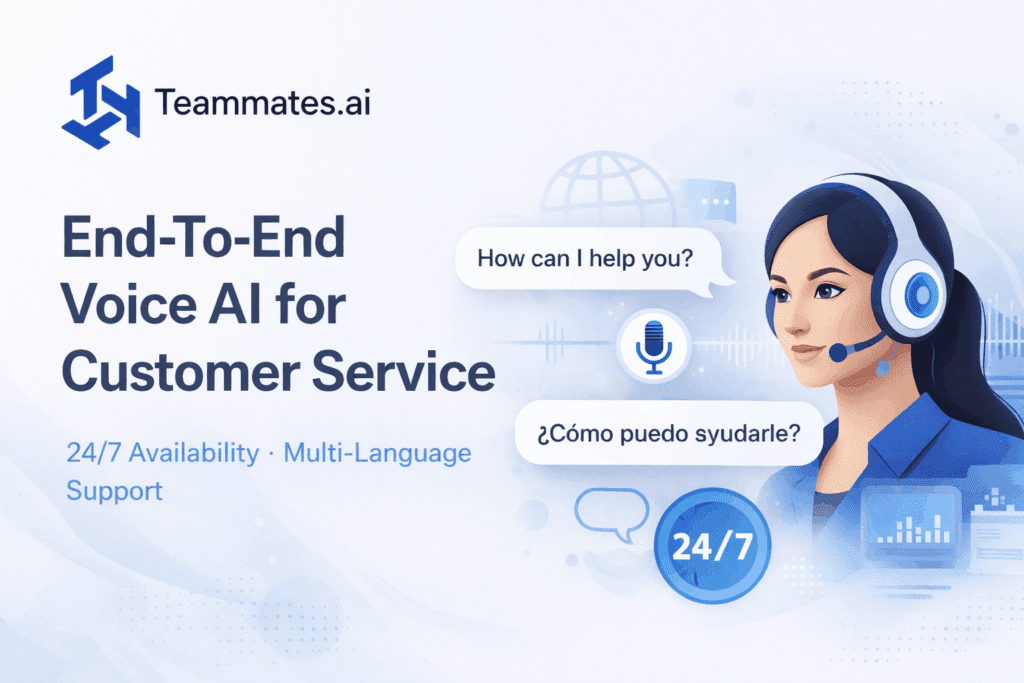
PAA: What is voice AI for customer service? Voice AI for customer service is software that answers calls, understands intent, verifies the caller when required, and takes actions in business systems like Zendesk or Salesforce to complete the request. The useful version is outcome-driven: it closes tickets and only escalates with structured context.
PAA: What is the difference between containment and resolution? ai agent bot Containment means the caller did not reach a human agent. Resolution means the customer’s issue is actually solved, the case is closed, and they do not recontact within a defined window (commonly 7 days). Containment can hide rework that reappears in email, chat, or backlog.
Teammates.ai Raya vs the main categories at a glance
Voice AI tools fall into predictable categories, and each category has structural limits. If you need verified end-to-end ticket resolution across voice, chat, and email, categories that stop at routing, scripts, or transcripts will disappoint. The differentiator is integrated workflows plus omnichannel continuity.
At a glance comparison
| Category | What it’s structurally good at | Where it breaks | Best fit | End-to-end resolution readiness |

|—|—|—|—|—|
| Legacy IVR (DTMF) | Basic routing, compliance-safe menus | No real understanding, no workflow execution | Simple call steering | Low |
| CCaaS voicebots (Genesys, Five9, NICE CXone, Talkdesk) | Telephony controls, queues, enterprise routing | Often stops at dialog + handoff; workflow depth varies by integration | Enterprises standardizing on one CCaaS | Medium |
| Conversational AI platforms (Google CCAI, Amazon Lex) | Builder tooling, intent design, channel connectors | Requires heavy integration work; easy to end up with transcript-only outcomes | Teams with strong engineering and dialog ops | Medium |
| LLM voice layers (Twilio Voice + LLM stack, etc.) | Fast prototypes, flexible conversation | Governance, reliability, and structured ticket writes are on you | Demos and low-risk FAQs | Low to Medium |
| Autonomous agents (Teammates.ai Raya) | Integrated actions, verified workflows, omnichannel continuity | Overkill for simple routing-only needs | Teams judged on resolution, QA, and ROI | High |
Pros and cons by category (straight-shooting view)
Legacy IVR
– Pros: predictable, easy to control, low compliance surface.
– Cons: pushes callers into dead ends, creates recontact and agent frustration.
CCaaS voicebots
– Pros: best-in-class telephony operations: queues, routing, recording, supervisor tooling.
– Cons: many implementations optimize deflection; escalations often arrive as audio + transcript without completed ticket fields.
Conversational AI platforms
– Pros: strong dialog design and NLU tooling; good for complex guided flows.
– Cons: the hard part is integration and governance. Without tight workflow execution, you end up with “understood” intent but no closed case.
LLM voice layers
– Pros: quickest path from idea to working call.
– Cons: reliability and auditability are your responsibility: redaction, retention, identity, and evidence trails.
Teammates.ai Raya
– Pros: built for autonomous resolution across voice, chat, and email, with integrated workflows into systems like Zendesk and Salesforce, plus Arabic-native dialect handling for multilingual customer support.
– Cons: if your only goal is cheaper routing, Raya is not the cheapest way to build a phone tree.
When Raya is the better choice
– You are measured on end-to-end resolution, not containment.
– You need compliant verification before sensitive actions.
– You require omnichannel continuity when voice becomes email or chat.
When a competitor might be better
– You only need enterprise telephony governance and routing (a CCaaS-first project).
– You are building a highly scripted, menu-driven experience and want maximum predictability (legacy IVR).
– You want a fast proof-of-concept for low-risk FAQs (LLM voice layer).
PAA: How do you measure ROI for voice AI in customer service? Measure ROI by verified resolution, not voice minutes. Track baseline call volume by intent, AHT, cost per minute, transfer rate, recontact within 7 days, and QA fail rate. Savings come from reduced agent minutes plus avoided recontacts minus platform costs and added escalation work from low-fidelity handoffs.
If your definition of voice AI for customer service stops at “answered the call,” you will buy the wrong thing. The structural difference is simple: some products are great voice front-ends, others are built to resolve tickets end-to-end with verification, system writes, and clean escalation. That difference shows up in your CRM.
| Category | What it’s structurally good at | Where it breaks in real ops | Best fit | Typical “vanity metric” failure mode |
|---|---|---|---|---|
| Legacy IVR (DTMF trees) | Basic routing, hours, simple status checks | No natural language, no personalization, no workflow execution | High-volume routing, compliance-heavy call gating | Looks “contained” but still generates agents, callbacks, and emails |
| CCaaS voicebots (Genesys, Five9, NICE CXone) | Telephony controls, queues, transfer logic, call recording | Often stops at transcript + transfer; deep business actions require heavy build | Enterprise contact centers optimizing routing and staffing | High containment with low true resolution on account-specific intents |
| Conversational AI platforms (Google CCAI, Amazon Lex) | Dialog design, NLU, channel coverage with engineering control | You still have to build workflows, data writes, and governance yourself | Teams with strong dev capacity and stable, well-defined intents | Great demos, brittle in edge cases and policy exceptions |
| LLM “voice layers” (Twilio Voice + LLM, speech-to-speech APIs) | Fast prototyping, natural conversation | Verification, audit, ticket hygiene, and safe actioning are usually bolted on | POCs, internal tools, low-risk FAQs | “Human-like” calls that create messy tickets and rework |
| Autonomous resolution teammate (Teammates.ai Raya) | Verified resolution across voice, chat, and email with integrated workflows | Overkill if you only need routing or a small FAQ bot | Teams measured on closure, not minutes | Optimizes closures and escalation fidelity, not containment |
Pros and cons by category (the straight-shooting view)
– CCaaS voicebots
– Pros: enterprise telephony, queueing, controls, workforce alignment.
– Cons: transcripts are not ticket resolution; agents still do the real work.
– Conversational platforms (CCAI/Lex)
– Pros: powerful tooling, deep customization if you have engineers.
– Cons: most projects die in integration, testing, and governance debt.
– LLM voice layers
– Pros: quickest path to a “talking AI.”
– Cons: weakest on verification, audit trails, and structured handoff.
– Teammates.ai Raya
– Pros: designed as an autonomous teammate that executes workflows, writes back to Zendesk or Salesforce, and preserves omnichannel continuity. Strong multilingual performance, including Arabic-native dialect handling.
– Cons: if your only goal is deflection or a basic menu replacement, Raya is not the cheapest path.
When a competitor might be better: If your success metric is primarily telephony governance (complex queue policies, carrier controls, regional PSTN needs), a CCaaS-first stack can be the right anchor, with automation layered on top.
Head-to-head decision factors that decide success in 30 days
You can predict success in the first month by testing three things: latency to action, verified true resolution by intent, and escalation fidelity into your system of record. Teams fail when they celebrate “calls handled” while agents drown in after-call work, duplicate tickets, and half-filled CRM fields.
Time-to-first-resolution (stopwatch test)
Define an SLA for the full loop: caller speaks -> verification (if required) -> system action -> confirmation -> ticket updated.
Run a stopwatch test on 30 calls per top intent and log:
– ASR time to first usable transcript.
– Tool-call latency (CRM lookup, refund API, order status).
– Write-back time (Zendesk/Salesforce fields populated).
What actually works at scale: you budget latency per step. If tool calls are the bottleneck, no amount of prompt tuning fixes it.
Containment vs true resolution (measure what closes cleanly)
Separate metrics by intent and by verification state.
– True resolution rate = closed without recontact in 7 days.
– Containment rate = no agent transfer, even if a ticket is still created.
Require close reason codes. If the AI “contained” a billing dispute by sending an email form, your agents still pay that cost later.
Escalation quality checklist (what QA and the CFO will inspect)
Escalation fidelity is measurable. Score every escalation on whether it includes:
– Verified identity status (none, partial, verified, step-up needed).
– Structured intent and entities (order ID, SKU, policy type).
– Steps already attempted and results.
– Next-best-action recommendation.
– Prefilled Zendesk or Salesforce fields plus evidence (timestamps, consent).
A transcript is not a handoff. A handoff is a pre-built case an agent can finish in 60 seconds.
Conversation quality and continuous improvement
Voice quality degrades quietly after changes. Treat it like releases.
– Maintain a golden set of calls per intent, including multilingual customer support and Arabic dialect variants.
– Regression test after every workflow or knowledge update.
– Track barge-in behavior, fallback prompts, and escalation etiquette as first-class QA items.
PAA (40-60 words): What is the best metric to evaluate voice AI in customer service? The best metric is verified true resolution: the percent of contacts closed without recontact within 7 days, separated by intent and verification status. Containment can be gamed. Verified resolution plus escalation fidelity into Zendesk or Salesforce predicts real cost-to-serve reduction.
ROI model for voice AI that procurement cannot poke holes in
ROI in voice AI for customer service is not “minutes deflected.” It is reduced cost-to-serve without increasing recontact, QA failures, or refunds issued incorrectly. Your finance team will accept the model when it includes rework and escalation cost, not just automation volume.
Baseline metrics to collect (before pilot)
– Monthly contacts by channel (voice, chat, email).
– Intent distribution (top 20 intents cover most volume).
– Average handle time and after-call work.
– Fully loaded cost per minute.
– Transfer rate and escalation AHT.
– Recontact rate within 7 days.
– QA fail rate and main failure reasons.
Step-by-step sample calculation (simple, defensible)
1. Pick one intent: “order status.”
2. Baseline: 10,000 calls/month, 4 minutes AHT, $1.20/min fully loaded.
3. Target true resolution: 55% with verified account lookup.
4. Savings = 10,000 x 55% x 4 min x $1.20 = $26,400/month.
5. Subtract new costs:
– Platform cost.
– Residual escalation work (the 45% plus any fallbacks).
– Recontact penalty: if recontact rises, subtract those minutes.
Sensitivity analysis (what procurement will ask)
Model ROI at 35%, 55%, 70% true resolution and at 0%, 5%, 10% change in recontact. If ROI only works at perfect resolution, the business case is fantasy.
Incremental revenue (real, but only on eligible intents)
Measure separately:
– Churn saves from faster cancellations or retention offers.
– Upsell acceptance on policy-allowed flows.
– Faster lead conversion (for revenue teams using Teammates.ai Adam).
PAA (40-60 words): How do you calculate ROI for voice AI in customer service? Calculate ROI using true resolution, not containment: savings from reduced agent minutes plus avoided recontacts, minus platform cost and incremental escalation work. Run sensitivity analysis on resolution and 7-day recontact. Include QA fail and compliance rework costs so finance can validate the model.
Risk compliance and governance playbook for voice AI in customer service
If you cannot prove consent, verification state, and who changed the workflow, you will not pass security review. Governance is not paperwork. It is how you prevent the two real failures: an unauthorized account change and a “helpful” model violating policy.
Consent and disclosure scripts (operationally usable)
At call start, you need: disclosure, recording notice, and opt-out path.
– “You’re speaking with an automated agent. This call may be recorded to help resolve your request. If you want a human at any time, say ‘agent’.”
Store the consent artifact on the case.
PCI and PII handling (don’t leak through transcripts)
– Use secure capture for payment data (DTMF collection or tokenized payment links).
– Redact PII in logs.
– Prohibit storage of card data in transcripts and summaries.
Auditability and change control
Require:
– Immutable logs of actions taken (what, when, system).
– Versioning on prompts and workflows.
– Evidence attached to Zendesk or Salesforce tickets.
What not to automate (mini-matrix)
– Financial services: disputes, fraud claims, identity resets without step-up.
– Healthcare: triage and diagnosis.
– Insurance: coverage determinations and liability admissions.
– Government: identity-sensitive benefits changes without strong verification.
– E-commerce: high-value refunds without verification gating.
PAA (40-60 words): Is voice AI compliant for regulated customer service? Voice AI can be compliant when it supports consent disclosure, configurable recording and retention, PCI-safe payment capture, PII redaction, and immutable audit logs of every action. The risk is not “AI talking,” it’s unverified actions and missing evidence trails in the system of record.
Implementation architecture blueprint for autonomous voice with Teammates.ai Raya
End-to-end resolution requires an architecture that treats voice as one channel, not the channel. The working pattern is: telephony routes to an autonomous layer (Teammates.ai Raya), Raya reads approved knowledge, verifies identity, executes workflow actions, writes back to Zendesk or Salesforce, and escalates with structured context when needed.
Reference architecture (practical and deployable)
– Telephony: Twilio, Genesys, Five9, or SIP trunking.
– Routing: queue policy stays in CCaaS, automation in Raya.
– Systems of record: Zendesk and Salesforce field writes, not just notes.
– Knowledge: RAG over approved sources (policies, macros, product docs), with change control.
Identity and verification (policy-driven)
– Low-risk intents: no verification.
– Account intents: OTP or KBA.
– Sensitive intents: step-up authentication before refunds, cancellations, address changes.
Omnichannel continuity (the hidden cost center)
When a call becomes email or chat, keep one case ID, one summary, one state machine. Otherwise you pay twice: duplicate tickets and agents re-asking questions.
Monitoring that prevents silent failures
Track:
– Resolution by intent.
– Escalation fidelity score.
– Latency per tool call.
– Escalation spikes after knowledge updates.
Conclusion
Most voice AI for customer service tools are optimized for containment, not closure. That is why teams hit the same wall: calls look “handled,” but tickets still pile up in Zendesk or Salesforce and agents spend their day fixing summaries, re-verifying customers, and cleaning fields.
Buy based on three metrics: time-to-first-resolution, verified true resolution (with 7-day recontact), and escalation fidelity with structured fields and evidence. If you need real end-to-end ticket resolution across voice, chat, and email with compliant verification and omnichannel continuity, Teammates.ai Raya is the logical choice.