US B2B revenue leaders in 2027 face a clear divide in outbound software. On one side sit first-generation email blasters and opaque annual-contract AI SDR vendors that treat outbound pipeline generation as a high-volume copywriting problem. On the other side sit autonomous AI sales teams capable of researching accounts, running live outbound voice calls, coordinating email and SMS follow-ups, handling real buyer objections, booking qualified meetings, and keeping CRM records clean from first touch to handoff.
If you are evaluating an AI sales team or comparing 11x, Artisan, AiSDR, and Adam, our autonomous AI sales teammate, the buying criteria have changed dramatically since early outbound pilots. Deliverability filters are stricter, US buyers spot templated AI intros immediately, and finance teams refuse to sign blind annual software contracts before seeing booked pipeline.
This buyer guide breaks down how autonomous outbound actually works in 2027, compares the leading platforms honestly on architecture, onboarding speed, voice execution, and pricing transparency, and gives your revenue team a practical evaluation checklist.
How an Autonomous AI Sales Team Generates Pipeline in 2027
An autonomous AI sales team does not stop at drafting cold emails. It operates the complete top-of-funnel workflow from account research through booked discovery calls, coordinating every channel from a single shared memory of your company, offer, and target buyer.
In practice, a modern virtual inside AI sales agent executes six connected stages in one continuous loop:
- Account and contact research: Before sending a single touch, the teammate reviews company positioning, hiring signals, tech stack context, and persona priorities against your Ideal Customer Profile (ICP) so outreach starts with a concrete operational reason to talk.
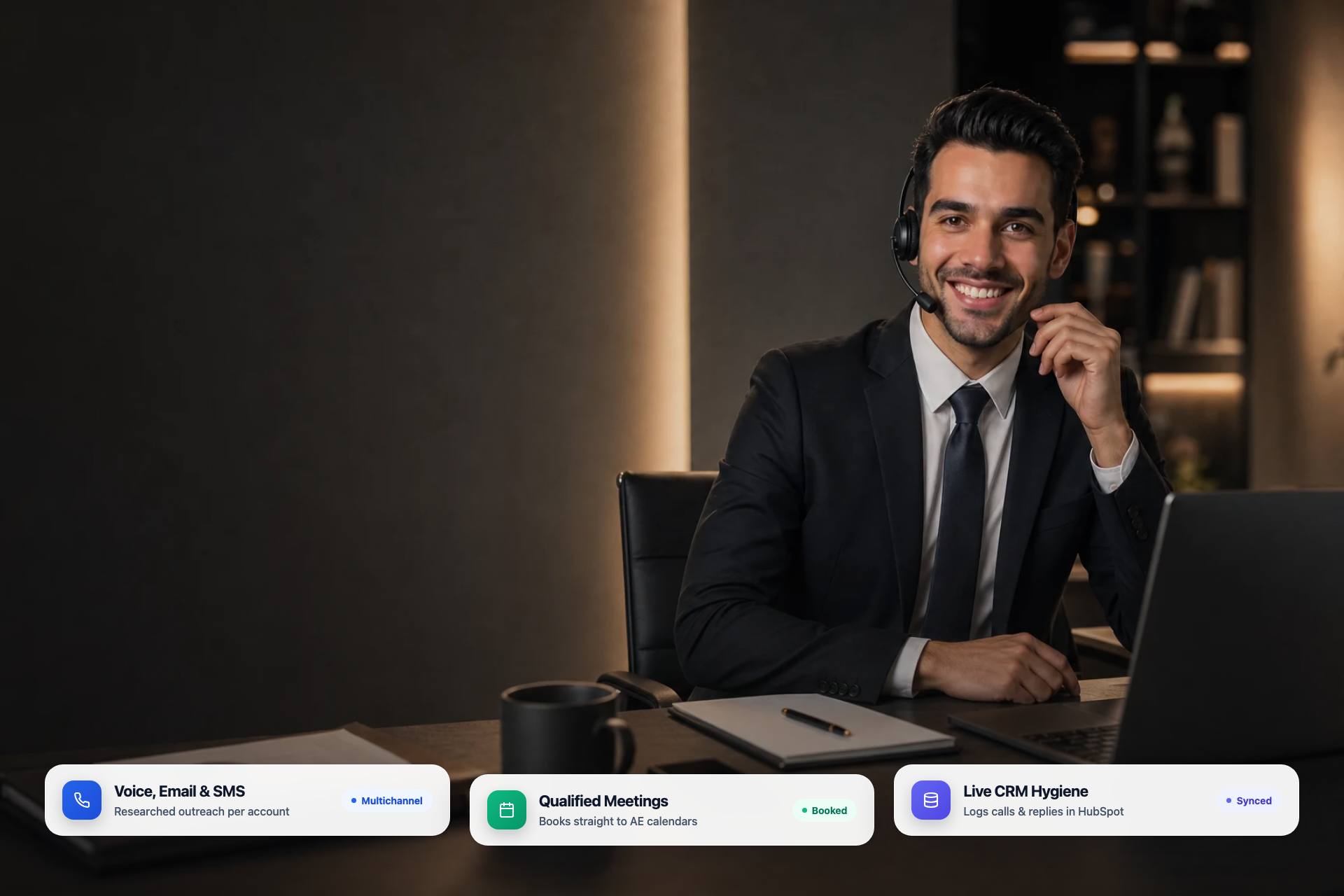
- Multi-channel sequence orchestration: Rather than trapping prospects in an email-only cadence, the teammate coordinates personalized email, live outbound voice calls, and concise SMS follow-ups based on prospect responsiveness and local US business hours.
- Live outbound calling and objection handling: When a prospect picks up the phone, the teammate speaks naturally, answers product and pricing questions from verified company truth, handles common stalls such as existing vendor contracts or timing, and pivots directly to booking next steps.
- Real-time inbox and reply management: Interested replies, referral forwards ("talk to our VP of Ops instead"), and out-of-office dates are parsed immediately so sequences pause, re-route, or resume automatically without awkward duplicate follow-ups.
- Direct calendar booking and qualification: Qualified buyers receive live time slots synced to your account executives' calendars, complete with routing rules by territory, company size, or product line.
- Bidirectional CRM synchronization: Every call summary, email thread, disposition, and qualification note writes back cleanly to your built-in CRM, native HubSpot integration, and Salesforce or your broader revenue stack across 65+ connected apps, 310+ ready-made governed actions, and custom MCP/API connectors.
Because Adam shares one Company Brain with your broader Teammates workspace, your outbound sales motion stays aligned with current product capabilities, approved positioning, and live customer context instead of repeating stale pitch decks.
Can an AI SDR Support Personalized Outbound Outreach at Scale?
Yes, provided personalization is built on structured account intelligence and strict message discipline rather than superficial merge fields.
Early outbound tools failed because they equated personalization with inserting a prospect's college mascot or paraphrasing a recent LinkedIn post into the first sentence of an otherwise generic pitch. US decision-makers learned to archive those emails in seconds.
In 2027, effective personalized outbound outreach at scale relies on three architectural elements:
- Company Brain grounding: Every claim, case proof, integration detail, and compliance boundary comes from your verified workspace knowledge rather than model guesswork.
- Persona-to-problem mapping: A CFO evaluates predictable cost structure and contract flexibility, while a VP of Sales evaluates meeting show rates, CRM hygiene, and rep ramp time. An autonomous AI sales teammate adapts the angle, proof points, and call-to-action to the specific buyer persona.
- Signal-aware branching: If a prospect opens a pricing link, replies with a technical question, or asks to reconnect after quarter-end, the teammate adjusts the next touch across email, phone, and SMS instead of blindly firing step four of a rigid cadence.
Equally important is knowing when to stop. Disciplined outbound platforms suppress existing customers, open opportunities, opted-out contacts, and teammates at the same account who already booked a meeting.
Which AI Cold Calling Tools Actually Help Book More Meetings?
The AI cold calling tools that actually book qualified meetings combine natural conversational latency, verified product grounding, live calendar execution, and instant cross-channel follow-up.
Many standalone voice dialers fail in B2B sales because they operate in isolation. They place robotic calls from disconnected scripts, struggle when a prospect interrupts mid-sentence, and cannot follow up with a contextual email or calendar link the moment the call ends.
When evaluating AI solutions for outbound pipeline generation that include voice, test four live capabilities before committing budget:
- Interruption and turn-taking control: Prospects interrupt cold calls within the first ten seconds. The voice agent must pause immediately, listen to the objection, and respond concisely without reading past the buyer.
- Grounded objection handling: When a US buyer asks how your product connects to HubSpot, what onboarding requires, or how pricing scales, the agent must answer accurately from your approved Company Brain or offer to loop in a specialist rather than inventing features.
- Voicemail and SMS coordination: Most cold calls still go to voicemail. High-performing outbound teams pair a brief, calm voicemail with an immediate contextual email or SMS referencing the exact reason for the call, while respecting US calling windows and consent rules.
- Multilingual reach for global accounts: For US companies selling into multinational teams or international subsidiaries, Adam supports 54+ languages including 19 Arabic dialects, keeping discovery fluid across regions without hiring separate regional BDR pods.
11x vs. Artisan vs. AiSDR vs. Adam: 2027 US Buyer Comparison
Buyers searching for a 11x vs. Artisan vs. AiSDR comparison usually hit the same frustration: glossy product demos paired with opaque enterprise pricing pages, mandatory sales calls, and multi-month or annual lock-ins before you can verify whether the tool books real meetings for your ICP.
Below is an honest architectural and commercial comparison of how Adam stacks up against standalone AI SDR vendors in 2027. For a deeper head-to-head breakdown, see our 11x.ai vs. Teammates.ai comparison and our full competitor comparison hub.
| Capability | Adam (Teammates.ai) | 11x (Alice) | Artisan (Ava) | AiSDR |
|---|---|---|---|---|
| Commercial Model | Self-serve monthly plans with transparent Credit tiers and zero annual lock-in | Opaque sales-led quotes with annual contract commitments | Sales-led contracts typically requiring multi-month or annual terms | Tiered monthly subscriptions tied to email outreach seat limits |
| Published Entry Pricing | Free (5 starter Credits, no card), Pro $50/mo (160 Credits), Business $250/mo (900 Credits), Scale $500/mo (2,000 Credits), Enterprise from $2,500/mo | Custom sales quote required; no self-serve monthly entry tier | Custom sales quote required; no open self-serve checkout | Published email-centric tiers without unified cross-functional teammates |
| Outbound Channels | Coordinated email, live outbound voice calling, and SMS follow-up | Email-primary SDR automation with separate voice products | Email and social sequencing; limited native live voice closing | Email-first sequences without integrated live cold calling |
| Pre-Live Rehearsal | Built-in Playground to test live objections, voice tone, and replies before launch | Configured through managed onboarding sessions | Guided setup with vendor onboarding team | Campaign preview inside email builder |
| Governance & Approvals | Granular draft approval, account-level gates, and Workspace Constitution rules | Sequence-level autopilot and suppression lists | Sequence-level review rules | Template and lead list approvals |
| Cross-Functional Architecture | Part of one shared Teammates platform alongside Raya (support) and Sara (hiring) | Single-function outbound point tool | Single-function outbound point tool | Single-function email SDR point tool |
The structural difference is clear. Point-tool AI SDR vendors sell isolated outbound automation priced like a traditional enterprise software license. Teammates.ai gives you an autonomous sales teammate priced transparently on our public pricing plans, running on the same Company Brain and governance controls as the rest of your customer-facing operation.
How Does Artisan's Onboarding Speed Compare to Self-Serve AI Sales Teammates?
Onboarding speed is one of the sharpest operational differences in the 2027 AI SDR market.
With sales-led platforms such as Artisan or 11x, time-to-first-booked-meeting typically involves an initial discovery call, a live demo, security and procurement review for an annual contract, an onboarding kickoff call, domain configuration, and several weeks of vendor-managed campaign staging. If your messaging needs to pivot mid-quarter after a product launch or pricing update, you often wait on account management cycles to rebuild sequences.
With a self-serve AI sales teammate like Adam, onboarding moves at founder and RevOps speed:
- Workspace creation in minutes: Start on the Free plan with 5 starter Credits (no card required) or pick Pro ($50/mo), Business ($250/mo), or Scale ($500/mo) directly without booking a gatekeeping sales call.
- Instant knowledge ingestion: Connect your website, approved sales playbooks, ICP definitions, and CRM so Adam grounds every message in live company truth.
- Live Playground rehearsal: Before contacting a single real prospect, your sales leader tests Adam directly inside Playground, throwing real buyer objections, pricing pushback, and competitor questions at the teammate to verify tone and accuracy.
- Phased rollout with approval gates: Start with human-reviewed drafts on a focused segment of target accounts, inspect live replies and call transcripts, and expand autonomy once conversion quality meets your bar.
Faster onboarding is not just about convenience. It shrinks the feedback loop between testing a new US market vertical, refining your value proposition, and measuring real pipeline outcomes.
Human Approval Controls, Compliance Hygiene, and Deliverability Guardrails
Autonomous outbound only works long term when revenue leaders retain crisp operational control. Unchecked AI blasting damages sender reputation, alienates strategic enterprise accounts, and creates compliance exposure.
Before turning on any AI sales team, confirm that your platform enforces four non-negotiable guardrails:
- Tiered approval ladders: Require human approval before sending first touches to named enterprise accounts, offering custom commercial terms, or testing new outbound angles, while allowing routine meeting confirmations and CRM updates to run automatically.
- Deterministic suppression rules: Automatically block active customers, open pipeline opportunities, competitors, unsubscribed contacts, and global do-not-call numbers across every channel.
- Deliverability and sending discipline: Enforce healthy daily send pacing, clean domain authentication, bounce handling, and immediate sequence termination the moment a prospect responds on any channel.
- Transparent audit logs: Every outbound email, SMS, voice transcript, and CRM mutation should remain inspectable so sales managers can coach messaging just as they would with a human SDR pod.
US Buyer Evaluation Checklist for Autonomous Outbound
Use this seven-point scorecard when comparing AI SDR and outbound calling platforms for your US sales team in 2027:
- Self-serve proof before annual lock-in: Can your team test real workflows on transparent monthly plans before committing annual budget?
- True multi-channel execution: Does one teammate coordinate email, live outbound voice calls, and SMS follow-up from a single conversation history?
- Grounded Company Brain accuracy: Does the system pull verified product facts and pricing boundaries instead of hallucinating claims during live calls?
- Pre-live Playground testing: Can your sales managers roleplay tough objections live before prospects ever hear from the agent?
- Granular approval gates: Can you require human sign-off on high-value accounts without slowing down routine scheduling and CRM updates?
- Clean bidirectional CRM sync: Do dispositions, transcripts, and booked meetings land directly in Salesforce or HubSpot with zero manual cleanup?
- Room to scale beyond outbound: Can the same workspace expand into autonomous customer service or candidate screening later without managing disconnected vendor silos?
Ready to evaluate autonomous outbound without a multi-week procurement cycle? Explore Adam for your sales team or review transparent monthly plans on our pricing page to launch your first rehearsed outbound workflow today.