Every US recruiting leader knows the two-sided trap of modern high-volume hiring. Post an attractive remote, sales, operations, or engineering role today and hundreds of applications hit your ATS before breakfast. Screen everyone manually by phone and top candidates accept competing offers before your team reaches page three. Send everyone a legacy one-way video questionnaire and your strongest experienced applicants close the browser tab in disgust.
That tension explains why US HR buyers searching for candidate screening software and HireVue alternatives in 2027 are moving away from asynchronous webcam monologues toward real-time, two-way AI interviews.
This buyer's guide explains why one-way recorded prompts break down with serious talent, how live two-way AI interviewing works under the hood, what to look for in candidate ranking and ATS handoffs, and how to test Sara live in your browser right now.
Try a Live AI Interview Demo in Your Browser First
Before comparing feature matrices, step into the candidate's shoes. The fastest way to evaluate AI recruitment tools is to experience the actual interview conversation yourself:
- Launch the interactive demo: Try a live interview with Sara at /ai-interviewer/demo
- What to test during your session: Give a nuanced answer about a past project, pause to think, or mention a specific metric or tool, and notice how Sara listens and asks a direct follow-up rather than blindly reading the next scripted prompt.
If an AI interview feels robotic to you during a two-minute demo, it will feel ten times worse to a senior candidate applying for your hardest-to-fill role.
Why One-Way Video Questionnaires Frustrate Top US Candidates
Asynchronous one-way video platforms gained popularity a decade ago because they solved a scheduling headache for recruiters. They did so by shifting all the friction onto the applicant:
- Zero conversational signal: Talking to a silent countdown clock feels impersonal and signals to experienced US candidates that the employer will not invest real attention in early conversations.
- No follow-up probing: When a candidate gives a vague, rehearsed answer to a static prompt, a one-way tool cannot ask "What specific part of that migration did you own personally?" or "Walk me through the trade-off you rejected." Recruiters end up reviewing polished surface-level answers that hide actual capability gaps.
- High drop-off among passive and senior talent: Candidates with strong options in the market routinely abandon one-way webcam assessments, leaving hiring managers with a skewed pool of applicants who had the most spare time rather than the strongest domain depth.
- Heavy manual review burden: Watching dozens of asynchronous video clips still eats hours of hiring manager time unless teams rely on opaque automated filters they cannot explain or audit.
How Live Two-Way AI Interviews Work in 2027
Real-time conversational AI teammates replace passive video forms with an interactive first-round screen that mirrors how a prepared senior recruiter runs an intake call, available 24/7 whenever the applicant is ready.
Here is the end-to-end screening workflow Sara runs for US hiring teams:
1. Resume Parsing Tied Directly to Your Role Rubric
Before the conversation starts, you define the job description, non-negotiable qualifications, core competencies, and structured rubric weights. Sara reads each candidate's resume against those exact criteria so the interview starts informed rather than generic.
2. Adaptive Camera-Proctored Voice Conversation
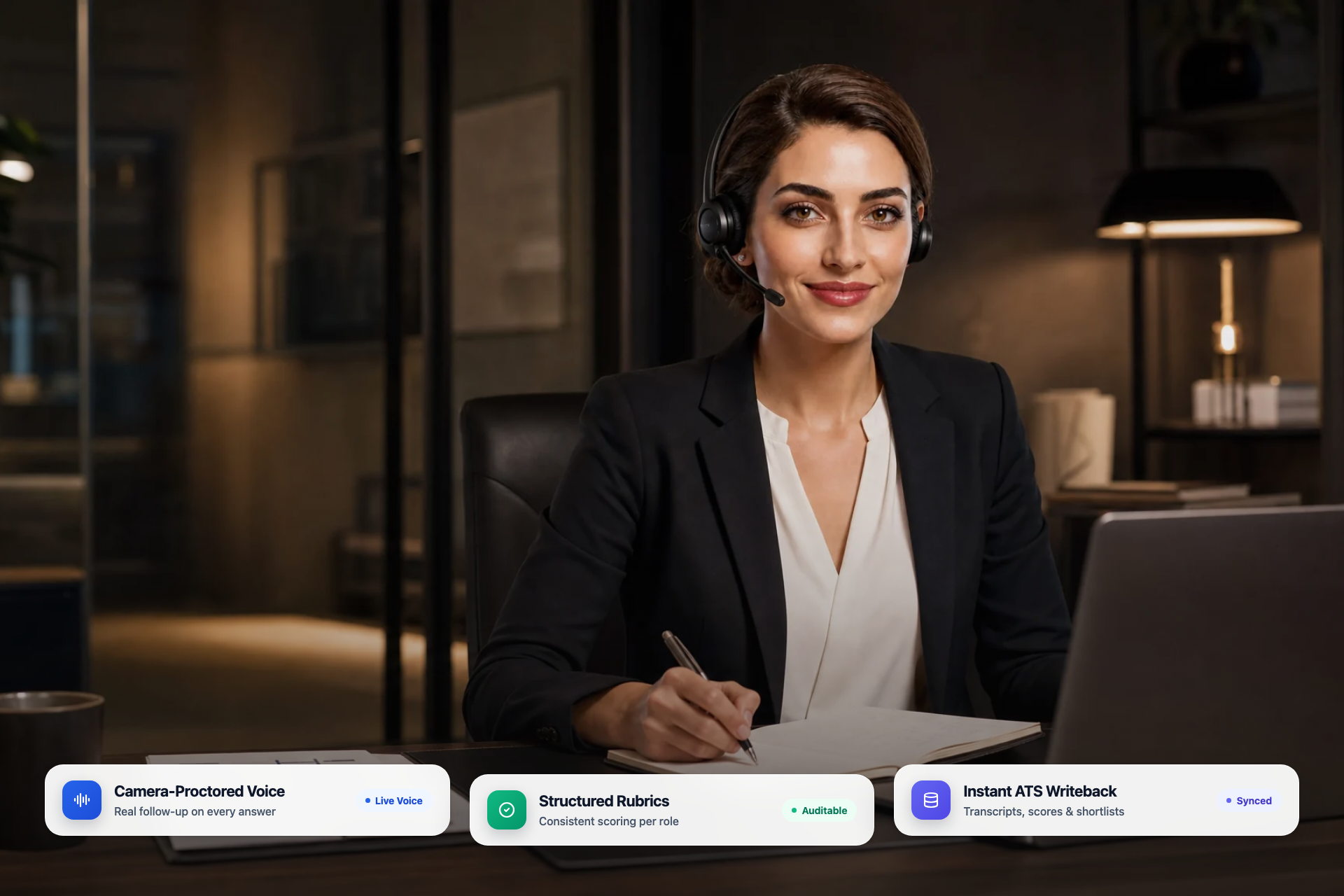
Candidates click a single link and join a live camera-proctored voice interview (two-way adaptive voice with real-time camera proctoring) at the hour that fits their schedule, whether that is a lunch break or 9:00 PM after their current shift. Sara asks role-specific questions, listens to the full answer, probes gaps or concrete project ownership in real time, and conducts interviews natively across 54+ languages and 19 Arabic dialects when roles span global teams.
3. Consistent Criteria and Evidence-Backed Scorecards
Instead of handing hiring managers an opaque single score, Sara produces a structured candidate scorecard mapped directly to your role rubric. Every criterion is backed by verbatim transcript excerpts and clear notes showing what the candidate demonstrated and where gaps appeared. Because human judgment remains essential and bias can still surface in any hiring process, every transcript and scorecard stays transparent so your human hiring team reviews the evidence and makes every final shortlist and hiring decision.
4. Clean ATS Handoff into Final Human Rounds
Once candidates complete their live screens, recruiters review the ranked shortlist in minutes instead of days. Teammates.ai connects natively to Workable and Greenhouse, and integrates with additional HR and applicant tracking platforms through 65+ connected apps, 310+ ready-made governed actions, and custom MCP/API connectors so qualified finalists move straight onto hiring manager calendars with full interview packets attached.
2027 Buyer's Comparison: Live AI Interviews vs. One-Way Video vs. Manual Screens
| Screening Dimension | Sara Live AI Interviews | One-Way Video Platforms | Manual Phone Screens |
|---|---|---|---|
| Interaction Format | Live camera-proctored voice conversation (two-way adaptive voice with real-time camera proctoring) and adaptive follow-up questions | Static recorded monologues into a countdown timer | Live human conversation, limited to recruiter calendar slots |
| Candidate Completion Experience | Natural dialogue available 24/7 on the candidate's own schedule | Awkward one-sided recording that pushes senior candidates to drop off | Requires multi-day email back-and-forth just to book 20 minutes |
| Rubric Consistency | Every applicant is evaluated against the same structured role rubric with full evidence transcripts | Same static prompts, but review notes vary widely across human watchers | Prone to interviewer fatigue and inconsistent questioning late in the week |
| Shortlist Auditability | Verbatim transcripts, voice and camera-proctoring playback, and criterion-by-criterion scorecards for human reviewers | Long recordings or black-box vendor scores | Brief recruiter summaries in ATS notes |
| Time to Shortlist | Continuous overnight and weekend screening delivers ready shortlists by morning | Fast collection, slow manual video review | Bottlenecked by recruiter hours during hiring spikes |
| Pricing Accessibility | Free (5 Credits, no card), Pro ($50/mo) for job publishing and CV screening, Business ($250/mo) and Scale ($500/mo) for live camera-proctored voice interviews, Enterprise ($2,500/mo) | Typically gated behind annual enterprise licenses and seat minimums | High internal recruiter cost per qualified finalist |
Where Live AI Candidate Screening Delivers the Fastest Operational Lift
US HR and talent acquisition leaders see immediate workflow relief across four high-friction hiring profiles:
- High-volume frontline, retail, hospitality, and support hiring: Screen hundreds of applicants over a weekend without forcing candidates to wait a week for a ten-minute phone call.
- Sales, SDR, and account executive roles: Hear real spoken communication clarity, objection handling, and composure live in voice rather than judging sales ability from a formatted PDF resume.
- Technical and operations first-round screens: Probe real hands-on architecture, tooling, and troubleshooting ownership through adaptive follow-up questions before booking precious senior engineering hours.
- Multi-region and multilingual hiring: Run structured first-round screens across time zones and languages (54+ languages supported) without needing dedicated bilingual recruiters for every opening.
A 5-Step Evaluation Checklist for US HR & Talent Leaders
Before selecting candidate screening software or replacing a legacy HireVue-style contract, test every finalist platform against five operational standards:
- Test the live candidate flow yourself: Never buy screening software without completing an interview as an applicant. Launch Sara's live demo and evaluate conversational realism, latency, and follow-up relevance directly.
- Inspect scorecard transparency: Verify that every ranking links back to explicit role rubric criteria and verbatim transcript quotes so your hiring managers can verify every shortlist decision directly.
- Keep humans firmly in final decision control: Confirm your workflow uses AI screening to prepare consistent structured evidence while keeping human recruiters and hiring managers responsible for advancing, interviewing, and hiring candidates.
- Verify ATS and calendar fit before rollout: Confirm native connections (Workable and Greenhouse on Teammates.ai) or clean connected-app syncs via MCP so recruiters do not copy-paste scorecards manually.
- Match your Credit tier to your hiring stage: Start on the Free tier (5 starter Credits, no credit card), use Pro ($50/mo) for job publishing and automated CV/resume screening, and activate Business ($250/mo) or Scale ($500/mo) to unlock Sara's live camera-proctored voice interviews with external candidates on the Teammates.ai pricing page.
Move from Resume Backlog to Qualified Finalists
Great recruiting teams should spend their time closing finalists, coaching hiring managers, and building candidate relationships, not repeating the same five intake questions forty times a week or chasing silent webcam uploads.
Experience how a live two-way AI interview feels in under two minutes at /ai-interviewer/demo, review full workflow architecture on the Sara AI Interviewer page, or compare transparent monthly plans on Teammates.ai pricing.